 BAUDOG The dictionary of dog–human communication
Contents
- The finished behavior
- Assessment: where is your dog now?
- The cue
- How to signal
- Teaching steps
- When to reward
- What is nose work? A home game and a dog sport
- Is nose work good for dogs? What the research shows
- Does 20 minutes of sniffing equal an hour’s walk?
- How long per session? What age can dogs start?
- Should you help, or not?
- Do you need a snuffle mat?
- A good sign to move on
- If it isn’t working
- Prescription: a suggested order
- In the moment: do / don’t
- When to see a professional
- Sources
The finished behavior
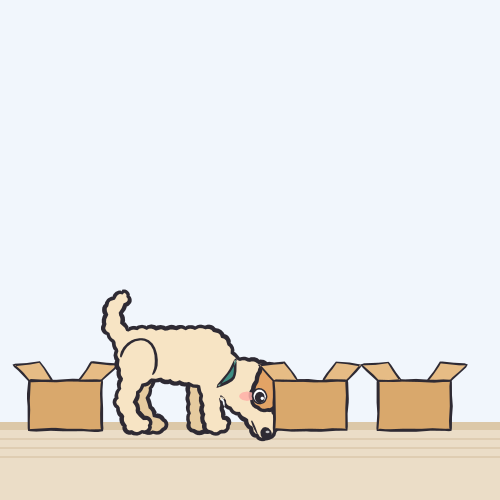
On “Find it,” your dog sniffs out treats hidden around the room — and later a box with one particular scent. When the search is over, she settles down to rest.
Assessment: where is your dog now?
Before starting, a visiting trainer might check something like these three things.
Around food, does she growl, gulp things down fast, or chase other dogs or people away?
→If so, talk to your vet or a behavior professional before playing games with food. In a multi-dog home, play with one dog at a time.
Does she eat a lot of things off the ground on walks?
→Skip the steps that use the ground outdoors; the indoor steps are plenty. Don’t hide things anywhere you don’t want her to rummage.
Do you want a fun game at home, or to work toward scent trials?
→For a home game, steps 1–3 (treat hunts) and the practice Sniffing Games are all you need. If you’d like her to search for a specific odor, as in the sport, go on to steps 5–6.
The cue
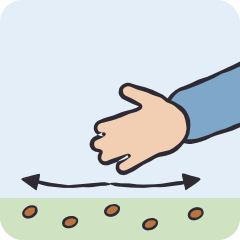
The voice cue is “Find it,” said once before each search. The hand signal is an open hand, palm down, sweeping side to side above the floor — showing her where to search. There’s no standard signal, so agree on one gesture as a family.
How to signal
- Voice
Say “Find it” once before the search starts. When she finds it, a quiet “Yes.”
- Hand
At first, put things where she can see them. Once she’s used to it, hide them out of sight. Don’t over-help by pointing. As you say “Find it,” show the hand signal: an open hand, palm down, sweeping side to side above the floor.
- Leash
None indoors. Outdoors, use a fenced yard. In public places, keep her on a leash and hold it. Leash rules vary — New York City, for example, requires a leash in public. Check your local rules.
- Body
Step back behind her and watch. If she starts to get stuck, go over near the hiding spot with her and help.
Teaching steps
- 1
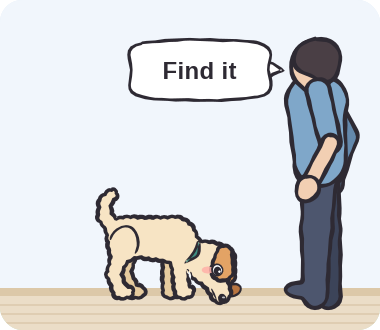
Start where she can see it At home, quiet
“Find it” in plain sight
Put a treat on the floor right in front of her and say “Find it.” When she’s eaten it, do it again. She learns that “Find it” means something tasty is on the floor.
A good sign to move onOn “Find it,” she goes straight for the treat
- 2
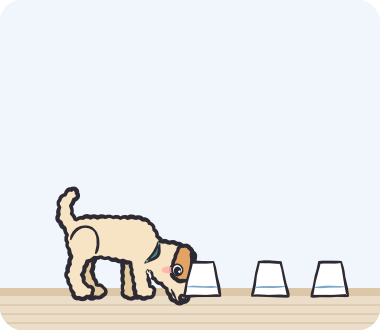
Start with one cup At home, quiet
Under a paper cup or a towel
While she watches, put a treat under a single paper cup and say “Find it.” Once she’s got that, line up three cups and put the treat under just one. Rolling treats up inside a towel works too.
A good sign to move onShe noses the cup over or unrolls the towel to find the treat
- 3
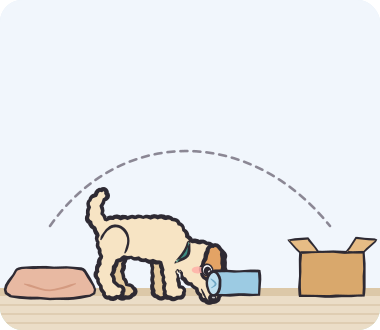
Searching the whole room with her nose At home, small distractions
Around the room
Have her wait in another room while you hide treats in 5 places around the room, then say “Find it.” At the end, lure her out of the search area with a treat, and leave together.
A good sign to move onShe finds all 5
- 4
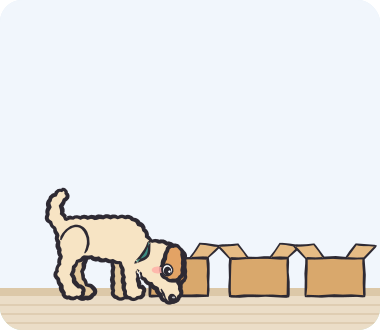
Finding the box with the smell At home, small distractions
Search the boxes
Line up a few cardboard boxes of the same kind on the floor (say, 3 to start) and put a treat in just one. Say “Find it.” When she puts her nose in the right box, “Yes.” As she gets better, add boxes and change where they go each time.
A good sign to move onShe heads straight for the right box
- 5
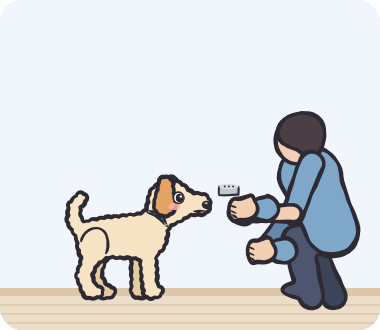
The reward comes at the source of the smell At home, small distractions
Learn an odor (the start of the sport)
One example of how the American Kennel Club (AKC) suggests starting at home: put 2 drops of essential oil (birch) on a cotton swab and put it in a small tin with holes in it. Hold the tin in one hand and treats in the other, and offer both hands about 12 in (30 cm) apart. When she sniffs the tin hand, “Yes” → treat right at the tin hand. Switch hands now and then.
A good sign to move onShe picks the tin hand within a few seconds, 3 times in a row
- 6
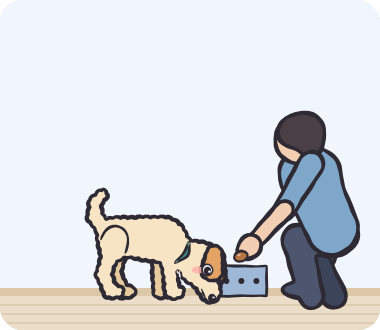
Finding one particular smell, out of sight At home, small distractions
Find the odor in a container
Put the tin inside a container with holes. Hold it in your hand as before → then place it on the floor between your feet → then, with her waiting in another room, put it somewhere on the floor and send her in with “Find it.” When she finds it, give the treat right at the source of the smell.
A good sign to move onShe comes in from another room and finds the scented container
When to reward
Just right
“Yes” the instant her nose touches the source of the smell. Give the treat right there, at the source.
Too late
Handing her a treat after she has come back to you — the source of the smell and the reward never get linked.
What is nose work? A home game and a dog sport
Nose work means your dog using her nose to track down food or the source of a smell. At home, it can start as a treat hunt using things you already have — towels, paper cups, cardboard boxes (Battersea, Dogs Trust Ireland).
As a dog sport (the AKC calls it Scent Work), nose work is modeled on detection dogs that search for drugs or explosives. In AKC trials, cotton swabs scented with birch, anise, clove or cypress oil are hidden out of sight; the dog searches for them and signals the find to the handler. Neither the dog nor the handler knows where they are.
In the US, the National Association of Canine Scent Work (NACSW) also runs K9 Nose Work trials; to compete, dogs first have to pass an odor recognition test. Best Friends Animal Society notes that K9 Nose Work instructors work with one dog at a time, so classes can suit even dogs who are reactive toward other dogs.
Is nose work good for dogs? What the research shows
Not much is known yet. In one study, 20 pet dogs were split into two groups of 10. For two weeks, one group did a nosework game every day (about 5 minutes) and the other practiced heelwork. Only the nosework dogs went on to respond more optimistically in a judgment test afterwards. In another study, comparing the heart rates of 29 dogs, searching for food read as more aroused than sniffing the ground on their own. And a project report from Okayama University of Science in Japan (8 beagles; not a peer-reviewed paper) found the dogs spent more of their time searching with their noses as the program went on — while noting that evidence for the benefits of nose work is still very scarce.
So we don’t claim that sniffing will calm your dog down. Instead, we suggest always finishing a search with some quiet rest.
Does 20 minutes of sniffing equal an hour’s walk?
You’ll see this claim a lot. We couldn’t find a study behind it: the research above looked at mood and heart rate, not at how tired dogs get. So we treat scent games as something to add to her walks, not a replacement for them.
How long per session? What age can dogs start?
- About 5 minutes per session, hiding things in no more than 5 places, is our rule of thumb (the same as the practice Sniffing Games). Finish while she still wants more.
- Take the treats out of her daily food allowance, so she doesn’t overeat (Battersea).
- The AKC says scent games are fun for dogs of any age, including puppies and older dogs. Just set the difficulty to suit your dog. To compete in AKC Scent Work, a dog must be at least 6 months old.
Should you help, or not?
Some articles say owners should never help. We suggest helping early, as soon as she starts to get stuck. Battersea says to give your dog a hand if it’s too hard and they seem frustrated. The AKC suggests luring your dog out of the search area with a treat at the end, which stops her searching on and on, frustrated, when there’s nothing left to find. We think ending on a success makes her keener to search next time.
Do you need a snuffle mat?
No — you can start without one. Towels, paper cups and cardboard boxes are plenty. Paper and cardboard are generally considered less likely to cause a blockage if a little gets swallowed. Fabric things like mats and towels can be chewed up and eaten, so stay nearby, and put them away if she starts tearing them apart (East Bay SPCA).
A good sign to move on
- Steps 1–3 (treat hunts): move on once she finds things at that step without getting stuck. The homework for home is the practice Sniffing Games
- Step 4 (boxes) comes once she can find all 5 hiding places around the room
- Steps 5–6 (a specific odor) are only for when you want to go further, toward the sport. Move to the next step once she finds it within a few seconds 3 times in a row (one AKC example)
- If she struggles, go back a step (our rule of thumb: two searches in a row where she doesn’t find it)
If it isn’t working
She gives up quickly
Make the hiding places easier and use smellier treats. If it’s too hard and she seems frustrated, give her a hand (Battersea).
I think she’s searching with her eyes, not her nose
Go back to the steps where things are hidden out of sight (cups, towel). In the odor steps, switch the tin between your hands now and then, so she finds it by smell rather than by remembering which hand (AKC).
Will this make her scavenge more?
Don’t hide things anywhere you don’t want her to rummage (Battersea). Only use the ground outdoors in a fenced yard with nothing lying around. If she already scavenges a lot, the indoor steps alone are fine.
She growls around food, or there are other dogs
If she growls over food, talk to your vet or a behavior professional before you start. In a multi-dog home, play with one dog at a time (Battersea).
What should I watch out for with essential oils?
Put just 2 drops on the swab, and keep the swab in a tin or container with holes, so she can’t lick or eat it. The AKC advises preparing scents in a separate room away from your dog, wearing gloves, handling swabs with tweezers, and sealing used items in a bag and putting them in an outdoor trash can — so the smell doesn’t spread around your practice area.
Prescription: a suggested order
The homework version — how many times a day, for how long, and what a visiting trainer checks next time — is on the practice page.
In the moment: do / don’t
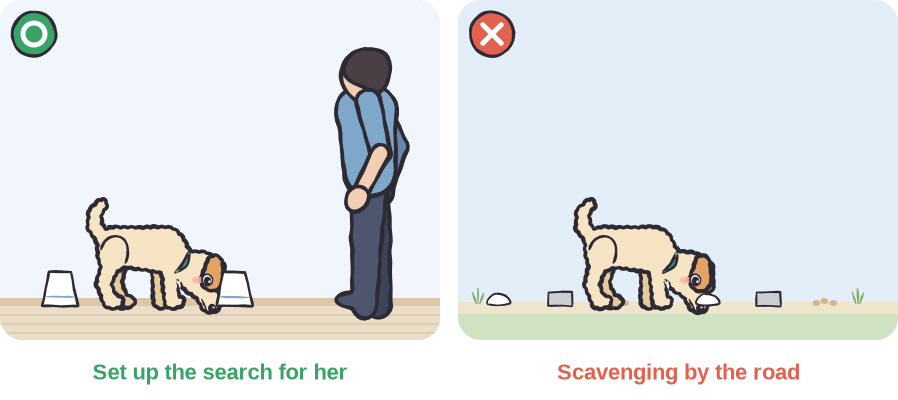
Do
- Start with treats where she can see them
- Help early, as soon as she starts to get stuck
- Take treats out of her daily food allowance
- After the search, let her rest quietly
Don’t
- Play where there’s lots of stuff lying on the ground
- Take away a treat she has found
- Let a dog who growls over food play alongside other dogs or children
- Let her lick essential oil directly
When to see a professional
- She freezes, growls or tries to bite over food or toys (resource guarding). Talk to your vet or a behavior professional
The skills behind this command
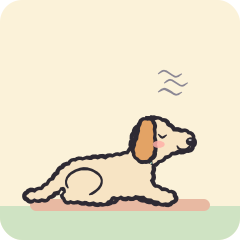 Core skill Settling Down Resting quietly after the search — bringing her own excitement back down.
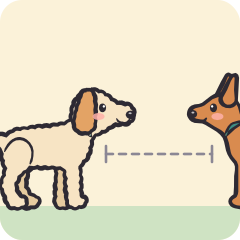 Core skill Confidence Finding something she can’t see, with her own nose. Best Friends Animal Society says nose work can increase the confidence of shy or fearful dogs.
- ExerciseScent Games for Dogs: Easy Treat Hunts With a Towel and Paper CupsDoable at home (Steps 1–3 at home)Read →
Sources
- American Kennel Club — How to Teach Your Dog Scent Work (Kathy Santo)
- American Kennel Club — AKC Scent Work
- American Kennel Club — Indoor Scent Games for Dogs
- Best Friends Animal Society — Dog Nose Work: Scent Training Sport for Dogs
- Battersea Dogs & Cats Home — Brain Games for your dog (video transcript)
- Dogs Trust Ireland — Towel treats
- Dogs Trust Ireland — Scatter Feeding
- East Bay SPCA — Canine Enrichment Handout (PDF)
- Duranton & Horowitz (2019). Let me sniff! Nosework induces positive judgment bias in pet dogs. Applied Animal Behaviour Science 211:61–66
- Berg et al. (2026). Behavior-related changes in canine heart rate and heart rate variability during short-term measurement. Applied Animal Behaviour Science 296:106899
- Saeki, Furumoto & Iwata (Okayama University of Science, 2021 project report, in Japanese). Nose work and quality of life in dogs
- ASPCA — Food Guarding
- Blue Cross — How to play with your dog
- RSPCA Brighton & the Heart of Sussex — Enrichment (PDF)
- Purdue University Center for Animal Welfare Science — summary of “Let me sniff!”
- Edmonton Humane Society — Canine enrichment: toys and games (PDF)
- New York City Health Code Article 161, §161.05