 BAUDOG The dictionary of dog–human communication
Contents
- In short
- When it happens
- How your dog feels
- How strong is the “no”? Protest or panic
- If a trainer came to your home: the first session and the first homework
- How to get a dog to like the crate again: door off → meals inside → door closed for minutes → you leave the room → outings and nights
- Crate size and where to put it
- How long can a dog stay in a crate?
- Why it’s worth getting her comfortable in a crate
- Common questions
- The missing core skill
- Exercises
- In the moment: do / don’t
- When to see a professional
- Sources
In short
A dog who hates the crate has learned that going in means being shut in or left alone. Start by taking the door off or propping it open. Toss treats at the entrance and then further in, and feed her meals inside. Close the door only once she eats calmly inside, and only while she’s eating at first. If she whines, you went too fast — make the next time shorter. Don’t open the door mid-whine; wait for a moment of quiet. But heavy panting, drooling and frantic escape attempts are panic, not protest. Stop using the crate for now and use a room closed off with a baby gate instead.
When it happens
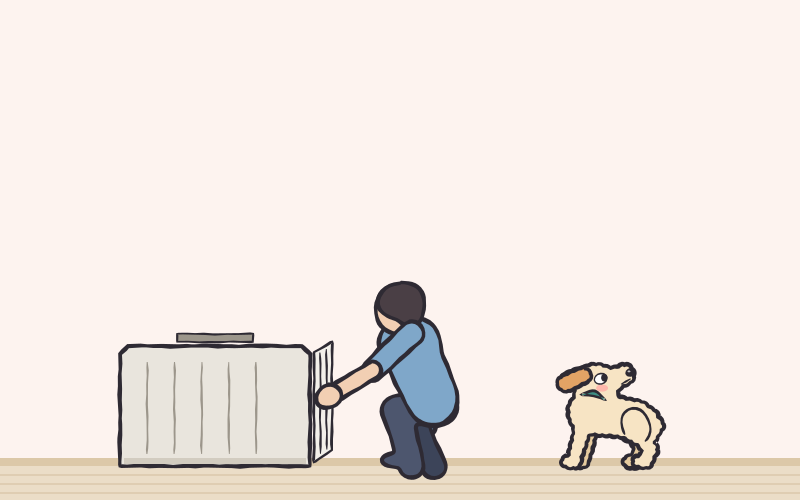
- She backs away and leaves the room as soon as the crate comes out
- She goes in, but the moment the door shuts she whines and scratches at it
- The crate only comes out for vet visits and car trips
- You want her to sleep in the crate at night, but she cries to get out
How your dog feels
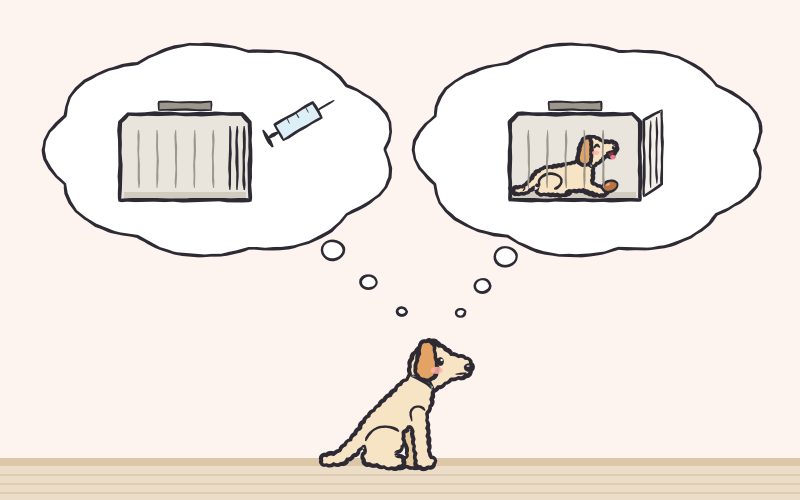
Dogs naturally look for a comfortable, quiet, safe place when things get noisy or they’re tired. Introduced well, a crate becomes that place — her own room.
But if the door was shut the moment she went in and she was left for a long time, or she was put in there as a punishment, the crate becomes a scary place where she gets trapped. Humane World for Animals (formerly the Humane Society of the United States) warns that, used incorrectly, a crate can leave a dog feeling trapped and frustrated.
If the crate only comes out on vet and car days, our view is that it’s likely to become a sign that something unpleasant is coming. So leave it out in the room every day, as a place where good things happen.
How strong is the “no”? Protest or panic
- She won’t go near the crate, or leaves when she sees it → going inside still scares her. Take the door off and start with treats at the entrance.
- She goes in, but whines or scratches when the door closes, then quiets down after a while → that’s protest: “let me out.” The door may be staying shut too long. Go back to shorter times.
- Heavy panting, drooling, trying to escape so frantically she could hurt herself, non-stop howling or barking → that’s panic. The ASPCA says that if you see these signs, crate confinement isn’t the answer — use a single room closed off with a baby gate. If it only happens when she’s alone, read our separation anxiety page too.
- She used to go in happily but suddenly won’t, or won’t lie down inside → something may hurt. Have your vet check her.
If a trainer came to your home: the first session and the first homework
Here is how we’d expect a first in-home session to go — one example, not a fixed script.
- Today: take the crate door off or prop it open. Put the crate in a room where the family spends time, place treats at the entrance, halfway in and at the back, and watch with the trainer as your dog goes in by herself. The door stays open for now (step 1 of Making the Crate a Happy Place).
- Homework: feed every meal with the bowl at the crate entrance, and move it a little further in as she’s happy to follow. The rest of the time, leave the crate open in the room and drop a treat inside now and then.
- Next visit: with the bowl at the very back, does she walk in and eat by herself? If so, the next homework is “close the door only while she eats, and open it when she finishes.”
How to get a dog to like the crate again: door off → meals inside → door closed for minutes → you leave the room → outings and nights
Depending on her age, temperament and past experiences, this takes days to weeks. There’s no evidence-based number of repetitions for moving on. Our rule of thumb: move to the next step once she has stayed relaxed at the current one several times in a row.
- Take the door off, or prop it open and secure it so it can’t swing and startle her.
- Drop treats near the crate, then just inside the door, then all the way at the back. It’s fine if she doesn’t go all the way in yet. Never push her in.
- Put her food bowl only as far in as she’ll go without getting worried. Each meal, move it a little further back.
- Once she eats calmly at the back, close the door while she eats and open it as soon as she finishes. Each time, leave it closed a few minutes longer, up to about 10 minutes after the meal.
- Give her something to chew for a long time inside (a food-stuffed toy, for example). With the door closed, sit quietly nearby for 5–10 minutes → go into another room for a few minutes → come back and sit again → let her out.
- Humane World for Animals says that once she stays quietly in the crate for about 30 minutes with you mostly out of sight, you can start leaving her crated for short outings, or letting her sleep in it at night.
- If she whines, you went too fast; make the next time shorter. Opening the door while she’s whining teaches her that whining gets her out, so wait for a moment of quiet. But if you see the panic signs above, let her out and take a break, then go back a step.
- Use the crate for short spells on days you’re home, too. If it only comes out when you leave, the crate comes to mean “being left alone.”
Crate size and where to put it
- Big enough for her to stand up, turn around and lie down comfortably, with room for bedding. Too big, and she may use one end as a toilet.
- For a puppy, you can buy a crate that fits her expected adult size and use a divider to adjust the space as she grows.
- To begin with, put it in a room where the family spends a lot of time — out of direct sun, away from heaters and drafts, and a little out of the way of people walking past.
- Some dogs feel more secure with the crate covered. Leave the door side uncovered.
- She should always have access to water.
- When she’s inside, nobody peers in, taps on it or pokes fingers through the bars — tell children too. Inside is where she doesn’t get disturbed.
How long can a dog stay in a crate?
There’s no single number. For puppies, organizations say no more than an hour or two at a time except at night (ASPCA), two to three hours (Best Friends), or three to four hours under 6 months of age (Humane World for Animals, whose same guide also gives “their age in months, plus one hour” as the upper limit). For adults, no more than four hours at a time (ASPCA) or four to five hours during the day (Humane World for Animals).
All of them agree a dog shouldn’t spend most of her day in a crate. At night, keep a puppy’s crate near your bedroom so you can hear her if she needs the toilet.
Why it’s worth getting her comfortable in a crate
In an emergency you may need to put her in a carrier or crate quickly. Ready.gov, the US government’s preparedness site, says it’s important that pets are comfortable in a carrier, and suggests leaving it out with the door open and feeding treats near it and inside. Best Friends Animal Society adds that a crate is valuable for travel and for times when an injury or illness means she has to be confined.
Even so, crates aren’t right for every dog. Battersea says crates can be helpful, but they’re not for everyone. If it really doesn’t suit her, a safe area closed off with a baby gate is fine.
Common questions
- Can an adult dog learn to like a crate? Yes. The ASPCA says even adult dogs with no crate experience can learn to be comfortable in one. If she’s had a bad experience in a crate, go more slowly.
- Why is my dog suddenly afraid of the crate? Think back: was she left in it much longer than usual, startled while inside, or put in as a punishment? Pain is also possible, even if one of these happened: a dog who suddenly won’t go in, or won’t lie down inside, should see the vet.
- She won’t go in, even for treats. Go back further: treats next to the crate rather than inside it, the bowl at the entrance, and the door off. Never push her in. Some dogs do better with an exercise pen or a dog-proofed room instead.
- I only want her in the crate at night. Daytime practice comes first. Use it at night once she can stay quietly in it for about 30 minutes in the day with you mostly out of sight.
- She pees in the crate. Usually it’s one of two things: the crate is too big, or she’s in it too long (puppies can’t hold it for long). If it starts suddenly, consider her health.
- Can I use the crate as a time-out? No. Make it a punishment spot and she’ll learn to fear it.
The missing core skill
Exercises
Rebuilding the crate takes just this one practice. The full steps and when to move on are on the practice page.
In the moment: do / don’t
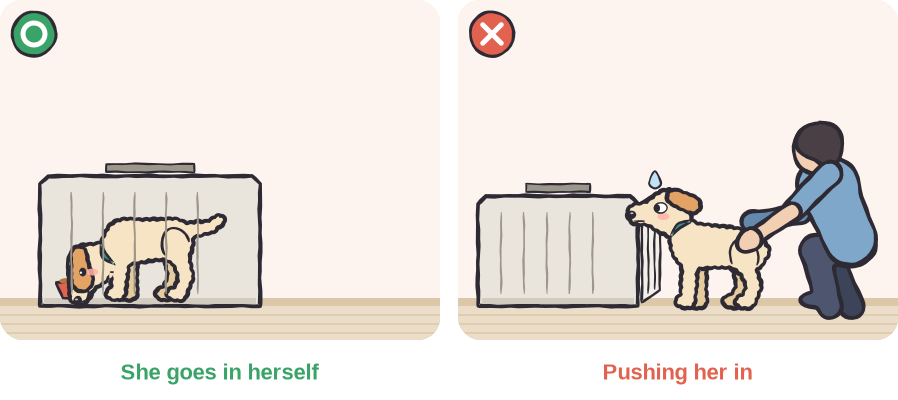
Do
- Take the door off or prop it open
- Give meals and treats inside the crate
- Open the door in a moment of quiet
- Leave it out in the room as a place where good things happen
Don’t
- Push or force her in
- Use it as a punishment
- Bring it out only for vet visits and car trips
- Keep the door shut while she shows signs of panic
When to see a professional
- She injures her teeth, claws or paws struggling in the crate
- She panics when left alone, whether in the crate or loose in a room. This may be separation anxiety — talk to your vet or a qualified behavior professional
- She used to be fine but suddenly won’t go in, or doesn’t want to lie down. This can be pain
Go to the root
Don’t stop at the quick fix. Growing the skill underneath makes other problems lighter too.
Sources
- Humane World for Animals (formerly the Humane Society of the United States) — How to crate train your dog or puppy
- ASPCA — Introducing your dog to a crate
- ASPCA — Separation Anxiety
- Best Friends Animal Society — How to crate train a puppy or dog
- Battersea — How to crate train your dog
- Battersea — How to settle in your new puppy or dog
- The Royal Kennel Club — How to crate train your dog
- The Royal Kennel Club — How do I help my dog adjust to spending time alone?
- MSD Veterinary Manual (veterinary edition) — Behavioral Problems of Dogs (Borns-Weil, 2025)
- Cornell Riney Canine Health Center — Recognizing pain in dogs
- Ready.gov (FEMA) — Prepare your pets for disasters