 BAUDOG The dictionary of dog–human communication
Contents
- In short
- When it happens
- How your dog feels
- Why is she crying? Sort it by age and by how it started
- If a trainer came to your home (puppy crying at night): the first session and the first homework
- Your puppy’s first nights: bed, toilet, and what to do when she cries
- Will my puppy eventually stop crying at night?
- Adult and senior dogs crying at night: see your vet first
- If the neighbors complain
- Common questions
- The missing core skill
- Exercises
- In the moment: do / don’t
- When to see a professional
- Sources
In short
A puppy crying at night is usually doing two things: telling you she has never slept alone before — she’s just left her mother and littermates — and telling you she needs the toilet (to go potty). Don’t leave her to cry it out, especially in the first few nights. Put her bed in your bedroom or right next to it. When she cries in the night, take her to the toilet first, then back to bed with the lights low, no chatting and no play. Once she sleeps through the night, move the bed gradually to where you want it. If an adult or senior dog suddenly starts crying at night, see your vet before you treat it as a training problem: pain, illness and age-related changes in the brain are common causes.
When it happens
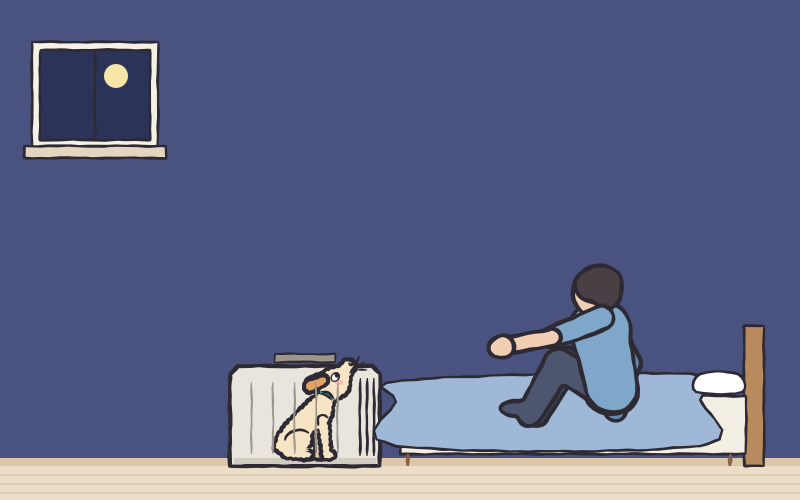
- From the first night home, she cries in her crate and doesn’t stop
- Every night she wakes you at 2 or 3 a.m.
- Outside your bedroom she cries; in the same room she falls asleep right away
- At 14, she has started pacing and crying in the middle of the night
How your dog feels
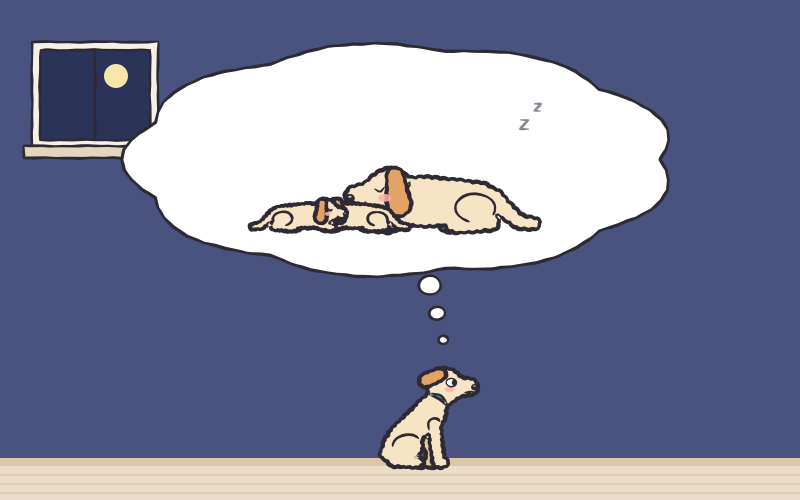
Until the day she came home, your puppy slept in a pile with her littermates, right next to her mother. That’s how she knew how to fall asleep safely. Waking in the dark to find no one there is a big deal for a puppy.
Why does she cry at night but not much during the day? In the day, when she wakes, someone is usually around. At night, the person who was there when she fell asleep has gone when she wakes up. And many young puppies can’t yet hold their bladder through the night.
When an older dog cries at night, the reasons are different. Something may hurt, so she can’t get comfortable. Or brain aging (cognitive dysfunction) may have scrambled her day–night rhythm, so she wakes at night unsettled. Neither one stops if you scold her.
Why is she crying? Sort it by age and by how it started
- A puppy in her first days or weeks with you → sleeping alone and needing the toilet. Start with “Your puppy’s first nights” below.
- She also cries when left during the day, or whenever she can’t see you → she finds being alone hard. Read our pages on leaving your dog home alone and on separation anxiety.
- At night she barks at noises outside (cars, voices, other dogs) → she’s reacting to sound. Close the curtains and try ways to soften the noise.
- An adult dog who has suddenly started crying at night → she may be in pain or unwell. See your vet first.
- A senior dog who paces at night, sleeps a lot in the day, or gets lost in the house → this can be cognitive dysfunction. See your vet.
If a trainer came to your home (puppy crying at night): the first session and the first homework
Here is how we’d expect a first in-home session to go — one example, not a fixed script. Even when the problem is at night, the practice a trainer does with you happens in the daytime.
- Today: decide together where her bed (crate or bed) goes in or next to your bedroom. If she isn’t used to a crate yet, leave the door open at night, or use a bed or a puppy pen. Set a bedtime routine: evening meal → toilet → a little play → last toilet → into bed with a chew. In the daytime, with the crate door open, put treats at the entrance and then further in, and watch her go in by herself (step 1 of Making the Crate a Happy Place).
- Homework: the same routine every night. When she cries in the night, toilet first; then back to bed in the dark — no talking, no play. Write down what time she cried. In the daytime, treats and meals in the open crate.
- Next visit: do your notes show fewer wake-ups? Once she has slept through several nights in a row, the next homework is moving her bed, bit by bit, to where you want it.
Your puppy’s first nights: bed, toilet, and what to do when she cries
- Put her bed in your bedroom or right next to it. Humane World for Animals (formerly the Humane Society of the United States) suggests starting with the crate in your bedroom or nearby in a hallway. PDSA says that if she struggles to settle, you might sleep in the same room as her. (Battersea also lists putting her in another room and listening with a baby monitor.) If she isn’t used to a crate yet, leave the door open or use a bed or pen. Shut the crate door for the night only once she can settle in it calmly during the day.
- Give her a blanket or soft toy that smells of her old home, and a chew that’s safe to leave with her. Chewing helps puppies settle.
- Keep the same bedtime routine every night: evening meal → toilet → a little play → last toilet before she gets overtired → into bed with a chew.
- In the night, expect to be up every 3–4 hours (Battersea’s guide). When she cries, check first whether she needs the toilet. Take her out, praise her quietly when she goes, and put her back to bed. Low lights, no chatting, no play.
- Don’t leave her to cry it out, especially in the first few nights. PDSA, a UK veterinary charity, says it would never recommend ignoring a puppy who cries at night, especially in the first few nights. Battersea suggests calm reassurance with your voice and a light stroke. Avoid picking her up or playing.
- Once she sleeps soundly through the night, move her bed a little at a time to where you want it to be.
- Puppies sleep a lot. The Royal Kennel Club says puppies aged 4–12 weeks need 15–20 hours of sleep a day. Our suggestion: let daytime naps run — don’t wake her.
Will my puppy eventually stop crying at night?
Usually, yes — but we couldn’t find a reliable number of nights. PDSA says that, gradually, a puppy gets more confident and is more likely to sleep through the night.
Our rule of thumb: if the crying hasn’t eased after a few weeks, or she also cries when left in the daytime, it’s not just a night-time problem. Start practicing time alone during the day (Building Alone Time Step by Step).
Adult and senior dogs crying at night: see your vet first
Illness and pain are a major cause of behavior problems. The MSD Veterinary Manual describes a study of veterinary behaviorists’ cases in which 28% to 82% of patients showed signs of pain. A dog in pain may whimper, yelp or groan, and may not be able to get comfortable enough to sleep.
Older dogs can develop cognitive dysfunction, similar in some ways to dementia in people. The signs: disorientation, changes in how she interacts with the family, changes in sleep–wake cycles, house soiling, anxiety and changes in activity. In one study cited by MSD, 28% of dogs aged 11–12 and 68% of dogs aged 15–16 showed signs consistent with it. She may start wandering at night and sleeping more in the day.
Alongside your vet, there are things you can do at home: spend time with her in the day, give her plenty of daylight, keep the room dark at night, and keep a consistent place and time for sleep. Quietly praise her when she lies still. Scolding backfires — it raises her anxiety, which makes it even harder for her to learn. Medication, diets and supplements may improve the signs or slow them down, so ask your vet.
If the neighbors complain
Night-time noise is a real issue for neighbors, and there are rules about it. In England, barking dogs are one of the examples of noise that councils must look into as a possible “statutory nuisance”, at any time of day or night; if they find one, they must serve an abatement notice. In the US it depends on your city or county. New York City’s Noise Code, for example, allows enforcement when an animal’s noise is unreasonable and plainly audible from a nearby home for 10 minutes or more between 7 a.m. and 10 p.m. — or for five minutes or more between 10 p.m. and 7 a.m. There, a first complaint may simply lead to advice being mailed to the owner. Check your local rules.
Rather than trying to scold her quiet, use the checklist above to find the cause. If she’s barking at noises outside, closing the curtains so she can’t see out, or playing sound to mask the noise, can help.
Common questions
- Should I ignore my puppy crying at night? Organizations disagree. PDSA, a UK veterinary charity, would never recommend ignoring a puppy who cries at night, especially in her first few nights, and warns that leaving her to cry it out can make her more anxious about being alone. Humane World for Animals’ crate-training guide describes a narrower case: a dog who is already crate-trained and has never been let out of the crate for whining. For that dog, it suggests ignoring the whining for several minutes; if it carries on, saying the phrase she links with going out to the toilet and, if she gets excited, taking her out (a trip with a purpose, not playtime); and if you’re sure she doesn’t need to go, ignoring her until she stops. Our view: with a puppy who is new to you or not yet happy in her crate, we go with PDSA: check whether she needs the toilet, then settle her calmly. Humane World’s approach is for a dog who meets all of its conditions. Either way, never punish her for crying.
- Should I cover the crate? Some dogs settle better with it covered. Battersea suggests covering all sides with a thick blanket or towel except the door. Some dogs fuss more when it’s covered, so watch how she reacts and decide.
- Can she sleep in my bed? There’s no rule. Humane World for Animals notes that time spent with your dog, even sleep time, is a chance to strengthen your bond. But a dog who can only sleep pressed against someone may struggle when she has to stay home alone, stay at the vet or be boarded. Our suggestion: give her some daytime rest alone in her crate or bed too.
- Do calming plug-ins or sprays stop the crying? The evidence is weak. A 2010 systematic review of pheromone studies counted the one on vocalizing and house soiling in newly adopted puppies among those that didn’t provide enough evidence of an effect. Bedtime routine, toilet trips and a bed close to you come first.
- Can I scold her or startle her with a loud noise when she cries? No. It makes her more afraid, and nights alone get harder. The American Veterinary Society of Animal Behavior (AVSAB) recommends reward-based methods for all training.
The missing core skill

Exercises
Our suggested order. You practice these in the daytime, not at night.
- ExerciseMaking the Crate a Happy Place: Step-by-Step Crate Training Your Dog Will ChooseDoable at home (Steps 1–4 at home)Make her bed (the crate) a place she goes into and rests in by choice. Use it at night once she can settle in it calmly during the day.Read →
- ExerciseBuilding Alone Time Step by Step: Training Your Dog to Stay Home AloneDoable at home (Steps 1–3 at home)For puppies who also cry when left in the daytime, or whose night crying hasn’t eased after a few weeks: build up time alone without upsetting her.Read →
In the moment: do / don’t
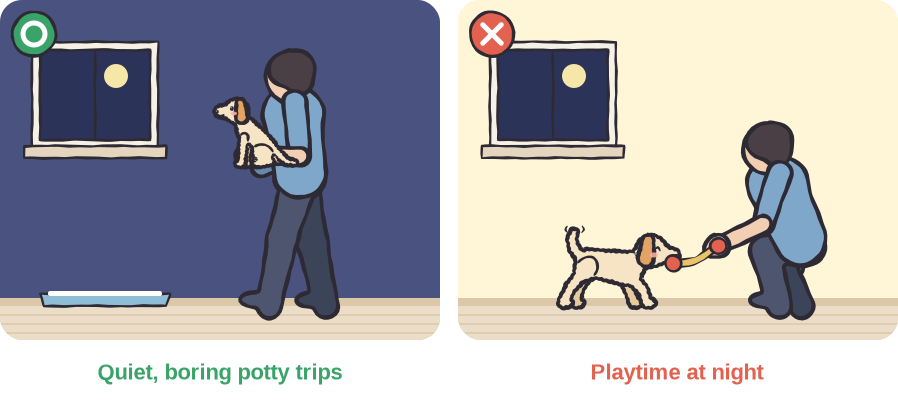
Do
- A toilet trip and a little play before bed
- Start with her bed close to your bedroom
- Keep night-time toilet trips dark, quiet and boring
- See your vet first if an adult or senior dog suddenly starts crying at night
Don’t
- Leave her to cry it out (especially in the first nights)
- Play or chat with her in the middle of the night
- Scold her or startle her with loud noises
- Write off a senior dog’s night crying as “just old age”
When to see a professional
- An adult or senior dog suddenly starts crying at night
- She paces at night, has swapped night and day, gets lost in the house or stuck in corners — this can be cognitive dysfunction
- She whimpers or groans, gets up again as soon as she lies down, or flinches when touched — this can be pain
- She suddenly needs to pee much more at night or starts having accidents — illness or pain can cause this
- An older puppy still can’t sleep through the night. The Royal Kennel Club advises talking to your vet to rule out health problems
Go to the root
Don’t stop at the quick fix. Growing the skill underneath makes other problems lighter too.
Sources
- PDSA — Vet Q&A: Why do puppies cry at night?
- Battersea — Bringing your puppy home
- Battersea — How to crate train your dog
- Humane World for Animals (formerly the Humane Society of the United States) — How to crate train your dog or puppy
- The Royal Kennel Club — Why does my puppy sleep so much?
- The Royal Kennel Club — How to crate train your dog
- RSPCA (UK) — Recognising separation-related behaviour and anxiety in dogs
- MSD Veterinary Manual (veterinary edition) — Behavioral Problems of Dogs (Borns-Weil, 2025)
- Cornell Riney Canine Health Center — Cognitive dysfunction syndrome
- Cornell Riney Canine Health Center — Recognizing pain in dogs
- GOV.UK — Noise nuisances: how councils deal with complaints (England)
- NYC Department of Environmental Protection — A Guide to New York City’s Noise Code
- Frank, Beauchamp & Palestrini (2010). Systematic review of the use of pheromones for treatment of undesirable behavior in cats and dogs. JAVMA 236(12):1308–1316
- AVSAB — Position Statement on Humane Dog Training (2021)