 BAUDOG The dictionary of dog–human communication
Contents
- The finished behavior
- Assessment: where is your dog now?
- The cue
- How to signal
- Teaching steps
- When to reward
- “Place” vs. “Stay,” “Crate” and “Settle”
- Distance, duration, distraction: one at a time
- Bed, cushion, cot or café mat
- A good sign to move on
- If it isn’t working
- Prescription: a suggested order
- In the moment: do / don’t
- When to see a professional
- Sources
The finished behavior
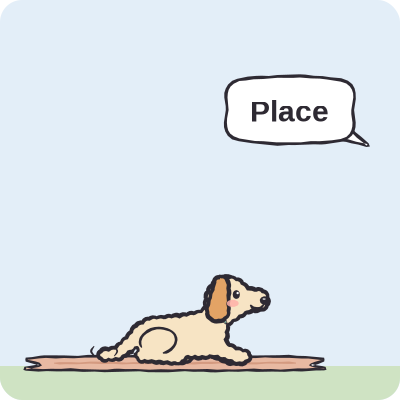
Say “Place,” and your dog walks across the room to her mat, lies down, and rests there until you say “Free.” While you cook, when guests arrive or on a café patio, she knows exactly where to be — and everyone relaxes. It isn’t about pinning her down. She stays because the mat is comfortable and good things happen there.
Assessment: where is your dog now?
Before adding the cue, check a few things — for example, these three.
When you put the mat down, does she get on it and lie down by herself?
→If not, don’t add the word yet. Start with steps 1–2 of Relaxing on a Mat (treats on the mat when she steps on and when she lies down).
Does she know a release word (“Free”)?
→If not, teach that first: after she eats a treat on the mat, say “Free” and toss a toy to get her off. Don’t praise her for getting off (American Kennel Club). Practicing getting off on cue makes it clearer that she stays until “Free.”
What will you use as the mat, and where will it go?
→A common choice is somewhere the family can see, a little away from the front door where guests come in. Avoid anything slippery or noisy.
The cue
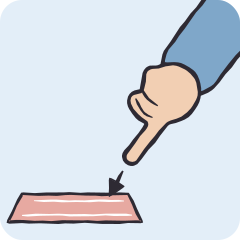
The spoken cue is “Place,” and the hand signal is an index finger pointing at the mat on the floor. Dogs Trust likewise describes saying the cue word while pointing to the bed. The release is “Free.” Her dog bed or a cushion can be the destination too. Some families say “Mat” or “Bed” instead of “Place” — any of them is fine, as long as you pick one and everyone uses it.
How to signal
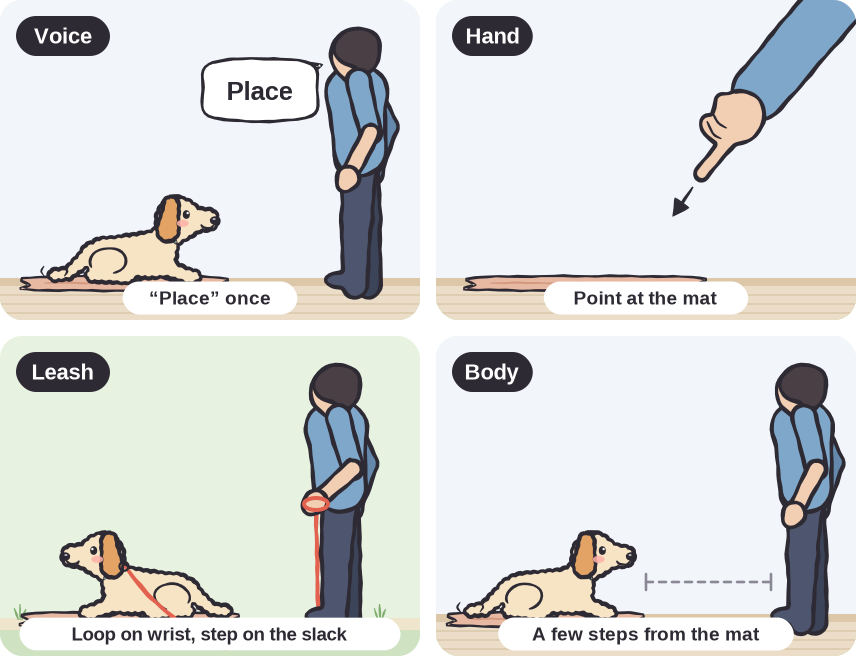
- Voice
Once she gets on by herself, say “Place” once. End with “Free.” While she’s on it, don’t keep talking to her.
- Hand
Point at the mat on the floor with your index finger as you say “Place.” Don’t hand treats over — put them on the mat or toss them there.
- Leash
None at home. Our suggestion: outside, keep the end of the leash in your hand or looped over your wrist, and stand on the slack (never let go).
- Body
Start right next to the mat. Once she’s got it, send her from one step farther away at a time. Mix up where you stand — left, right, in front of the mat.
Teaching steps
- 1
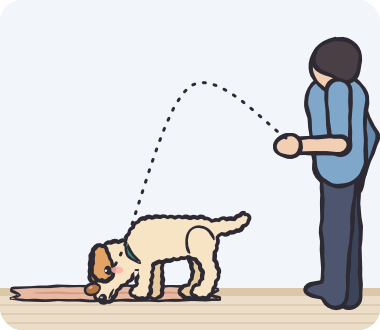
Treats go on the mat At home, quiet
Make the mat a great place
Toss a treat onto the mat, and when she steps on, keep the treats coming on the mat. Don’t say the word yet (steps 1–2 of Relaxing on a Mat).
A good sign to move onWhen the mat goes down, she gets on and lies down by herself
- 2
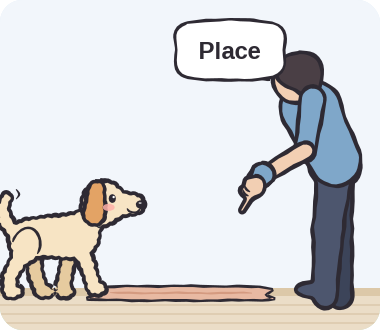
Toss → pretend toss → word and point only At home, quiet
“Place” and a point
Right beside the mat, say “Place” and point at it with your index finger. When she gets on, a treat on the mat. At first it’s fine to toss a treat as you say it. Then switch to a pretend toss, and finally just the word and the point.
A good sign to move onWith just the word and the point, she gets on the mat right next to you
- 3
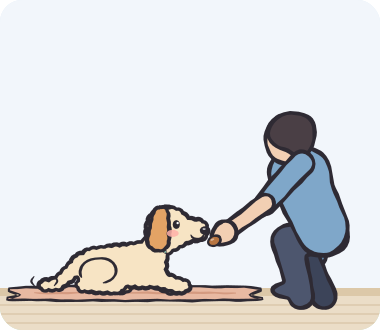
Reward her while she stays At home, quiet
Rest until “Free”
Once she’s on and lying down, place a treat on the mat every few seconds, then release her with “Free.” Stretch the gap between treats a few seconds at a time. If she gets up, say nothing and wait; when she gets back on and lies down, treat.
A good sign to move onShe stays lying on the mat until “Free” (about 30 seconds to start)
- 4
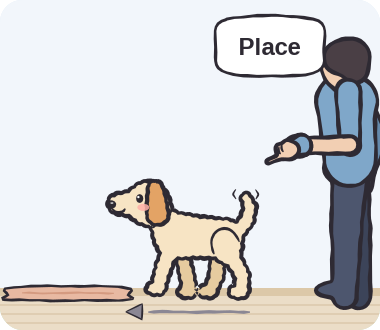
One step farther at a time At home, small distractions
Send her from a distance
Say “Place” from one step away. Then two or three steps, then the edge of the room, a little farther each time. Change where you stand, too — left, right, in front of the mat. When she gets on, walk over and put a treat on the mat (or toss it). On days you add distance, go back to shorter stays.
A good sign to move onFrom anywhere in the room, she goes to the mat and lies down by herself
- 5
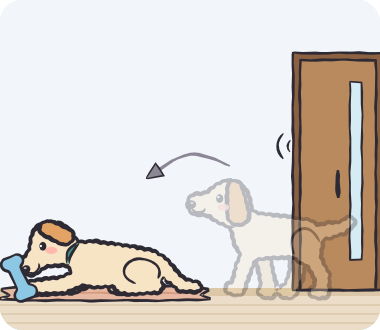
Hear the door, go to the mat Around distractions
Before the doorbell and visitors
Only once she goes to her mat on cue from anywhere in the house. Have a family member knock on the door, or play a doorbell sound quietly → “Place” → treat on the mat once she’s there. When she’s good at it, give her something long-lasting to chew. For getting used to the doorbell itself, see our Doorbell Barking page.
A good sign to move onAfter a knock or the doorbell, she goes to her mat on “Place” and lies down
When to reward
Just right
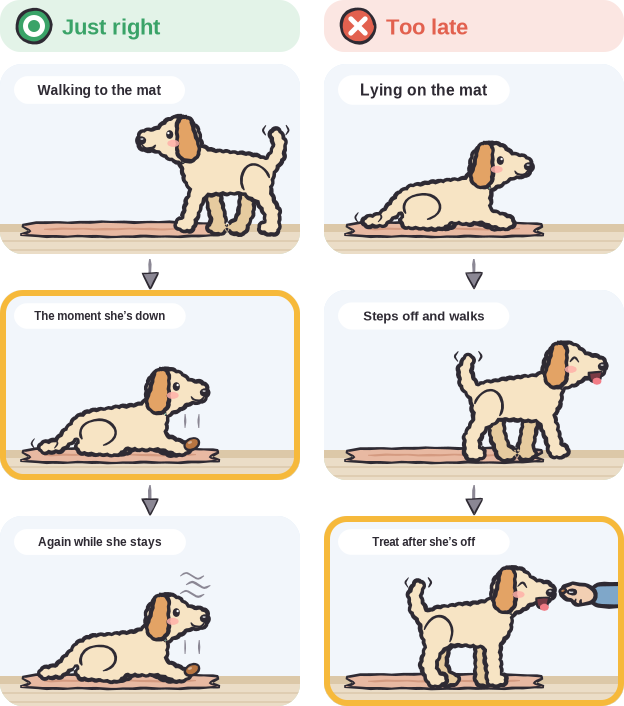
The moment all four paws are on the mat, and the moment she lies down, a treat on the mat. While she stays, keep placing one on the mat now and then.
Too late
Giving the treat as she’s stepping off the mat. That rewards getting off. Praising or treating after “Free” also teaches her that getting off is the better deal.
Rewards come while she’s on the mat, and on the mat. After “Free,” no praise and no treat (American Kennel Club). Being on the mat should be where all the good stuff is.
“Place” vs. “Stay,” “Crate” and “Settle”
“Place” means go to a particular spot and stay there until released (American Kennel Club). What sets it apart from other cues is that it has a destination you can use anywhere.
- “Stay”: don’t move from where you are. No set spot
- “Crate”: go into the crate. The door may be closed (see our Crate page)
- “Settle”: relax, rolled onto a hip — on a mat, for example (see our Settle page)
- “Place”: go to her own mat or bed and rest there until “Free” (this page)
Distance, duration, distraction: one at a time
Three things make “Place” harder: how far away you send her from (distance), how long she stays (duration), and what’s going on around her (distraction). Raise only one at a time, and save distraction for last (American Kennel Club). For example, on a day you add distance, keep the stays short.
When it falls apart, that’s a sign you moved on too fast. Go back a step (our rule of thumb: two misses in a row).
Bed, cushion, cot or café mat
The destination doesn’t have to be a floor mat. A dog bed or cushion works too, taught the same way — Dogs Trust’s visitor training uses the dog’s bed. Many US trainers use a raised dog cot; in our view that works the same way, as long as it’s stable and easy for her to step onto. A portable mat means you can move it from room to room or take it on trips and to the vet, so it works anywhere (American Kennel Club).
Try it on a café patio only once she can do it in lots of rooms at home. Take her mat from home and start again from relaxing on it with no word. Outside, we suggest you never let go of the end of the leash.
A good sign to move on
- When to add the word and the point: when the mat goes down, she gets on and lies down by herself
- When to start sending her from a distance: from right beside her, she gets on with “Place” and stays until “Free” (our rule of thumb is about 30 seconds; the American Kennel Club also adds distance only once she stays until the release word)
- When to start using it with the doorbell and visitors: at home, she goes to her mat and lies down on cue from anywhere in the room (Dogs Trust also adds knocks and the doorbell only once she reliably goes to her bed)
- If she struggles, go back a step (our rule of thumb: two misses in a row)
If it isn’t working
She gets on but hops straight off
Don’t scold her — just wait quietly. When she gets back on, a treat on the mat. Go back to shorter stays, and treat more often.
She gets on when I say “Place” but leaves before “Free”
Check whether you praise or treat after “Free.” Rewards should come only while she’s on the mat. If she still gets off, the stays are too long.
When the doorbell rings, she doesn’t hear the cue at all
She isn’t ready to use it with the doorbell yet. First make sure she goes to her mat from anywhere at quiet times, then add a soft knock. Work on getting used to the doorbell itself first (Getting Used to Sounds Step by Step, starting quiet).
She only stays if I keep saying “Stay”
Teaching her to relax on the mat lasts longer than holding her there with “Stay.” Go back to step 3 of Relaxing on a Mat (rewarding the moment she rolls onto a hip or rests her chin on the floor).
Can I use her crate instead?
You can. The American Kennel Club says a crate works, but a portable bed or mat is easier to use anywhere. If you’ll be closing the door and leaving her in for longer, read our Crate page.
Prescription: a suggested order
The “Place” cue sits on top of being able to relax on the mat.
In the moment: do / don’t
Do
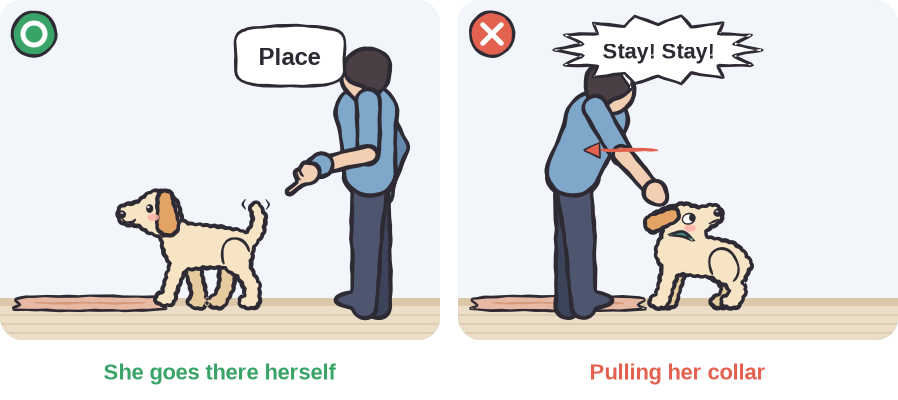
- Add “Place” and the point only once she gets on by herself
- Treats while she’s on the mat, and on the mat
- Raise distance, duration and distraction one at a time
- Always end with “Free”
Don’t
- Use the mat as a punishment spot (a time-out corner)
- Pin her there by repeating “Stay! Stay!”
- Give a treat or praise after “Free”
- Let go of the end of the leash outside
When to see a professional
- Lying down or getting up looks hard for her, or she used to lie on her mat and no longer does. These can be signs of pain (Cornell’s veterinary college). Have your vet check her
- She trembles, runs off or growls at the doorbell or visitors — she’s frightened. Don’t rely on the cue alone; talk to your vet or a qualified behavior professional
The skills behind this command
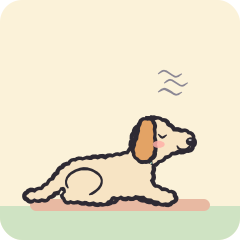 Core skill Settling Down Being able to let go and rest on the mat. With this, staying until “Free” is easy for her.
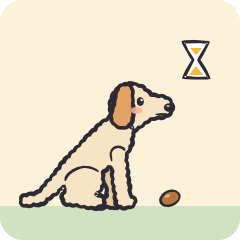 Core skill Impulse Control Going to her spot and staying there even when she wants to rush to the door or the visitors.
- ExerciseRelaxing on a Mat: How to Teach Your Dog to SettleDoable at home (Steps 1–4 at home)Read →
Sources
- Dogs Trust — How to prepare your dog for visitors
- Dogs Trust — How to train your dog to be calm, relax and settle
- American Kennel Club — How To Teach Your Dog To Go to Their Place
- American Kennel Club — The Three Ds of Dog Training: Duration, Distance, and Distraction
- ASPCA — Barking (“Go to Your Spot” training; we don’t recommend the mouth-holding or startle methods on the same page)
- Humane World for Animals (formerly HSUS) — How to get your dog to stop barking
- Battersea — My dog won’t settle: teaching your dog to be calm and relaxed
- MSD Veterinary Manual — Behavior Problems of Dogs
- Cornell Riney Canine Health Center — Recognizing pain in dogs