 BAUDOG The dictionary of dog–human communication
Contents
When to use this exercise
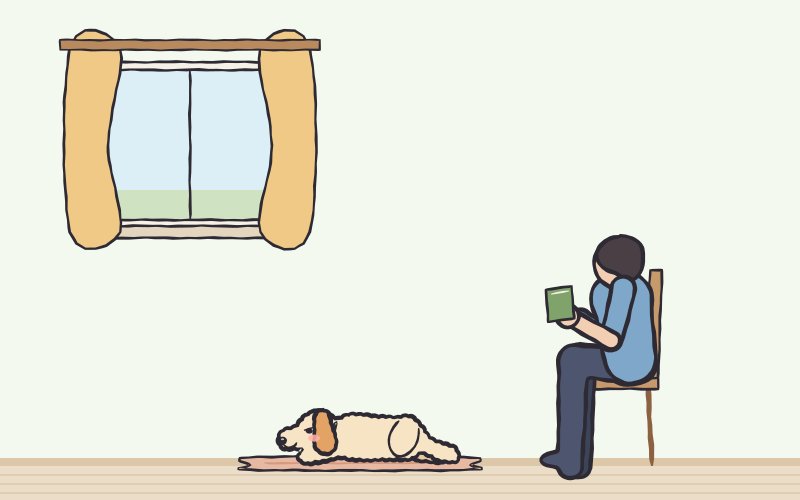
For a dog who barks at the doorbell or at noises, can’t settle when visitors come, hovers around the table at family meals, or is about to start alone-time practice. It gives her a portable “place where I can relax.” This isn’t a sit-stay, and it isn’t the kind of “place” cue where she’s held there until released: she learns to let her body go soft and rest of her own accord. Veterinary guidance (the MSD Veterinary Manual) notes that learning to relax on a mat or bed helps a dog manage arousal and fear, so practice for things like scary sounds moves along faster.
GoalWhen she steps onto the mat, she lies down on her own and rolls onto one hip to relax.
Assessment: what a trainer might check on the first visit
Before starting, a visiting trainer might look at three things at home.
When and where does your dog lie down to rest on her own at home?
→That time of day (after a walk, say) and somewhere near her usual resting spot are the easiest places to start.
After the doorbell or a noise, how many seconds until she settles?
→The longer it takes, the more useful the mat will be later as her “place to go” during sound practice. For now, practice at quiet times.
Will she step onto the mat material without hesitating?
→If she avoids it, change the material (skip anything slippery or crinkly). Start by putting treats next to the mat.
What you need
- Something to use as the mat (a bath mat, folded towel or thin blanket — whatever you have)
- Small treats she can eat in a second (her regular kibble is fine)
- A chair for you
- A leash (for the first few sessions)
- A chew (for the later steps)
How to signal
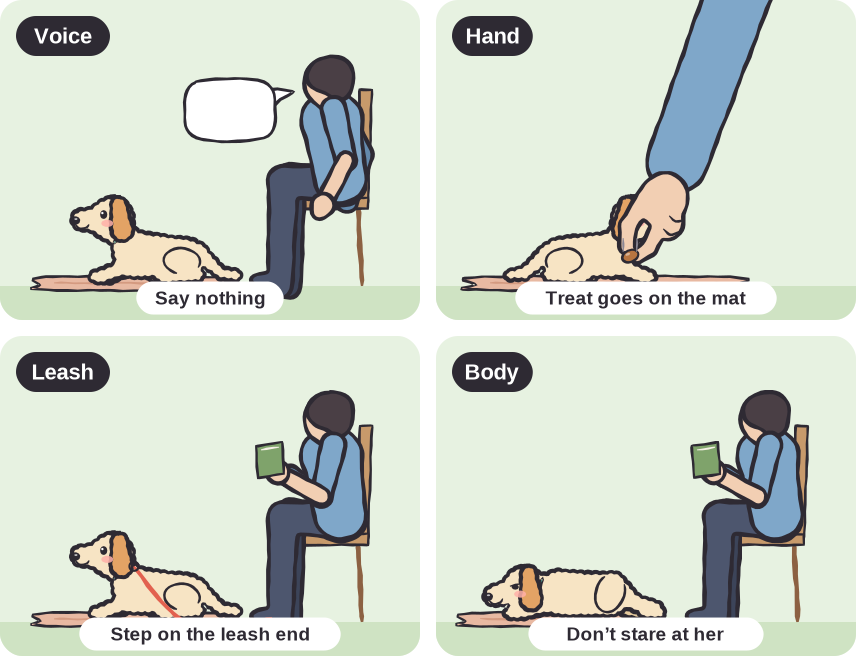
- Voice
Say nothing at first — if you talk, she’ll watch you and wait for instructions. Add the word “mat” once she’s stepping on by herself. While she’s relaxing, praise only in a low, quiet voice, if at all.
- Hand
Don’t put treats in her mouth. Place or drop them gently on the mat, between her front paws.
- Leash
For the first few sessions, keep her on leash: hold the end or stand on it. Once she gets the idea, go leash-free indoors. Outside, we suggest keeping the end in your hand or looped round your wrist, and standing on the slack to shorten it.
- Body
Sit on a chair next to the mat. Don’t stare at her. Don’t stand up or walk around (at first).
Today’s session
With the trainer, you work on step 1.
Step 1Treat for stepping on(At home, quiet)
The trainer shows you where and how often to place treats, then hands over. You sit on a chair, your dog on leash, and put the mat on the floor. When she puts a paw on it, a treat on the mat. When she lies down, keep placing treats on the mat. The trainer fixes, on the spot, any talking or treats going into her mouth. It takes about five minutes.
Homework until the next visit
- How often
- 1–2 times a day
- How long
- About 5 minutes each
- How much
- Treat spacing, for example: one every 5 seconds → every 10 seconds → longer (our rule of thumb)
A good sign she’s readyWhen you put the mat down, she steps on and lies down straight away, 8 out of 10 times (our rule of thumb)
What the trainer checks next visit
In front of the trainer, put the mat down and watch your dog step on and lie down. Ten times.
If she canIf she lies down straight away 8 out of 10 times, move up: step 3 (waiting for her to relax) becomes the new homework.
If not yetIf she steps on but stops there, go back to step 1 and look again at where and how often you place treats.
Next stages: steps
- 1
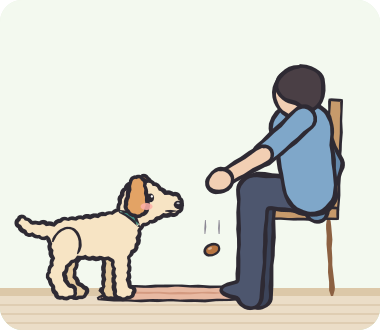
Paw on — treat on the mat At home, quiet
Treat for stepping on
Put the mat on the floor; when your dog puts a paw on it, a treat on the mat. At first, you can reward anything that isn’t staring at you, pulling on the leash or barking.
A good sign to move onWhen you put the mat down, she steps on by herself, 8 out of 10 times (our rule of thumb)
- 2
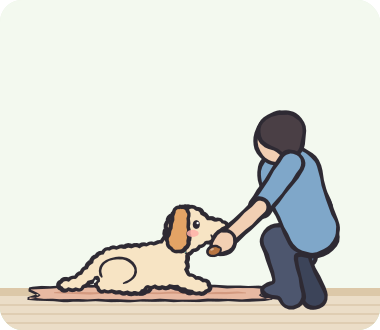
Lying down — keep the treats coming At home, quiet
Treat for lying down
After she steps on, wait until she lies down. When she does, keep placing treats on the mat (for example, one every 5 seconds → one every 10 seconds; our rule of thumb).
A good sign to move onShe lies down as soon as she steps on, 8 out of 10 times (our rule of thumb)
- 3
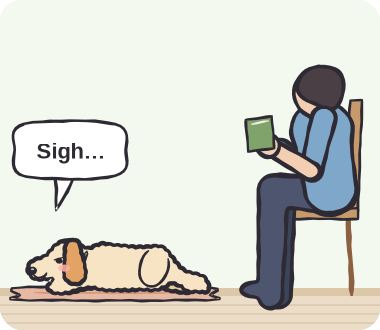
Hip rolled, chin down, a sigh At home, quiet
Wait for her to relax
Reward signs of real relaxation, not just lying down: rolling onto one hip, resting her chin on the floor, a sigh. Stretch the wait before each treat a few seconds at a time. You can give her a chew too.
A good sign to move onShe relaxes on the mat for 5 minutes (our rule of thumb)
- 4
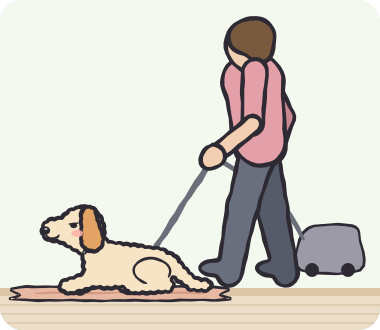
Add distractions a little at a time At home, small distractions
With the family moving around
Add small distractions bit by bit: someone walking through the room, then sweeping. Once she’s comfortable, take the leash off. If she gets up, say nothing and wait; reward again when she settles.
A good sign to move onShe relaxes on the mat for 5 minutes in a room where the family is moving around (our rule of thumb)
- 5
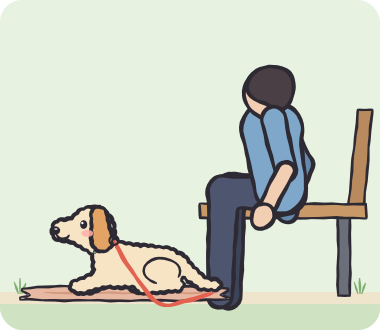
A portable place to relax Quiet street
On a bench or a café patio
Lay the mat by a bench in a quiet park, or on a dog-friendly café patio, and do the same. Our suggestion for safety: keep the end of the leash in your hand or looped round your wrist and stand on the slack to shorten it, rather than letting go of it outside.
A good sign to move onShe lies on the mat for 5 minutes outdoors, in 3 different places (our rule of thumb)
- 6
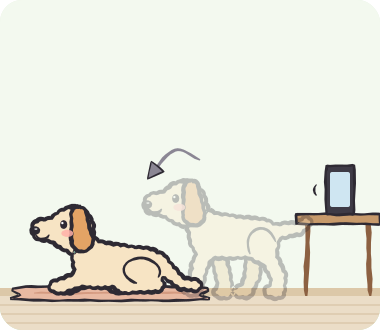
A sound — off to the mat Around distractions
After the doorbell or a noise
Only once she goes to the mat on the cue “mat.” Have someone knock softly on the door, or play a doorbell sound quietly → “mat” → treat when she’s on it. Once that’s easy, hand her a chew so she relaxes there for longer. More on the doorbell and visitor pages.
A good sign to move onShe lies down on the mat within 30 seconds of the sound, 8 out of 10 times (our rule of thumb)
Timing
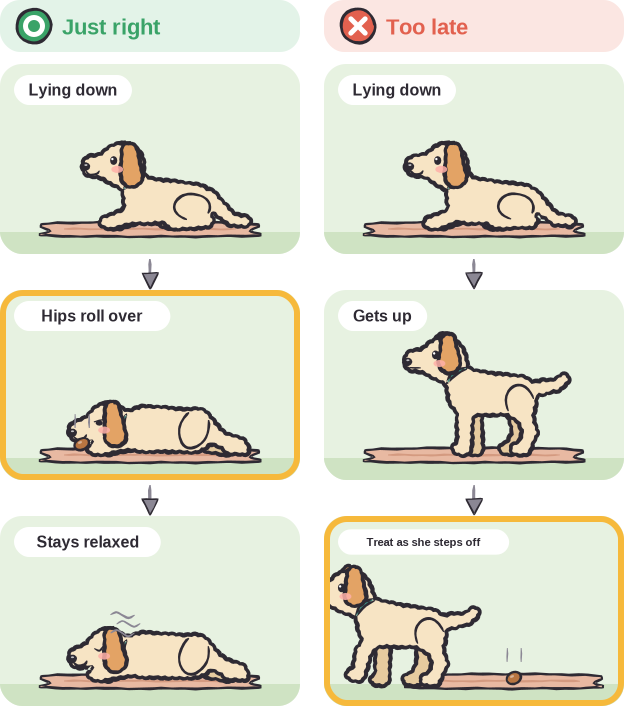
Just right
Place a treat on the mat the instant a front paw lands, she lies down, rolls onto a hip, rests her chin on the floor, or sighs.
Too late
Bringing out the treat as she starts to get off the mat — that rewards getting off.
This practice rewards relaxing, so put treats down gently and keep your voice low. The Dogs Trust settle-training steps work the same way: drop treats without talking at first, then shift what you reward from lying down to signs of relaxing — sighing, shifting weight to one side, resting the head.
How much and how often
About 5 minutes, 1–2 times a day, at times she’s likely to rest, such as after a walk.
If it isn’t working
She keeps getting off the mat
Don’t scold — say nothing and wait. When she steps back on, a treat. Go back to placing treats more often.
She’s too excited to bother with a mat
Practice after a walk or a sniffing game, when she’s tired and calm.
She stares at me, waiting for the treat
Start by rewarding her for not staring: standing quietly, or sniffing the mat. Look at a book or your phone instead of at her.
Once I added distractions, she couldn’t relax
Move further from the distraction, or go back to something smaller (someone walking slowly past, for example).
How long do I keep using treats?
Stretch the time before each treat bit by bit, until in the end a chew is all she needs to relax for a long while. When you notice her relaxing, quietly place a treat now and then.
Avoid
- Making the mat a place of punishment (a time-out spot)
- Pinning her there with “stay” once she’s on the mat (relaxing is the point)
- Praising in a high, excited voice that winds her up
- Talking to her or giving instructions throughout the session
A good sign to move on
- Steps 1–2: she steps on and lies down straight away, 8 out of 10 times
- Steps 3–4: she relaxes on the mat for 5 minutes in that room
- Step 5: she lies on the mat for 5 minutes outdoors, in 3 places
- Step 6: she lies down on the mat within 30 seconds of the sound, 8 out of 10 times
- These are all our rules of thumb. If she struggles, go back one step (our rule of thumb: two misses in a row)
Sources
- Dogs Trust — How to train your dog to be calm, relax and settle
- Dogs Trust — How to prepare your dog for visitors
- Dogs Trust — Separation anxiety in dogs: signs, causes and how to help
- Dogs Trust — Top ten dog training tips
- MSD Veterinary Manual — Behavior Problems of Dogs
- ASPCA — Barking (“Go to Your Spot” training)
- Humane World for Animals (formerly the Humane Society of the United States) — How to get your dog to stop barking