 BAUDOG The dictionary of dog–human communication
Contents
- The finished behavior
- Assessment: where is your dog now?
- The cue
- How to signal
- Teaching steps
- When to reward
- What is mat training?
- “Settle” vs. “Place”
- When to use “Settle” — and when not yet
- A good sign to move on
- If it isn’t working
- Prescription: a suggested order
- In the moment: do / don’t
- When to see a professional
- Sources
The finished behavior
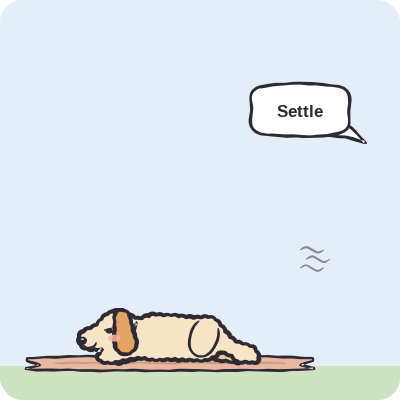
Say “Settle,” and your dog lies down, rolls onto one hip, rests her chin on the floor and stays quiet. It isn’t a telling-off, and it isn’t a magic word that stops a dog mid-frenzy. You build it by teaching her to relax on a mat first, then quietly adding the word just as she starts to relax.
Assessment: where is your dog now?
Before adding the word, check a few things — for example, these three. Only start saying “Settle” once she can relax without it.
When you put the mat down, does she get on it and lie down by herself?
→If not, don’t add the cue yet. Start with steps 1–2 of Relaxing on a Mat.
After lying down, does she go further — roll onto one hip, rest her chin on the floor, let out a sigh?
→If she stops at a plain down, work first on rewarding those relaxed signs (step 3 of the practice). The cue comes after that.
Has the family been saying “Settle!” or “Calm down!” over and over to an excited dog?
→If so, that word may already mean “the thing people say when I’m wound up.” Pick a fresh one — “Relax,” “Easy” — and get everyone using it.
The cue
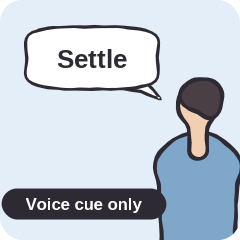
The spoken cue is “Settle.” There’s no standard hand signal, and we suggest voice only: if your hand moves when you want her to relax, she’ll watch your hand and wait for something to happen. In the early days, putting the mat down is itself the signal that it’s time to relax (Battersea). Keep it a different word from “Place” (go to your mat and stay until released).
How to signal
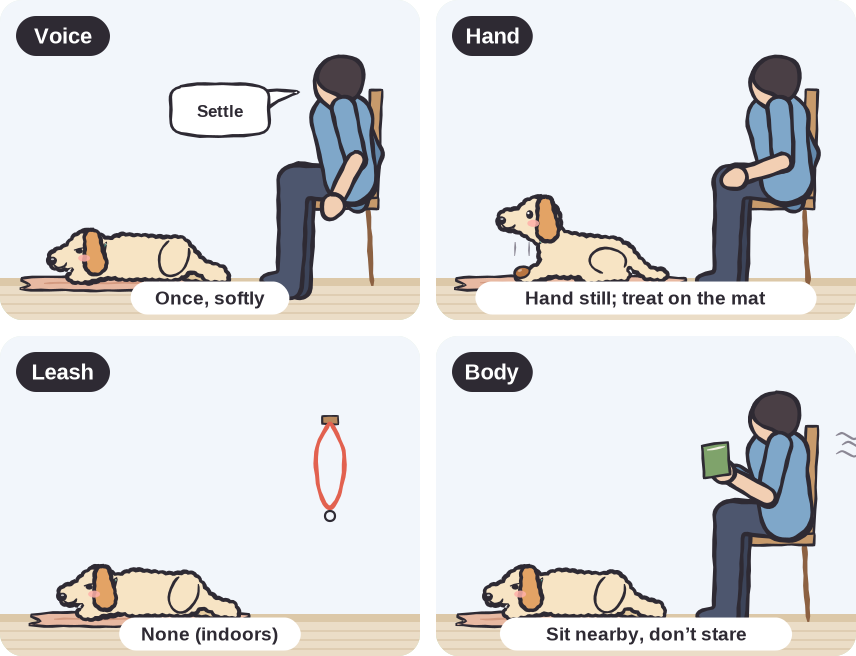
- Voice
Low, slow and soft — once. Say it just as she starts to relax. Don’t keep repeating it.
- Hand
Keep your hands still (no hand signal). Place treats gently on the mat, between her front paws.
- Leash
None at home (fine for the first few sessions). Our suggestion: outside, keep the end of the leash in your hand or looped over your wrist, and stand on the slack.
- Body
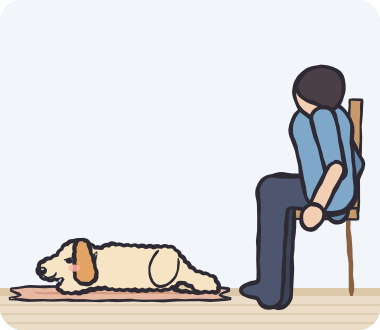
Sit in a chair beside the mat. Don’t stare at her. Breathe slowly yourself.
Teaching steps
- 1
No word yet At home, quiet
First, relaxing without a word
Using the Relaxing on a Mat practice, build up to her getting on the mat as soon as you put it down, lying down and rolling onto a hip. Say nothing at this stage.
A good sign to move onWhen the mat goes down, she gets on, lies down and relaxes without any word
- 2
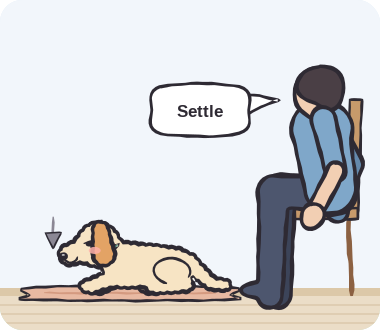
Lay the word over the relaxing At home, quiet
“Settle” as she starts to relax
The moment your dog, already lying down, rolls onto a hip or starts to lower her chin, say “Settle” softly. Then place a treat gently on the mat.
A good sign to move onShe hears the word and stays relaxed instead of sitting up
- 3
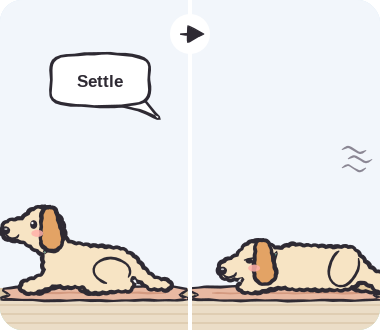
Say it, then wait for her to relax At home, quiet
Word first, relaxing after
Say “Settle” as soon as she’s on the mat and lying down, wait for her to roll onto a hip, then place the treat. Stretch the wait before the treat a few seconds at a time.
A good sign to move onA few seconds after “Settle,” she’s in a relaxed position
- 4
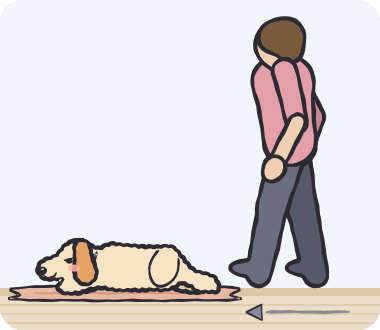
Add distractions a little at a time At home, small distractions
In a room where people are moving
Do the same with mild distractions — family members walking past, someone tidying up. If she gets up, say nothing and wait; when she relaxes again, treat.
A good sign to move onShe relaxes on her mat on “Settle” even with people moving around
- 5
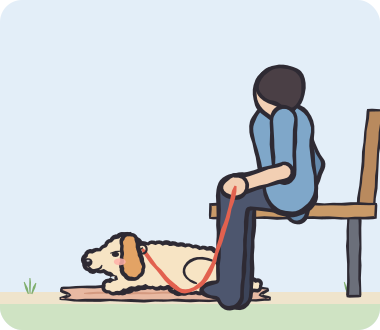
Bring the same mat along Quiet street
Outside: a park bench or café patio
Take her mat from home to a quiet park bench or a dog-friendly patio. Start with no word, and say “Settle” once she relaxes. Keep the end of the leash in your hand.
A good sign to move onOutside too, she relaxes on her mat after “Settle”
When to reward
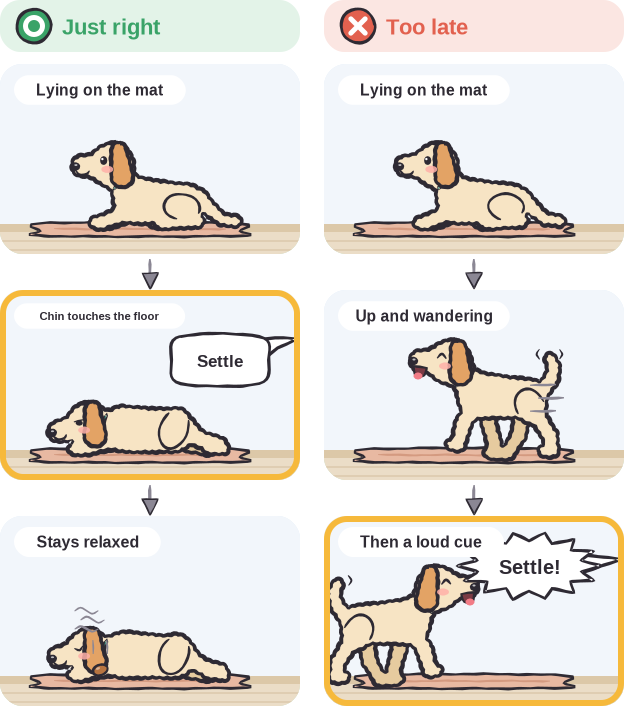
Just right
She rolls onto one hip, rests her chin on the floor, or sighs. At that moment, softly, “Settle.” The treat comes after, on the mat.
Too late
Saying “Settle!” after she’s up and pacing. The word gets linked with being wound up.
Add the word once she can do the behavior, just before it happens (or as it begins). A handout from the Humane Society of Missouri, based on material by board-certified veterinary behaviorists, describes rewarding the behavior when she offers it, then adding the cue word just before she does it. Speak slowly and quietly.
What is mat training?
Mat training teaches your dog to lie down on a particular mat by herself and relax there. Because the mat is portable, it can become her “relax here” spot away from home too — at family or friends’ houses, or in the vet’s waiting room (PAWS Chicago, American Kennel Club).
The MSD Veterinary Manual notes that once a dog has learned to relax on cue on a particular mat or bed, it’s easier for her to stay calm and less fearful while you gradually get her used to things that worry her, like certain sounds — and that this helps the training go faster.
Anything you have at home works as a mat: a bath mat, a folded towel, a thin blanket (PAWS Chicago suggests a kitchen rug, a yoga mat or a crate pad). Avoid anything slippery or noisy.
“Settle” vs. “Place”
“Settle” asks for a relaxed state. “Place” asks her to go to a particular spot and stay there until you release her. Mat training often uses both, so giving them different words makes things clearer for your dog and your family.
- “Place”: go to the mat from wherever she is, and stay there until “Free” (see our Place page)
- “Settle”: on the mat, lie down, roll onto a hip and stay quiet (this page)
- “Stay”: don’t move from where you are. She doesn’t need to be relaxed
When to use “Settle” — and when not yet
Until she can relax on cue, using it in front of something scary or exciting (the doorbell, visitors, other dogs) won’t work. The Humane Society of Missouri handout says the same: until she can relax on cue where there’s nothing going on, expecting her to relax around those triggers isn’t realistic. Practice in quiet times first. Start somewhere calm with no distractions (Dogs Trust), when she’s tired — after a walk, for example (Battersea).
- Good times to use it: during family meals, once visitors are sitting down, on a café patio, in the vet’s waiting room
- Not yet: while she’s barking or panicking. In that moment, get her away from the trigger first (see our Stop Barking page)
- Only pair it with the doorbell or visitors once it works in quiet places. For the doorbell itself, see our Doorbell Barking page and the Getting Used to Sounds Step by Step practice
A good sign to move on
- When to start saying “Settle” first: without any word, she gets on the mat as soon as you put it down, lies down and relaxes (steps 1–3 of Relaxing on a Mat)
- When to move to a new place: in the current spot, she keeps relaxing within a few seconds of “Settle.” Our rule of thumb is 8 times out of 10
- If she struggles, go back a step (our rule of thumb: two misses in a row)
If it isn’t working
When I say “Settle,” she gets up or looks at me
Go back to the step before the word. Some dogs lift their heads when they hear a word because they think something’s about to happen. Say it even more softly, and only at the moment she relaxes.
She can do it on the mat but not without it
That’s exactly where she should be at first. Battersea also suggests using the mat itself as the signal to relax. Take her mat with you when you go out. Try without it only once she can relax on her mat in lots of different places.
It doesn’t work at all when she’s excited
She isn’t ready to use it around triggers yet. In the moment, move away from the trigger, and keep practicing at quiet times. Work on Play and Pause too, which teaches her to come down from excitement.
My puppy can’t keep still
Practice when she’s sleepy, or after a walk or play, and keep it very short — about 3–5 minutes at first. PAWS Chicago also says to keep the first few sessions to 3–5 minutes. How long she can stay still grows as you practice relaxing.
Prescription: a suggested order
Our suggested order. Relaxing itself is built through practice.
- ExerciseRelaxing on a Mat: How to Teach Your Dog to SettleDoable at home (Steps 1–4 at home)The core method behind this cue: building up to her lying down on the mat by herself and rolling onto a hip. Add the word “Settle” once she can do step 3 of this practice.Read →
- ExercisePlay and Pause: Teach Your Dog an “Off Switch” With TugDoable at home (Steps 1–3 at home)Practice for calming herself after play. Once she can come down from excitement, relaxing on the mat gets easier too.Read →
In the moment: do / don’t
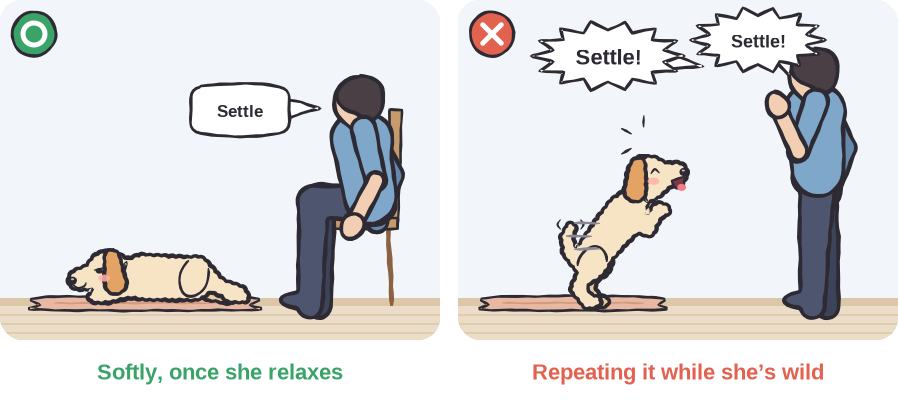
Do
- Say “Settle” softly, once, the moment she relaxes
- Place treats gently on the mat
- Practice when she’s tired, after a walk for example
- End the session with “Free,” then pick up the mat
Don’t
- Repeat “Settle! Settle!” while she’s bouncing around
- Praise in a high, excited voice that winds her up again
- Use the mat as a punishment spot (a time-out corner)
- Pin her in place with “Stay” (relaxing is the goal)
When to see a professional
- She can’t lie down and rest at any time or anywhere, and keeps pacing. This can be a sign of pain (Cornell’s veterinary college lists pacing and restlessness among the signs). Have your vet check her
- She can’t settle only when she’s left alone — pacing, whining, drooling or having accidents. This may be separation anxiety. Talk to your vet (ideally one who sees behavior cases)
The skills behind this command
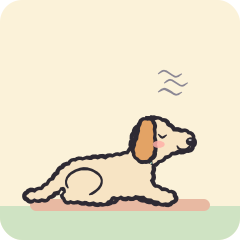 Core skill Settling Down Being able to relax and rest by herself after excitement or a noise. “Settle” puts a name to that ability.
- ExerciseRelaxing on a Mat: How to Teach Your Dog to SettleDoable at home (Steps 1–4 at home)Read →
- ExercisePlay and Pause: Teach Your Dog an “Off Switch” With TugDoable at home (Steps 1–3 at home)Read →
Sources
- Dogs Trust — How to train your dog to be calm, relax and settle
- Battersea — My dog won’t settle: teaching your dog to be calm and relaxed
- PAWS Chicago — Training Protocols: Relaxation (Teaching your dog to Relax on a Mat, PDF)
- Humane Society of Missouri — Teaching Calm: Settle and Relaxation Training (based on material by Debra Horwitz, DVM, DACVB and Gary Landsberg, DVM, DACVB; we don’t recommend the head-halter positioning it also describes)
- MSD Veterinary Manual — Behavior Problems of Dogs
- Cornell Riney Canine Health Center — Recognizing pain in dogs
- American Kennel Club — How To Teach Your Dog To Go to Their Place