 BAUDOG The dictionary of dog–human communication
Contents
- The finished behavior
- Assessment: where is your dog now?
- The cue
- How to signal
- Teaching steps
- When to reward
- “Leave it” vs “Drop it”
- “Leave it” or “No”?
- She never gets the thing she left
- Beyond food: toys, socks and other distractions
- Using it on walks
- A good sign to move on
- If it isn’t working
- Prescription: a suggested order
- In the moment: do / don’t
- When to see a professional
- Sources
The finished behavior
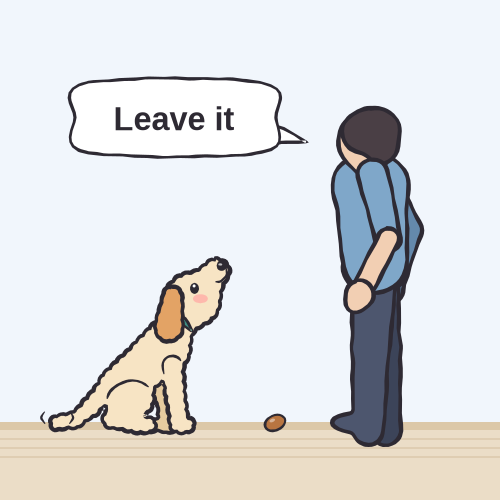
On “Leave it,” your dog turns her nose away from whatever is on the floor or the sidewalk and looks at you. She knows that leaving it means something better comes from you.
Assessment: where is your dog now?
Before teaching anything, a visiting trainer might check something like these three things.
When you hold a treat in a closed fist in front of her nose, how hard and for how long does she keep sniffing or licking it?
→Even if she keeps at it for a while, that’s fine — start at step 1. If she bites at your hand, use a less exciting treat in the fist, or wear a glove.
Does she snatch up things that fall on the floor, even at home?
→Spend longer on the indoor floor step (step 3). When you’re not practicing, don’t leave things lying on the floor.
When someone might take something from her mouth, does she freeze or growl?
→If so, teach trading first (“Drop it”). If the guarding is strong, talk to your vet or a behavior professional.
The cue
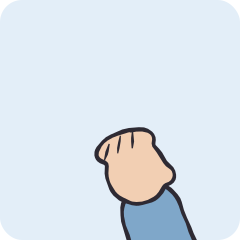
“Leave it” is the usual word for this cue; some people just say “Leave.” Pick one word for the whole family. We suggest not using a word you also use to scold her (like “No!”), and never saying the cue in a scolding voice. The hand signal is a closed fist with a treat inside, held in front of her nose: the hand position you start the training with becomes the signal.
How to signal
- Voice
Say nothing at first. Once she reliably turns away, say “Leave it” once, just before she does. Never in a scolding voice.
- Hand
Hold a closed fist with a treat inside in front of her nose. When her face moves away, give her a better treat from your other hand. She never gets the treat in the fist.
- Leash
From the floor step on, keep her on a leash so she can’t reach the treat if you’re too slow. On walks, hold the leash short enough that she can’t reach things on the ground. The leash is there to keep things out of reach — not to yank her back.
- Body
Crouch, or sit on the floor. For the floor step, stand where your foot can cover the treat.
Teaching steps
- 1
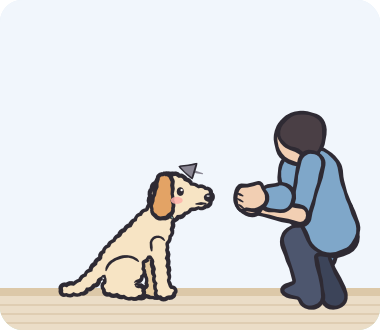
Turning away from the fist is the right answer At home, quiet
Leave the fist
Hold a closed fist with a treat inside in front of her nose. Let her sniff or lick; keep your hand closed and wait. The instant her face moves away, “Yes” → a treat from your other hand.
A good sign to move onTurns away from the fist as soon as you offer it, 8 times out of 10
- 2
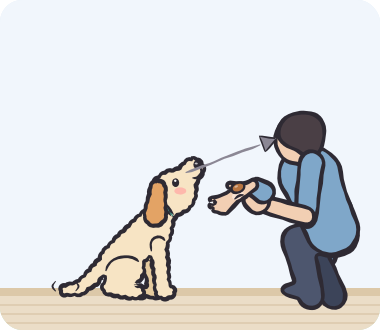
She can see it — and still doesn’t go for it At home, quiet
Open hand
Open your palm and show her the treat. If she moves toward it, close your hand. When she backs off, “Yes” → a treat from the other hand.
A good sign to move onStays away from the open hand for 5 seconds, 8 times out of 10
- 3
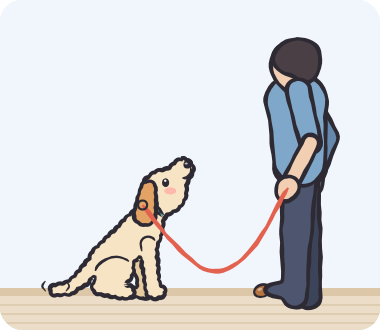
Your foot guards the treat on the floor At home, small distractions
On the floor
With her on leash, put a treat on the floor and stand where your foot can cover it. When she looks up at you, praise and reward. She doesn’t get the treat on the floor. Once she’s used to it, drop treats from a little height.
A good sign to move onLooks away from the treat on the floor by herself, 8 times out of 10
- 4
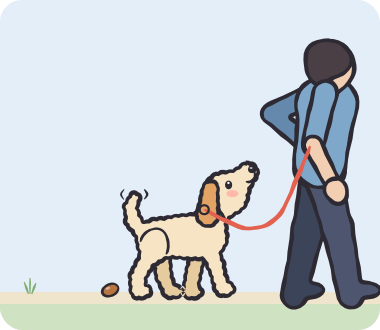
Practice outside with treats you placed yourself Quiet street
Add the cue, then a quiet street
Now add “Leave it” just before you put the treat down. Once it works at home, place practice treats along a quiet street ahead of time, say “Leave it” and walk past them. When she’s past, a good treat.
A good sign to move onWalks past a placed treat, 8 times out of 10
- 5
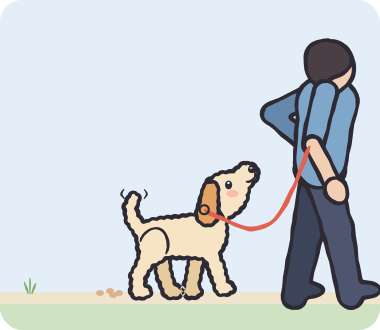
Even with the real thing, she looks at you Around distractions
Real things on the ground
When you spot something on the ground on a walk, “Leave it.” When she’s past it, a jackpot treat.
A good sign to move onWalks past something on the ground 3 times on one walk
When to reward
Just right
“Yes” the instant her nose leaves your fist. Then a treat from your other hand.
Too late
Saying “Yes” after she has come back for another sniff — you end up praising the sniff.
“Leave it” vs “Drop it”
- Leave it: ignore something she hasn’t picked up yet. Use it for things on the ground or food that falls off the table. This page.
- Drop it: let go of something that’s already in her mouth (the Drop It and Give pages).
- Teach both. The American Kennel Club (AKC) points out that you won’t always spot things before your dog does, so “drop it” matters just as much as “leave it.”
“Leave it” or “No”?
Plenty of people already say “No!” when their dog goes for something. The trouble is that “No” usually comes out as a scold, and it only tells her what not to do. “Leave it” is taught step by step as a trade: turn away from that, and something better comes from me. The American Veterinary Society of Animal Behavior (AVSAB) says training methods work best when they focus on teaching the animal what to do rather than punishing unwanted behavior. So we suggest keeping “Leave it” a calm, friendly cue — never a shout.
She never gets the thing she left
In this method she never gets the treat she turned away from — not even at the end. Her reward is a better treat from your other hand or your pocket. A pill or a bone on the sidewalk isn’t something she gets by waiting. The AKC and Dogs Trust in the UK both teach it this way, with the reward coming from a different hand than the thing she’s leaving.
Beyond food: toys, socks and other distractions
Once she leaves food reliably, swap the food for other things she loves — chew toys, balls, a sock. The AKC says this helps her generalize the cue, so she leaves anything you haven’t okayed, not just food. After that, the AKC adds distractions such as another pet or a person she likes — with a high-value reward ready and the leash on.
Using it on walks
- Always hold the leash. Leash rules vary — New York City, for example, requires a leash no longer than 6 ft (1.8 m) in public — so check your local rules. Held short enough that she can’t reach things on the ground, it means that even if you’re too late, nothing ends up in her mouth.
- Don’t say the cue where you know it won’t work. Every time she ignores it, she practices ignoring you (AKC). In those moments, use the leash to keep things out of reach, and go back to practicing at home.
- If she eats a lot of things off the ground, see our page Eating Things Off the Ground. Why it happens, and what to do about it, are covered there.
A good sign to move on
- Steps 1–4: move on once she manages that step 8 times out of 10 (our rule of thumb)
- The outdoor step (step 4) comes once she looks away from treats on the floor by herself at home
- If she struggles, go back a step and take it more slowly (our rule of thumb: two misses in a row)
If it isn’t working
She bites at my fist
Wear a glove, or put a less exciting treat in your fist. Even if she bites, don’t open your hand.
Outside, it doesn’t work at all
Get the floor step (step 3) solid at home before you go outside. Outside, hold the leash so she can’t reach things, so she doesn’t get the chance to fail.
I keep saying “Leave it, leave it”
Say the cue once. If it doesn’t work, don’t repeat it — move her out of reach instead, and go back to practicing at home.
She’s already got it in her mouth
Use “Drop it” (a trade), not “Leave it.” If she may have swallowed something dangerous, go to your vet straight away.
Can I teach a puppy?
Yes. Dogs Trust recommends teaching puppies fair trades (“Drop it”) first, without snatching things away, and then teaching “Leave it” for things you don’t want them to pick up.
Prescription: a suggested order
The full step-by-step is the practice Leave It, set out as a visiting trainer’s homework: twice a day, 3–5 minutes each, and what the trainer checks on the next visit.
- ExerciseLeave It Practice: From a Closed Fist to Food on the SidewalkDoable at home (Steps 1–3 at home)The full step-by-step for “Leave it,” from a closed fist to real things on the ground on walks.Read →
- ExerciseThe Trade Game: Teach Your Dog to Drop It by Swapping, Not GrabbingDoable at home (Steps 1–4 at home)Letting go of things she has already picked up. Used together with “Leave it.”Read →
In the moment: do / don’t
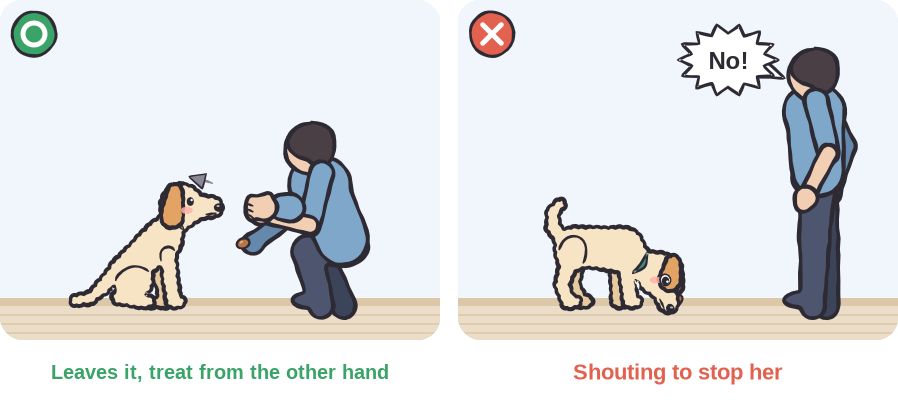
Do
- Start with a treat in a closed fist
- “Yes” the instant her face moves away → a treat from the other hand
- Outside, hold the leash short enough that she can’t reach things
- Say the cue once
Don’t
- Shout “No!”
- Hand her the treat she just left
- Reach into her mouth to take things out
- Keep saying the cue where it isn’t working
When to see a professional
- She freezes, growls or tries to bite over things in her mouth or her food bowl (resource guarding). Don’t take things from her yourself — talk to your vet or a behavior professional
- She may have swallowed something she found. If it could be toxic or cause a blockage, go to your vet straight away
The skills behind this command
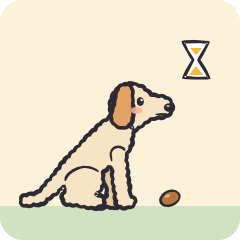 Core skill Impulse Control Choosing to give up something she wants that’s right in front of her — the simplest form of Impulse Control.
- ExerciseLeave It Practice: From a Closed Fist to Food on the SidewalkDoable at home (Steps 1–3 at home)Read →
- ExerciseThe Trade Game: Teach Your Dog to Drop It by Swapping, Not GrabbingDoable at home (Steps 1–4 at home)Read →
Sources
- American Kennel Club — ‘Leave It’ Command: Training Your Dog to Ignore Food and Other Items
- Dogs Trust — How to train your dog to leave it
- American Kennel Club — Teaching Your Dog to Drop It
- Toronto Humane Society — How to Teach “Leave It” (PDF)
- AVSAB — Position Statement on Humane Dog Training (2021)
- American Kennel Club — Teach Your Dog to Trade Items With You
- ASPCA — Food Guarding
- Dogs Trust — Resource guarding in dogs
- New York City Health Code Article 161, §161.05