 BAUDOG The dictionary of dog–human communication
Contents
When to use this exercise
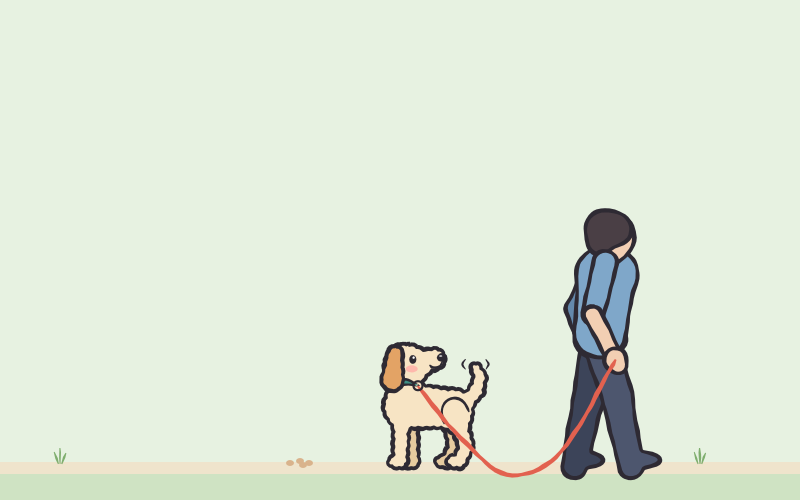
Use this when there’s something on the floor or the sidewalk your dog shouldn’t have — a dropped chicken bone, a food wrapper, another dog’s poop — and you want her to turn away from it and look at you. It’s the groundwork for stopping scavenging, poop eating and leash chewing. She isn’t learning “it gets taken away”; she’s learning “if I let it go, something better comes from my person,” so what grows is self-control. Start with a treat in your closed hand at home and build up to real litter on walks.
GoalYour dog turns her face away from the treat (or the thing on the ground) on her own and looks at you.
Assessment: what a trainer might check on the first visit
Before starting, a visiting trainer might check something like these three things at home.
Hold a treat in your closed fist in front of her nose. How hard and how long does she sniff and lick at it?
→If she gives up within a few seconds, keep step 1 short and move on to the open hand and the floor sooner. If she keeps at it hard enough to nibble your hand, make the treat she’s leaving less exciting — her regular kibble.
Does she pick things up off the floor even indoors? How fast does she go for them?
→If she scavenges indoors too, add tidying up as homework alongside the practice: nothing left lying on the floor.
When it looks like you might take something from her mouth, does she stiffen or growl?
→If so, start with Trade (Drop It) before this practice. If you see growling or biting, talk to your vet or a qualified behavior professional as well.
What you need
- Everyday treats to leave alone — her regular kibble is fine
- Better treats for the reward — something she likes more than the ones she’s leaving
- A marker word she already knows: “Yes” means a treat is coming (see Charging Your Marker Word)
How to signal
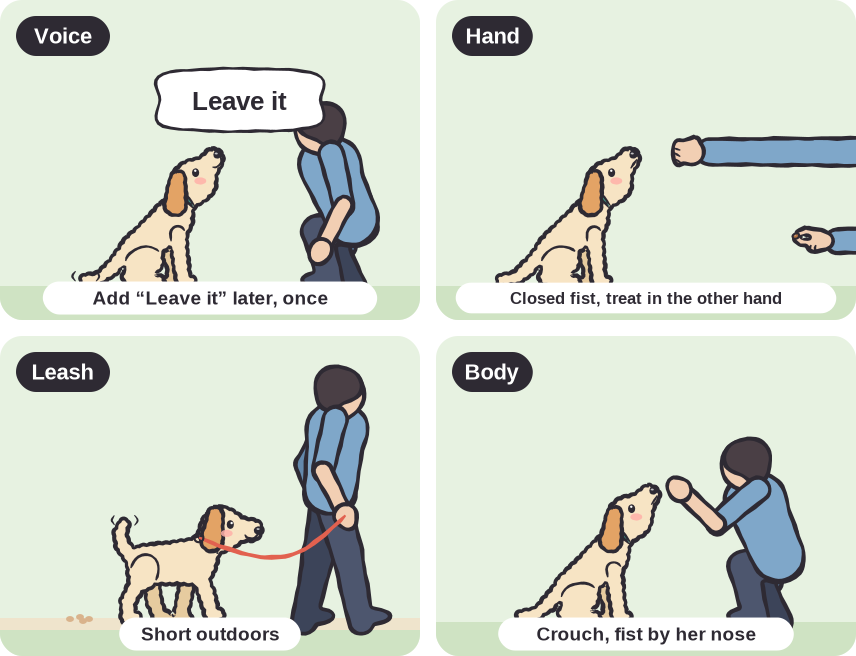
- Voice
Say nothing at first. Once she reliably pulls her face away, say “Leave it” once as you hold out your hand or the treat, just before she would back off on her own. Keep it calm, never scolding. (At BAUDOG we use “Leave it” rather than “No,” so the cue doesn’t get mixed up with scolding.) Out on walks, the AKC’s advice is not to use the cue if you know she won’t respond — shorten the leash and walk on instead.
- Hand
Hold your closed fist, with the treat she’s leaving inside, in front of her nose. When her face moves away, give a better treat from your other hand. The treat she left stays in the fist — she doesn’t get it.
- Leash
Indoors, no leash. Outside, hold it fairly short — short enough that she can’t reach whatever is on the ground. The leash isn’t for yanking her away; it’s so she can’t get there.
- Body
Crouch or sit on the floor. At the floor stage, stay close enough to cover the treat with your hand or foot in an instant.
Today’s session
With the trainer, you work on step 1.
Step 1Leave the closed fist(At home, quiet)
The trainer shows you once, then hands over. Hold your closed fist, with an everyday treat inside, in front of your dog’s nose, and wait quietly while she sniffs and licks. The instant her face moves away — even a little — say “Yes,” then give a better treat from your other hand. Ten repetitions. The trainer watches for marking too late and for pulling the fist away to “help” her, and fixes both on the spot. It takes about five minutes.
Homework until the next visit
- How often
- Twice a day
- How long
- 3–5 minutes each
- How much
- Up to 10 reps per session
A good sign she’s readyWith a treat on the floor, she looks away from it and at you on her own, 8 out of 10 times
What the trainer checks next visit
In front of the trainer, put a treat on the floor — 10 times.
If she canIf she looks away on her own 8 out of 10 times → next stage: step 4 (walking past a practice item on a quiet street) becomes the new homework.
If not yetGo back to step 2 (open hand) for another week, and check together whether the reward treat is clearly better than the one she’s leaving.
Next stages: steps
- 1
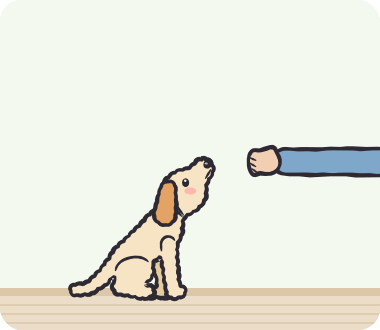
“Yes” the instant her face moves away At home, quiet
Leave the closed fist
Hold your closed fist, with an everyday treat inside, in front of her nose. Let her sniff and lick; just wait. The moment her face moves away, “Yes” → a better treat from your other hand.
A good sign to move onShe pulls away as soon as the fist appears, 8 out of 10 times
- 2
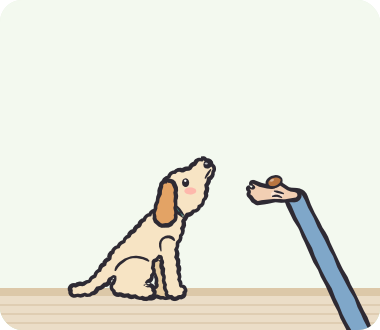
She can see it — and doesn’t go for it At home, quiet
Open hand
Open your palm so she can see the treat. If she moves toward it, close your hand; when she backs off, open it again. If she stays away, “Yes” → a treat from your other hand. Once she pulls away right away, add “Leave it” just before she backs off.
A good sign to move onShe stays away from the open hand for 5 seconds, 8 out of 10 times (our rule of thumb)
- 3
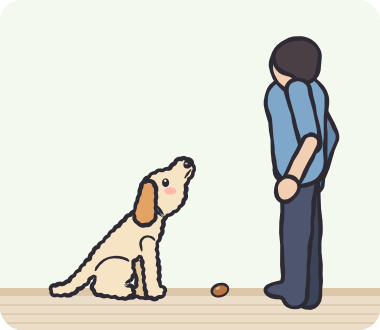
She lifts her face from the floor on her own At home, small distractions
On the floor
Put the treat on the floor and cover it with your hand. When she backs off, “Yes” → a different treat. Then take your hand away; then stand up and stay where your foot can cover it. Add dropping treats from just above the floor. She never gets the floor treats afterward, either.
A good sign to move onShe looks away from the floor treat and at you on her own, 8 out of 10 times
- 4
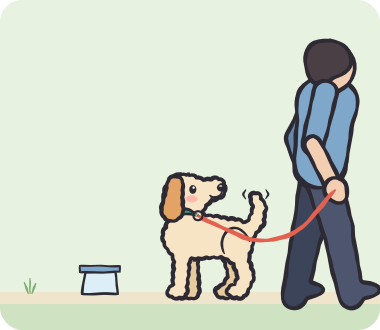
A practice item first, then the real thing Quiet street
On a quiet street
On a street with few people, have a family member put out a practice item first — treats in a lidded container, or a toy — and walk past it with the leash held short. The moment she looks up, give a jackpot treat. Always take the practice item home with you. Once that works, try it in a few different places, and with other things she loves, like a ball.
A good sign to move onShe walks past the practice item 8 out of 10 times
- 5
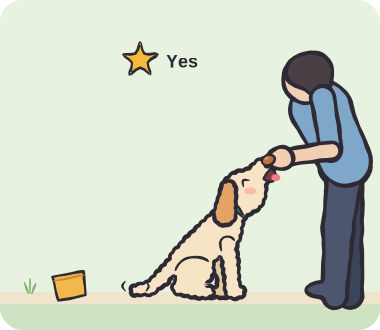
She walks past — jackpot Around distractions
Real litter on walks
When you spot something on the ground, say “Leave it” before she heads for it. When she walks past, give a jackpot treat. Keep the leash short enough that she can’t reach it.
A good sign to move onShe walks past litter 3 times on one walk (our rule of thumb)
Timing
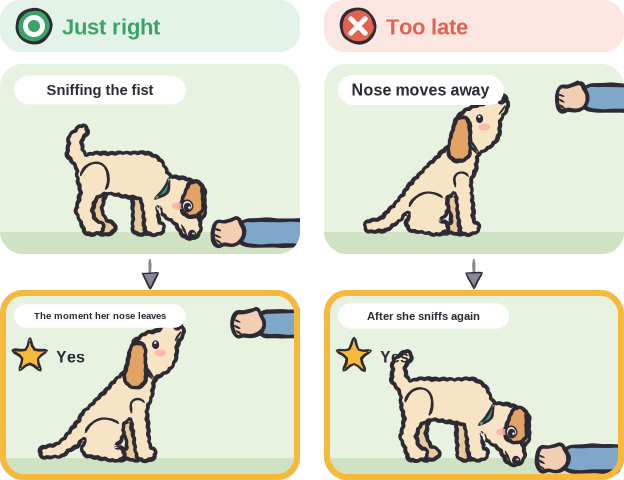
Just right
“Yes” the instant your dog’s nose leaves your fist — even a tiny bit. Then a better treat from your other hand.
Too late
“Yes” after she has come back to sniff again. Now the sniffing is what gets rewarded.
Canada’s Ontario SPCA and the Toronto Humane Society both describe the same sequence: mark the very moment the dog’s nose moves away from your hand, then reward from the other hand.
How much and how often
3–5 minutes a session, up to 10 reps, about twice a day. Once you reach the outdoor steps, use it on walks whenever there’s something on the ground.
If it isn’t working
She nibbles or paws at my fist
Make the treat she’s leaving less exciting — her regular kibble. A glove is fine too. Don’t open your hand, even if she nibbles. If she gets so excited that she keeps jumping at your hand, end that session, let her burn off some energy, and try again once she’s calmer.
She lunges at the floor treat and eats it
Go back a step and start with your hand covering the treat. At the floor stage, keep the treat close enough to cover with your hand or foot in an instant. Every treat she manages to grab is a reward in itself.
When does she get the treat she left?
Never. The San Francisco SPCA says never to let your dog have the item you asked her to leave. If you want to give it to her, pick it up off the floor first and hand it over from your other hand — or just use a different treat. Some guides do hand over the same treat in the early hand stage: the UK’s RSPCA does, and the AKC’s guide gives the fist treat with a “take it” cue before moving to the floor, where it switches to a different treat. If your goal is to stop scavenging, “what I leave, I don’t get” is the clearer rule, so BAUDOG uses the other-hand version all the way through.
She can’t do it at all outside
Get the floor stage (step 3) solid at home before you go outside. Outside, use the leash length so she can’t reach things, and don’t set her up to fail. Use even better rewards outside than at home.
She’s already got it in her mouth
This practice is about giving things up before they go in her mouth. Once something is in her mouth, don’t chase her — drop a few treats on the floor a little away from her so she lets go to get them. Practice Trade (Drop It) regularly too.
Does this work for poop?
Yes, you can use it. But in a survey of about 1,500 owners whose dogs ate poop, only about 4% of the owners who had tried “leave it” (praising the dog when it moved away) said it had worked. For poop eating, make picking up straight away and going out with her for potty breaks the foundation, and layer this practice on top (see our page on poop eating).
How long will it take?
There’s no fixed number of days or weeks — dogs vary a lot. Go by the milestones rather than the calendar: move on when she passes a step 8 out of 10 times (our rule of thumb), and go back a step when she struggles.
Avoid
- Shouting “No!”
- Reaching into her mouth to pull something out
- Handing over the treat she left later on (what she leaves, she doesn’t get)
- Saying “Leave it, leave it, leave it” — say the cue once
A good sign to move on
- Steps 1–3 (at home): she turns away on her own 8 out of 10 times at that step → move to the next step (our rule of thumb)
- Step 4 (quiet street): she walks past the practice item 8 out of 10 times
- Step 5 (real litter): she walks past litter 3 times on one walk
- If she struggles, go back one step — our rule of thumb is two misses in a row
Sources
- Ontario SPCA and Humane Society — How to teach “leave it”
- Toronto Humane Society — How to Teach “Leave It” (PDF)
- San Francisco SPCA — Leave It (PDF)
- Dogs Trust — Teach your dog to leave it
- RSPCA — Train your dog to leave alone
- American Kennel Club — ‘Leave It’ Command: Training Your Dog to Ignore Food and Other Items
- Best Friends Animal Society — How to Teach a Dog to ‘Leave It’
- Dogs Trust — How to stop your dog stealing
- Dogs Trust — Top ten dog training tips
- MSD Veterinary Manual (Pet Owner Version) — Behavior Problems in Dogs
- Hart, Hart, Thigpen, Tran & Bain (2018). The paradox of canine conspecific coprophagy. Veterinary Medicine and Science 4(2):106–114
- AVSAB — Position Statement on Humane Dog Training (2021)