 BAUDOG The dictionary of dog–human communication
Contents
When to use this exercise
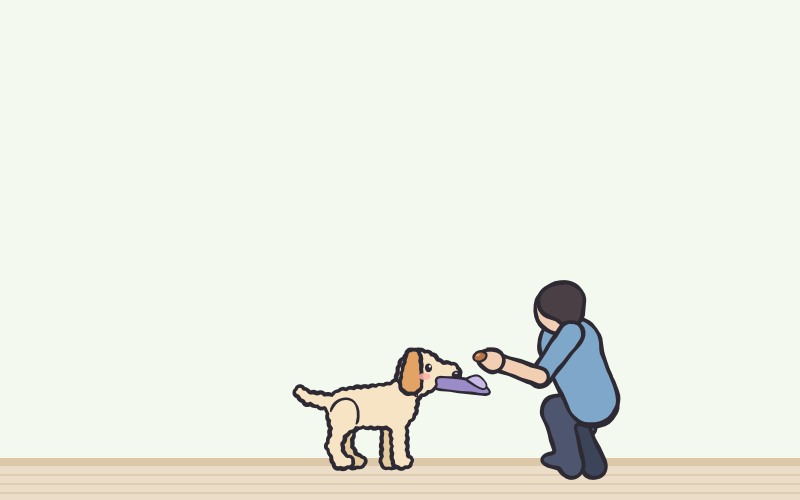
For dogs who run off with slippers and socks, won’t let go of things they pick up, or dodge away when you reach for a toy. You trade what’s in her mouth for something better so she lets go, and you give her everyday toys back. She learns that letting go doesn’t mean losing things — it means good things happen — so it’s less likely to turn into keep-away or into guarding. It builds Impulse Control and Comfort with Handling. Start at home; the last step is things she picks up on walks.
GoalOn “Drop it,” she lets go of what’s in her mouth by herself — and she knows that letting go pays.
Assessment: what a trainer might check on the first visit
Before starting, a visiting trainer might check something like these three things at home.
When someone comes near something in her mouth or her food bowl, does she freeze, growl, gulp it down fast or hunch over it?
→If so, this may be resource guarding. Don’t work on this practice on your own — do it with your vet or a behavior professional.
Which things does she especially hate to give up? (chews, bones, things she found)
→Save those for the end of the practice, and keep them put away until then.
Has anyone in the family chased her to get things back, or pried her mouth open?
→Make “no chasing, no prying” a family rule.
What you need
- Two of her everyday toys
- Treats she values more than whatever she’s holding (cut small)
- A marker word she already understands, “Yes” (the practice Charging Your Marker Word)
How to signal
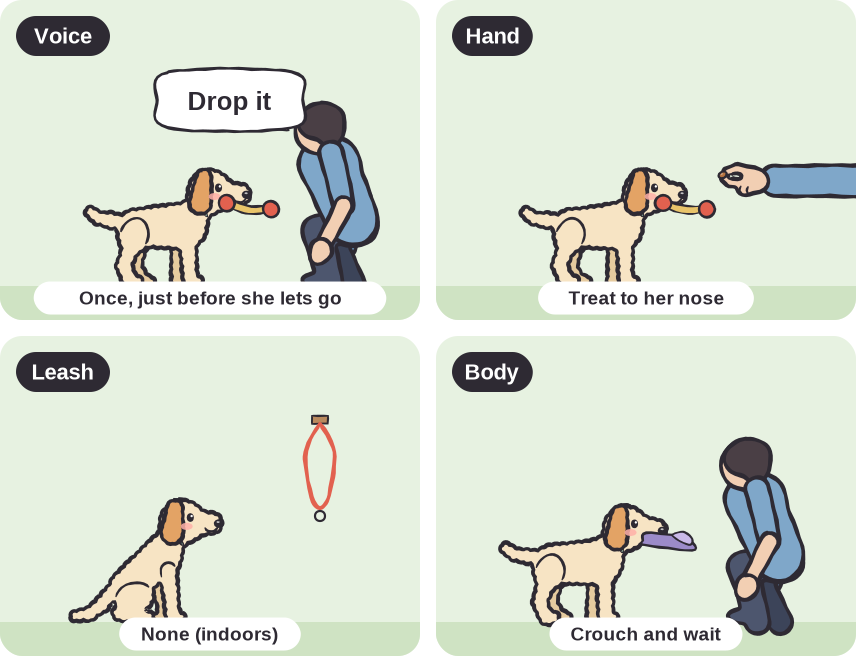
- Voice
Say “Drop it” once, just before you show the treat, in a calm voice. When she lets go, “Yes.”
- Hand
Bring the treat to her nose. When she lets go, place (or toss) the treat a little way off on the floor, and pick the item up while she eats. If it’s an everyday toy, give it back.
- Leash
None (at home). On the walk step, keep the leash loose.
- Body
Don’t chase. Crouch and wait. Don’t get into a tug-of-war over the item.
Today’s session
With the trainer, you work on step 1.
Step 1Trade for a treat(At home, quiet)
First, you and the trainer watch how she reacts when someone approaches something in her mouth (does she freeze?). If she’s relaxed, the trainer demonstrates: when your dog picks up an everyday toy, treat at her nose → the moment it leaves her mouth, “Yes” → treat → give the toy back. Family members take turns, 5–10 times each. Giving it back shows her that nothing gets taken.
Homework until the next visit
- How often
- Twice a day
- How long
- 3–5 minutes each
- How much
- 5–10 trades per session
A good sign she’s readyShe lets go on “Drop it” without seeing a treat, 8 times out of 10
What the trainer checks next visit
In front of the trainer, with treats still in the pouch: “Drop it.” Ten times.
If she canIf she lets go 8 times out of 10, move on: step 4 (favorite toys and chews) becomes the next homework.
If not yetGo back to showing the treat, use a better treat, and do another week.
Next stages: steps
- 1
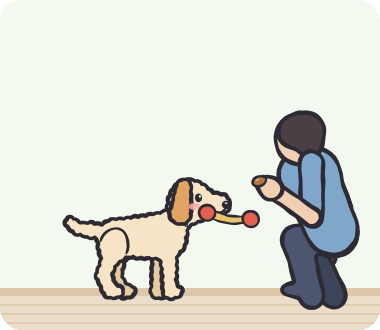
Treat at her nose. When she lets go, give the toy back At home, quiet
Trade for a treat
When your dog holds an everyday toy, bring a treat to her nose. When she lets go, “Yes” → treat. Give the toy back.
A good sign to move onLets go as soon as she sees the treat, 8 times out of 10
- 2
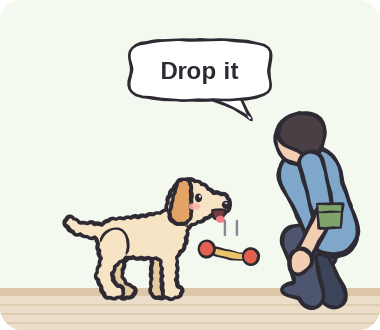
The cue comes just before the treat appears At home, quiet
Add the cue
Say “Drop it” just before you show the treat. Once she’s used to it, say it, wait about a second, then show the treat.
A good sign to move onOn hearing “Drop it,” she starts letting go before she sees the treat
- 3
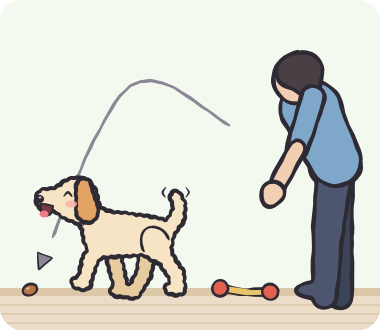
Toss a treat, and pick the toy up meanwhile At home, small distractions
Treat out of sight
Treats stay in your pouch as you say “Drop it.” When she lets go, bring one out. You can also toss the treat a few feet away and pick the item up while she goes for it.
A good sign to move onLets go without seeing a treat, 8 times out of 10
- 4
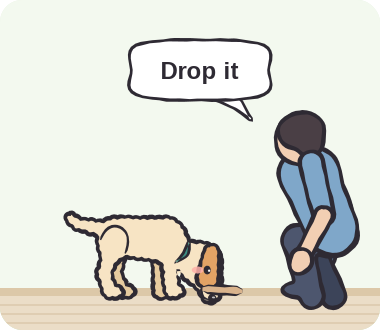
Even her favorite comes back to her At home, small distractions
With things she loves more
Do the same with a favorite toy or chew, and upgrade the treat too. When she lets go, treat — then give it back again.
A good sign to move onLets go even of favorite things, 8 times out of 10
- 5
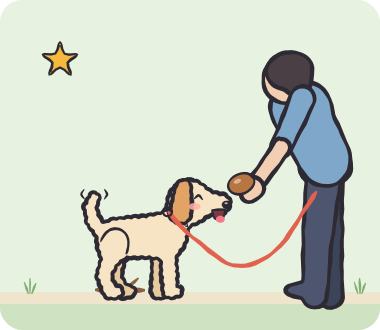
Outdoor finds get traded for a jackpot Around distractions
Things she picks up on walks
“Drop it” for things she picks up on walks. When she lets go, a jackpot treat (things from the ground don’t go back to her).
A good sign to move onLets go of things she picks up outside
Timing
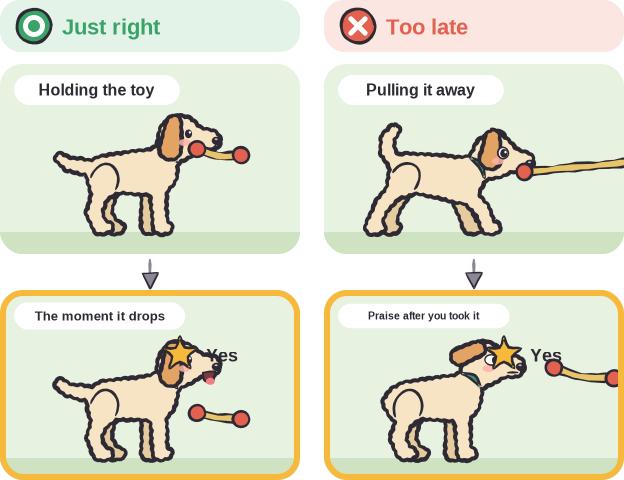
Just right
“Yes” the instant the item drops from her mouth. Then the treat.
Too late
Praising after you’ve pulled the item away — the letting go itself never got rewarded.
The American Kennel Club suggests that if your dog won’t drop the item without seeing the treats, you try waiting one second between saying the cue and showing the treats. It’s practice at letting go on the word alone.
How much and how often
5–10 trades per session (about 3–5 minutes). About twice a day.
If it isn’t working
She runs off with it
Don’t chase. To her, being chased is a fun game, and she learns to run away. Chasing can also make her swallow the item so you can’t get it. If you can’t get close, lay a trail of treats across the floor to lead her away from the item. Prying her mouth open is risky too: in a survey of the owners of 140 dogs seen for behavior problems, 39% of dogs who’d had items physically forced out of their mouths responded aggressively.
She growls or freezes over things
Don’t approach, don’t take the item, and move away. A growl is a warning: “don’t come closer.” Punishing it only stops the growl — not the feeling — and she may learn to bite without warning. Talk to your vet or a behavior professional.
She’s got something dangerous (a battery, a stone, medication), or may have swallowed it
If it’s still in her mouth, throw a handful of treats away from the item to distract her, then throw more even further away, and pick the item up meanwhile (Dogs Trust, a UK charity). If she may have swallowed it, or it could be toxic or cause a blockage, go to your vet straight away.
She won’t let go even when she sees the treat
Use a treat she values more than what she’s holding. The more forbidden the object, the more she values it.
She prefers toys to food
Trade a toy for a toy. Battersea, a UK rescue charity, suggests starting with two toys that are the same, or that she values equally, and making the second one look really exciting so she wants to drop the first. With practice she drops the first toy as soon as you offer the second. If she loves tug, you can play tug with two suitable toys the same way.
Should I practice taking things away (like lifting her bowl while she eats)?
No. Having things repeatedly taken away is described as the most common reason dogs guard toys and food (a resource from an RSPCA branch in the UK). A Canadian university’s survey of dog owners recruited through social media (2,207 owners, 3,589 dogs) found that removing the food dish during meals was linked to more severe guarding, while adding tasty bits of food during meals was linked to milder guarding. Dogs taught to reliably “drop” on request were less likely to show guarding aggression. (All of this comes from a one-time survey, so it can’t tell which causes which.)
Avoid
- Prying her mouth open
- Chasing her to get things back
- Punishing a growl (she may learn to bite without warning)
- Taking her everyday toys every time and never giving them back
A good sign to move on
- Steps 1–4: at that step, she lets go on her own 8 times out of 10
- Step 5 (things she finds on walks) comes after step 4 works at home
- If she struggles, go back one step and use a better treat — our rule of thumb is two misses in a row
Sources
- American Kennel Club — Teach Your Dog to Trade Items With You
- American Kennel Club — Teaching Your Dog to Drop It
- Battersea — Teaching your dog to “drop it”
- Toronto Humane Society — How to Teach “Drop It” (PDF)
- Dogs Trust — Resource guarding in dogs
- RSPCA Brighton & the Heart of Sussex — Preventing resource guarding (PDF)
- ASPCA — Food Guarding
- Edmonton Humane Society — Resource Guarding (PDF)
- Santa Fe Humane Society — Resource Guarding in Dogs (PDF)
- Humane World for Animals (formerly the Humane Society of the United States) — Resource guarding in dogs
- Blue Cross — Puppy biting and mouthing
- Jacobs et al. (2018). Factors associated with canine resource guarding behaviour in the presence of people: A cross-sectional survey of dog owners. Preventive Veterinary Medicine 161:143–153
- Herron, Shofer & Reisner (2009). Survey of the use and outcome of confrontational and non-confrontational training methods in client-owned dogs showing undesired behaviors. Applied Animal Behaviour Science 117:47–54