 BAUDOG The dictionary of dog–human communication
Contents
- The finished behavior
- Assessment: where is your dog now?
- The cue
- How to signal
- Teaching steps
- When to reward
- How do dogs learn their names?
- How long does it take a dog to learn its name?
- Is it OK to use nicknames?
- Can I change her name? (rescue dogs and new arrivals)
- When should I start?
- House rules for the whole family
- A good sign to move on
- If it isn’t working
- Prescription: a suggested order
- In the moment: do / don’t
- When to see a professional
- Sources
The finished behavior
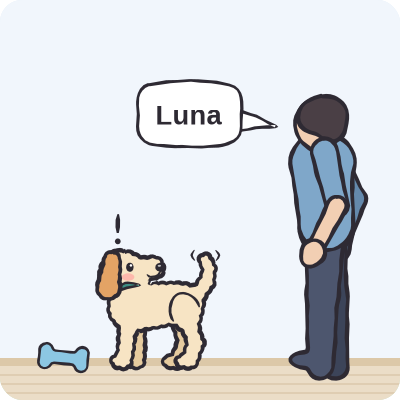
You say her name once, and your dog turns to you straight away — within about two seconds. That’s a dog who knows her name. Dogs don’t so much understand “this is me” as learn “after this sound, turning toward that person pays off.” So make something good happen after her name every time, and never use it for things she dislikes. That’s how a name is learned.
Assessment: where is your dog now?
If you suspect she doesn’t really know her name, a trainer might check these three things.
In a quiet room at home, from 3–6 ft (1–2 m) away, say her name once. Does she turn within about two seconds?
→If not, begin with “The first step” below. If she doesn’t react to her name at all, start by saying it and giving a treat several times in a row, to give the sound some value.
Does she react to the treat bag rustling or the doorbell?
→If she doesn’t react to other sounds either, it may not be the name — her hearing may be going. See your vet.
When you say her name, does she back away, freeze or flatten her ears?
→If so, her name may have been used to scold her or before things she dislikes. Sometimes it’s worth rebuilding with a new name (see “Can I change her name?” below).
The cue
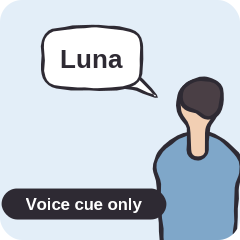
Her name is a voice-only cue, with no hand signal. You need it most when she isn’t looking at your hands — when she’s sniffing, or facing away. Her name means “look at me.” You don’t need to put her name in front of every cue like “sit” or “down.”
How to signal
- Voice
Say her name once, in a bright voice. Not “Luna, Luna, Luna.” When she turns, “Yes.”
- Hand
Keep your hands still before you call. Keep the treat out of sight as much as you can, and bring it out after she turns.
- Leash
Indoors, no leash. Outside, hold the leash long and loose. Never pull on it to make her turn.
- Body
About 3–6 ft (1–2 m) from her. At first call from her side; once that’s easy, from behind. Don’t loom over her face.
Teaching steps
- 1
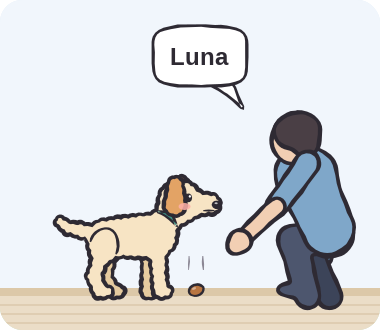
After her name, something good At home, quiet
Give her name some value
Only if she doesn’t react to her name at all. Whether or not she’s looking at you, say “Luna” → treat straight away, about 10 times in a row.
A good sign to move onWhen you say her name, her ears or face twitch
- 2
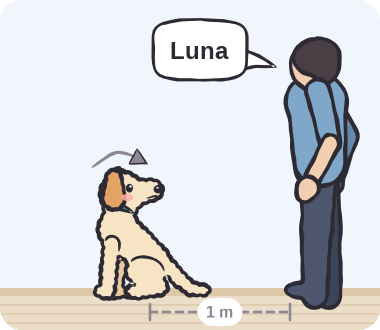
Once, while she isn’t busy At home, quiet
Once, while she’s doing nothing
When your dog is about 3 ft (1 m) away and not busy with anything, say “Luna” once. When her face moves toward you, “Yes” → treat.
A good sign to move onShe turns within about two seconds, 9 out of 10 times
- 3
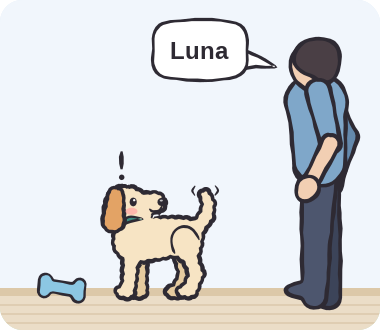
A little harder each time At home, small distractions
While she’s a little busy, then outside
Call while she’s sniffing a toy → in front of your house on leash → on your usual walk route, making it harder bit by bit. The detailed stages and homework are on The Name Game.
A good sign to move onShe turns 8 out of 10 times in that place (our rule of thumb)
When to reward
Just right
The moment your dog’s face starts to move toward you, “Yes.” Then the treat.
Too late
Saying it once she has come over, or a while after your eyes meet. The turn of her head never got the credit.
How do dogs learn their names?
To a dog, her name is the sound that means “look this way.” She hears it, turns, and something good happens. Repeat that enough times and the sound alone makes her turn. The American Kennel Club (AKC) puts it the same way: a dog’s name is all about associations — what follows the sound.
It works the other way too. If her name is followed by a telling-off or a nail trim, it becomes a warning of something unpleasant, and she stops turning when you call. Getting everyone in the family to use her name the same way matters as much as the practice itself.
How long does it take a dog to learn its name?
There’s no fixed number of days. The AKC says many dogs begin recognizing their name within a few days of consistent training, while reliable responses in distracting places often take longer.
Rather than counting days, check what she can do. If, in a quiet room at home, she turns to one call of her name 9 out of 10 times, she knows it indoors — that’s the benchmark certified applied animal behaviorist Dr. Megan Maxwell gives on the American Veterinary Society of Animal Behavior (AVSAB) blog. From there, widen it one step at a time: outside the house, on walks, around other dogs.
Is it OK to use nicknames?
The AKC says many dogs learn nicknames and extra names when those names are consistently paired with good things. But while she’s still learning, a mix of names makes it harder to know which sound means “turn around.” Our advice: until she reliably turns to her name, have everyone in the family use one version of it — “Luna,” not “Luna” one day and “Lulu” the next.
Can I change her name? (rescue dogs and new arrivals)
Yes. Dogs of any age can learn a new name (AKC), and an adult dog you’ve just adopted can start from the same place as a puppy (Dr. Maxwell). Teach it the same way: something good after the new name, every time. Once you’ve chosen it, everyone in the family uses only that name.
The AKC explains that if the old name seems to carry good associations, a new name with a similar sound or starting letter may make the switch easier — and if the old name carries bad feelings, it suggests going for something that sounds completely different.
When should I start?
There’s no set age. In the first weeks after she arrives, start practicing her name indoors (Dr. Maxwell). Puppy or newly adopted adult, the starting point is the same. Her name sits at the very front of the recall (“come”) and of many other skills.
House rules for the whole family
- Don’t use her name to scold her
- Don’t call her name and then do something she dislikes (nail trims, baths)
- If she doesn’t turn, don’t keep repeating her name
- Every time she turns to her name, praise her. Cut back treats gradually, only once she turns reliably
A good sign to move on
- Quiet room at home: when one call of her name gets a turn within about two seconds, 9 out of 10 times, move on to calling while she’s a little busy (the two seconds is our rule of thumb)
- After that (a little busy → in front of your house → a quiet street → where other dogs are in sight): when she turns 8 out of 10 times in that place, move to the next one (our rule of thumb)
- Once she turns to her name indoors, you can start “come” indoors (The Recall Game)
If it isn’t working
She doesn’t turn at all when I say her name
First check whether she reacts to other sounds (the treat bag, the doorbell). If she does, her name just doesn’t mean anything good yet. Pair “name → treat” about 10 times whether or not she’s looking, then move on to calling once while she’s doing nothing. If she doesn’t react to other sounds either, see your vet.
She runs away or freezes when I say her name
Check as a family whether her name has been used to scold her. For a while, use a new name and teach it from the beginning.
She turns at home but not outside
Outside, use better treats than at home, and start again somewhere quiet, like right outside your door.
She only turns if she can see the treat
Call with the treat out of sight, and bring it out after she turns. Showing her food to get her attention is only for when she doesn’t move at all.
How long do I have to use treats?
Once she reliably turns to her name, cut back gradually. Praise stays every time. How to cut back is on The Name Game.
Prescription: a suggested order
The whole plan — five steps, homework until the next visit, and what a trainer checks next time — is on this practice page.
In the moment: do / don’t
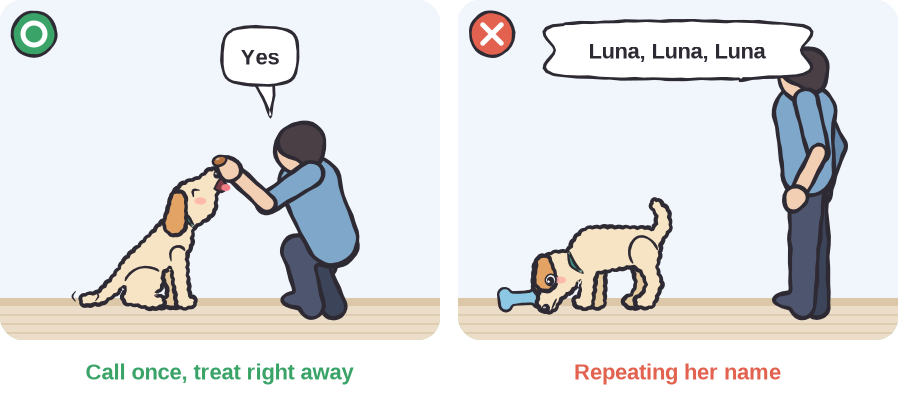
Do
- Say her name once, brightly
- The moment her face moves toward you: “Yes” → treat
- While she’s learning, the whole family uses one version of her name
- Start in a quiet room, when she isn’t busy with anything
Don’t
- Use her name to scold her
- Repeat her name over and over when she doesn’t turn
- Call her name and then do something she dislikes (nail trims, baths)
- Always show her the treat to make her turn
When to see a professional
- She doesn’t react to sounds other than her name either (the doorbell, the treat bag). Her hearing may be going. See your vet
- An older dog has gradually stopped reacting to her name. Hearing can fade with age. Ask your vet to check her ears
The skills behind this command
Sources
- American Kennel Club — How to Teach Your Dog Their Name
- American Kennel Club — Can You Rename a Dog? Here’s How, and Why You’d Consider It
- Maxwell, M. E. (2017). Teaching Name Recognition (AVSAB blog)
- Edmonton Humane Society — Name Recognition (Animal Behaviour Guide, PDF)
- Animal Welfare Society — The Name Game
- Battersea — How to teach a dog its name
- AVSAB — Position Statement on Humane Dog Training (2021)
- Merck Veterinary Manual — Deafness in Dogs
- Whole Dog Journal — Beware of the Poisoned Dog Cue
- Fenzi Dog Sports Academy — Poisoned Cues