 BAUDOG The dictionary of dog–human communication
Contents
What this skill is
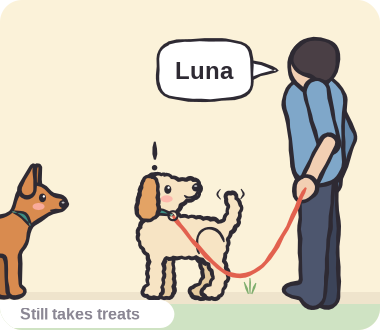
Focus doesn’t mean your dog stares at you all walk. She’s allowed to sniff, look around and enjoy the world. It means that when you say her name — or when she isn’t sure what to do — she turns back to you. A head turned your way is enough; she doesn’t need to hold eye contact. Focus is the doorway to every other cue: “sit,” “come” and “leave it” can’t land until she’s tuned in to you. And it isn’t something you can demand. It grows from many small moments in which looking at you paid off, until checking in with you becomes her own choice.
How your dog feels
Outside, the world is full of smells and moving things, and plenty of them are more interesting than you. When your dog doesn’t turn around, she isn’t ignoring you on purpose — the world is simply winning right now.
Dogs pay attention to whatever pays off. Every time looking at you leads to a treat, a game or the chance to go sniff again, you become a little more worth checking on. If looking at you leads to nothing — or to a scolding — the world wins more often. The job is to raise your value a little every day.
Assessment: where is your dog now?
A visiting trainer might check these at home before setting any homework. They tell you which stage to begin at.
In a quiet room at home, say her name once. Does she turn toward you within 2 seconds?
×Start at Stage 1, with The Name Game.
At home, when she’s absorbed in a toy or a smell, does her name still turn her head?
×Start at Stage 2.
On a 5-minute walk, how many times does she look up at you without being asked?
×Fewer than 5: work through Stages 3 and 4 — outside your front door, then quiet streets — adding Check-Ins. Five or more: move on to Stage 5.
Problems when this skill is weak
- Problems Dog Pulling on the Leash? Why Dogs Pull and How to Stop It — Plus the Right Harness and Leash Read →
- Problems Dog Won’t Come When Called? Why It Happens and How to Fix It Read →
- Problems Dog Barking at Other Dogs on Walks: Why It Happens and How to Help Read →
- Problems Dog Barks at Strangers on Walks: Why It Happens and How to Help Without Scaring Her Read →
- Problems Dog Eating Everything on Walks? How to Stop Scavenging, Safely Read →
- Problems Dog Eating Poop? Why Dogs Do It, How to Stop It, and When to See a Vet Read →
- Problems Dog Won’t Walk on a Leash? 5 Reasons Dogs Stop, Sit or Plant Their Feet — and What to Do Read →
- Problems Dog Not Listening? 5 Real Reasons (It’s Not Stubbornness) and How to Retrain Read →
- Problems Dog Escaping? How to Stop Door Dashing — and What to Do If Your Dog Gets Out Read →
Prescription: a suggested order
A suggested order. Start with The Name Game; once she turns to her name at home, you can work on the others side by side. If you came here from a specific problem, you can bring in the practice closest to it early, alongside The Name Game — Recall Games if she won’t come, for example.
- ExerciseThe Name GameDoable at home (Steps 1–2 at home)Turns her name into a signal that turning to you pays off. Every other practice builds on it.Read →
- ExerciseCheck-Ins: Teach Your Dog to Look at You Without Being AskedDoable at home (Step 1 at home)Rewards the moments she looks at you without being asked, so focus becomes her idea, not just your cue.Read →
- ExerciseHand Target: How to Teach Your Dog “Touch” — and Use It for Recall and Passing Other DogsDoable at home (Steps 1–3 at home)Gives her a clear job — touch your hand — that you can use to steer her away from distractions.Read →
- ExerciseEmergency U-Turn: Teach Your Dog to Turn and Walk Away HappilyStart at home, finish outside (Steps 1–2 at home)A cheerful way to change direction together when something ahead is too exciting.Read →
- ExerciseLoose Leash Walking: Stop When It’s Tight, Reward at Your Side (Starting Indoors)Start at home, finish outside (Steps 1–2 at home)Focus while moving: staying connected to you on walks.Read →
- ExerciseLook at That (LAT): The Game That Helps Reactive Dogs Stay Calm Around Dogs and PeopleStart at home, finish outside (Step 1 at home)Lets her look at something exciting or worrying, then turn back to you.Read →
- ExerciseRecall GamesDoable at home (Steps 1–3 at home)The full test of focus: leaving something interesting and running all the way back to you.Read →
How it grows
-
Level 1At home, quiet
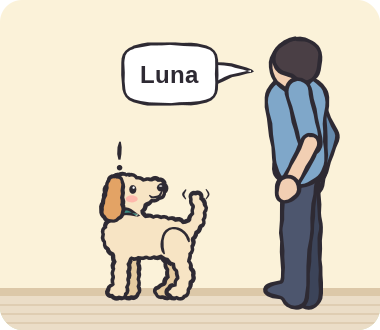
At home, in a quiet room: say her name once and reward the moment she turns to you. Reward the times she looks at you on her own, too. This is where the first homework starts.
A good sign to move on She turns to her name within 2 seconds, 9 out of 10 times
-
Level 2At home, small distractions
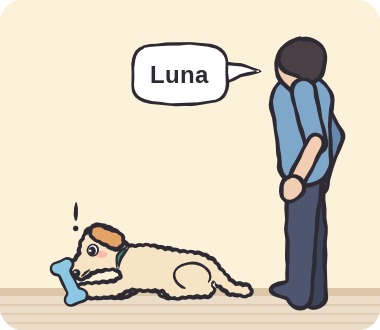
Still at home, but with small distractions: while she sniffs a toy or looks out of the window.
A good sign to move on She turns to her name 8 out of 10 times while a little absorbed
-
Level 3Yard, doorstep, outside the house
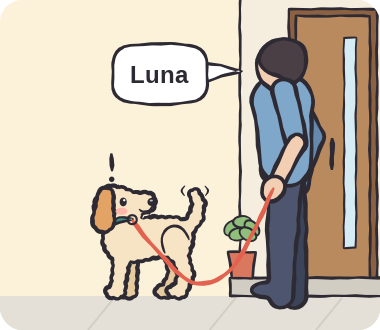
On leash in the yard, on the doorstep or right outside your home. Use a better treat than indoors.
A good sign to move on She turns to her name 8 out of 10 times outside your front door
-
Level 4Quiet street
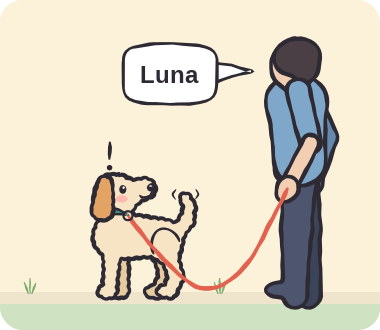
Outside somewhere calm — a quiet street or an empty park. Call her name in the pauses between sniffs, and reward every look she offers you on her own.
A good sign to move on On a 5-minute walk she checks in at least 5 times unasked, and turns to her name 8 out of 10 times
-
Level 5Around distractions
Around distractions: another dog or a person in view, food on the ground. Start far away and close the distance only as she succeeds.
A good sign to move on With another dog about 30 ft (10 m) away, she turns to her name 8 out of 10 times
Principles
- Catch the moments she looks at you on her own and reward them. A dog who is rewarded for checking in starts checking in without being called.
- Say her name once. If she doesn’t turn, this place is still too hard — add distance or move somewhere quieter, rather than calling louder.
- If she struggles, go back one stage — our rule of thumb: two misses in a row. Don’t scold her for it.
- Raise only one thing at a time: distance, place or distraction.
- Match the reward to the place. Outside, use something better than you use at home.
- Leave plenty of time for sniffing on every walk. It isn’t something she has to earn with focus — sniffing matters to dogs for its own sake, and Dogs Trust advises giving dogs plenty of opportunity and time to sniff on walks. There’s a small study on scent games, too: of 20 pet dogs, the 10 who played a nosework game every day for two weeks responded more optimistically in a judgment test afterwards, while the 10 who practiced heelwork didn’t change. It tested nosework games, not sniffing on walks.
- Keep sessions short — a few minutes; 3 to 5 is a good rule of thumb — and stop while she still wants more.
- Never use her name to scold her, and never punish her for being slow to turn. Her name should only ever predict good things — reward-based training is what the American Veterinary Society of Animal Behavior recommends for all dogs.