 BAUDOG The dictionary of dog–human communication
Contents
When to use this exercise
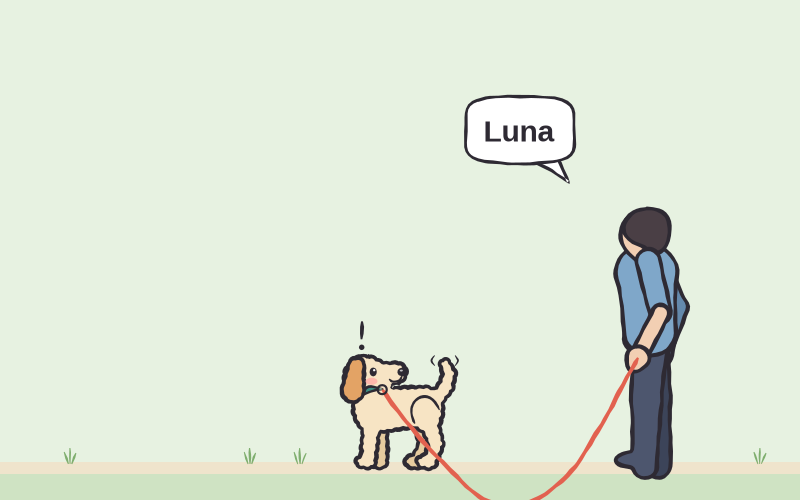
Use this when your dog is absorbed in a smell, a toy or the view and you need her attention back. Start in a quiet room at home, then outside your front door on leash, then quiet streets, then places where other dogs are in sight. It is the groundwork for recall and for calling her away from things on the ground.
GoalYou say (if her name is Luna) “Luna” once, and within 2 seconds she turns toward you.
Assessment: what a trainer might check on the first visit
A visiting trainer might check something like this before starting — it tells you where to begin. Stand 1–2 m (3–6 ft) away and say her name once, 10 times over a day.
At home, while she isn’t busy, she turns within 2 seconds at least 9 times out of 10
→Start at step 2.
At home she turns even when she’s sniffing a toy, 8 out of 10 times
→Start at step 3.
Outside your front door, on leash, she turns 8 out of 10 times
→Start at step 4.
On a quiet street she turns 8 out of 10 times
→Start at step 5.
She ducks, freezes or walks away when she hears her name
→Her name may have become linked with scolding. See “She ducks, freezes…” below before you start.
None of these yet — or she doesn’t turn at all
→Start at step 1. If she doesn’t turn even there, see “She doesn’t turn at all” below.
What you need
- Small, soft treats she can swallow in a second
- A marker word she already knows — “Yes” means a treat is coming
How to signal
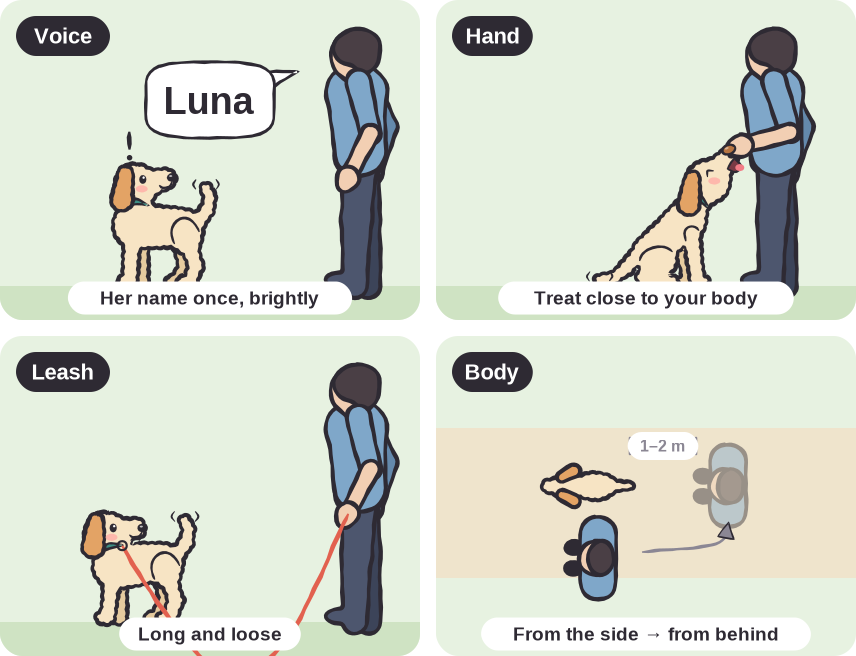
- Voice
Say “Luna” once, brightly. Don’t chain it — “Luna, Luna, LUNA” teaches her to wait for the third one. Everyone in the family plays the same way.
- Hand
Keep your hands still before you call — no waving, no showing food. After she turns, deliver the treat at your knee or near your face, so turning to you is what pays.
- Leash
Indoors, no leash needed. Outside, hold it long and loose, and never use it to turn her head.
- Body
Stand 1–2 m (3–6 ft) away. Start beside her; once that’s easy, call from behind her.
Today’s session
With the trainer, you work on step 1.
Step 1Call when she’s close and not busy(At home, quiet)
The trainer shows you once, then hands over. Your dog is about 3 ft (1 m) away, not busy: you say her name once, and the moment her head turns, “Yes” → treat. Ten repetitions. The trainer watches for the two most common slips — moving your hand before you call, and calling twice — and fixes them on the spot. It takes about five minutes.
Homework until the next visit
- How often
- Twice a day
- How long
- 3–5 minutes each
- How much
- 5–10 calls per session
A good sign she’s readyEven when she’s a little distracted, she turns to one call 8 out of 10 times
What the trainer checks next visit
In front of the trainer, call her name once while she’s sniffing a toy — 10 times.
If she can8 out of 10 → next stage: step 3 (outside your front door or in the yard, on leash) becomes the new homework.
If not yetGo back to step 1 for another week, and look together at the treats and the timing of your call.
Next stages: steps
- 1
At home, quiet
Call when she’s close and not busy
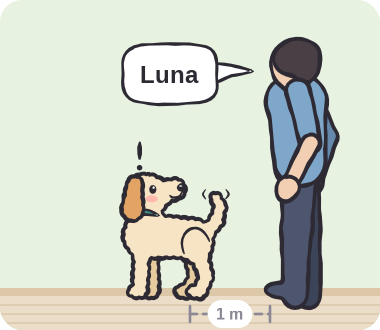
Your dog is about 3 ft (1 m) away, doing nothing much. Say her name once. Turn → “Yes” → treat.
A good sign to move onShe turns within 2 seconds, 9 out of 10 times
- 2
At home, small distractions
Call when she’s a little distracted
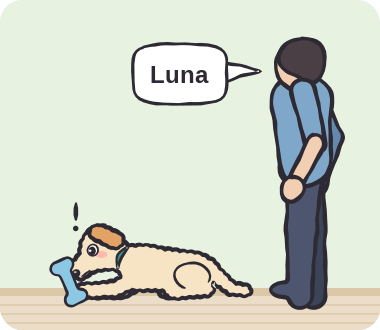
She’s sniffing a toy or looking out the window. Say her name once, and mark the turn.
A good sign to move onShe turns 8 out of 10 times
- 3
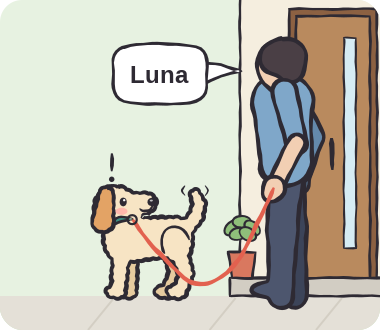
Yard, doorstep, outside the house
Outside your front door
On leash, step out into the yard or onto the sidewalk in front of your home. When she finishes a sniff, say her name once. Use a better treat than indoors.
A good sign to move onShe turns 8 out of 10 times
- 4
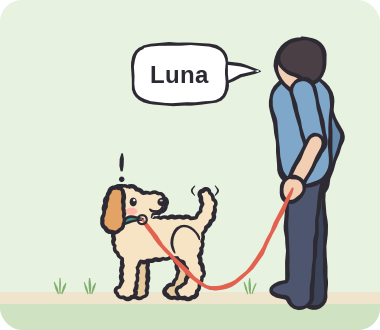
Quiet street
On a quiet street
On a walk, wait until she finishes a sniff, then say her name once.
A good sign to move onShe turns 8 out of 10 times
- 5
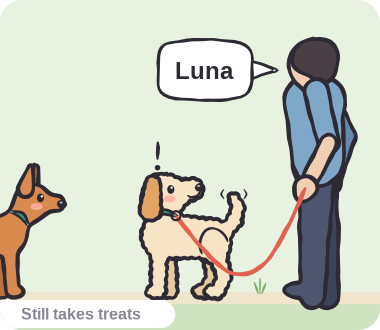
Around distractions
With a distraction in view
Another dog is in view. Start at a distance where your dog notices the dog but can still take treats and answer her name — there’s no set number; 15 m (50 ft) is one example of a starting point. Say her name when she isn’t looking at you.
A good sign to move onShe turns 8 out of 10 times. If she stops taking treats or can’t look away from the other dog, add a lot more distance — doubling it is a simple rule of thumb
Timing
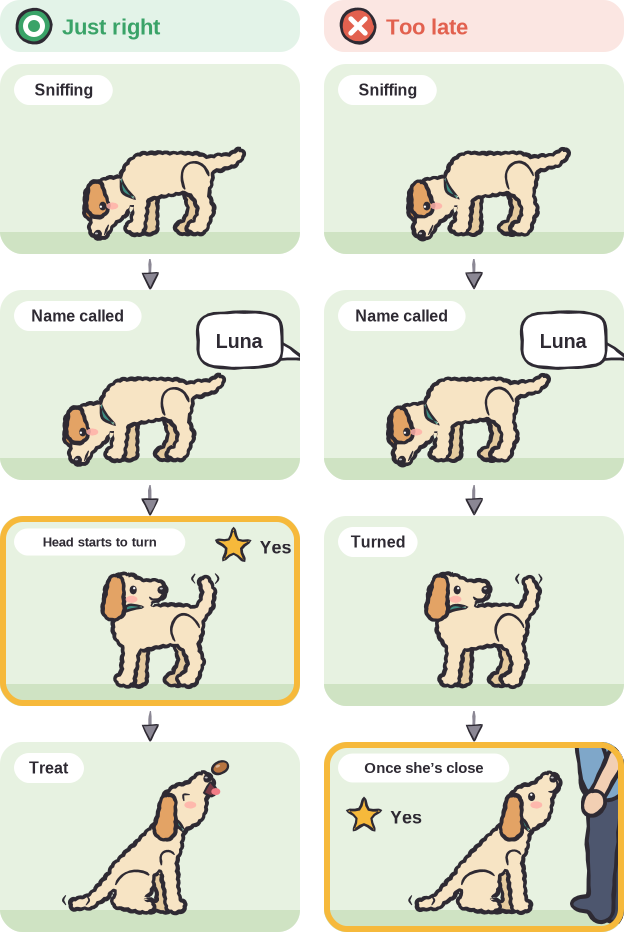
Just right
“Yes” the instant her head starts to swing toward you — then the treat
Too late
“Yes” once she has walked over, sat down, or been looking at you for a while — the turn itself goes unrewarded
How much and how often
5–10 calls per session, about two short sessions a day, and — once you’re working outside — a few more sprinkled through walks. Spacing sessions out doesn’t waste them: in one small study of 18 laboratory beagles learning a clicker-shaping task, dogs trained once a week needed fewer sessions to learn it than dogs trained five times a week (though they took more calendar days).
If it isn’t working
She doesn’t turn at all, even at home
Make it easier than easy. Say her name once and give a treat whether she looks or not — 10 times in a row, in a quiet room. After a few short sessions, you should start to see her ears prick at the sound. Then go back to step 1.
She turns at home but never outside
Outside, the world is worth more, so your reward has to be worth more too: try chicken or cheese instead of kibble. Restart somewhere quieter, like your front step, and add distance from whatever is grabbing her attention.
She ducks, freezes or walks away when she hears her name
Her name may have become linked with scolding or unpleasant things. Choose a fresh version — “Lulu,” for example — and teach it from step 1, pairing it only with good things. Keep that new name out of every telling-off.
She only turns if she can see the treat
Keep treats out of sight in a pouch or pocket. Call, wait for the turn, then bring the treat out. Showing food first is a bribe; delivering it after is a reward.
Do I have to use treats forever?
No. Once she passes a step at 8 out of 10, start rewarding most turns with food and the rest with praise or a chance to go sniff again. Keep food for the hardest places and for every new step.
What if she can’t hear well?
If she has stopped reacting to her name and to other everyday sounds, see your vet — gradual hearing loss in older dogs can look like ignoring you. For a dog with hearing loss, use a touch on the same spot or a flash of light in place of her name, and reward the turn just the same.
Avoid
- Using her name to scold her (“Luna, no!”)
- Repeating her name when she doesn’t turn — make the step easier instead
- Calling her name right before something she dislikes, like a bath or a nail trim
- Asking for a sit before the treat — the reward is for the turn
- Putting her name in front of every cue. Use it to get her attention, then give the cue
A good sign to move on
- Step 1 (at home, quiet): she turns within 2 seconds, 9 out of 10 times → move to step 2
- Steps 2–5 (a little distracted → outside your door → quiet street → distraction in view): she turns 8 out of 10 times in that place → move to the next step (our rule of thumb)
- If she struggles, go back one step — our rule of thumb is two misses in a row. No scolding: the step was simply too hard
- Once she passes the indoor steps (steps 1–2), you can start Recall Games indoors — and keep playing the Name Game as you move outside
Sources
- AVSAB — Position Statement on Humane Dog Training (2021)
- Meyer & Ladewig (2008). The relationship between number of training sessions per week and learning in dogs. Applied Animal Behaviour Science 111:311–320
- Merck Veterinary Manual — Deafness in Dogs
- American Kennel Club — How to Train a Deaf Dog
- AVSAB — Teaching Name Recognition (Maxwell, 2017)
- East Bay SPCA — Look At That: A Reactivity Exercise
- Best Friends Animal Society — “Look at That” Training for Reactive Dogs