 BAUDOG The dictionary of dog–human communication
Contents
- The finished behavior
- Assessment: where is your dog now?
- The cue
- How to signal
- Teaching steps
- When to reward
- If a trainer came to your home: the first session and the first homework
- Choosing a release word
- “Wait” vs. “Stay”: what’s the difference?
- Waiting at the front door — even without a cue
- Does my dog need to wait before eating?
- Stay outside: keep the leash in your hand
- Stays fall apart when you’re not watching
- A good sign to move on
- If it isn’t working
- Prescription: a suggested order
- In the moment: do / don’t
- When to see a professional
- Sources
The finished behavior
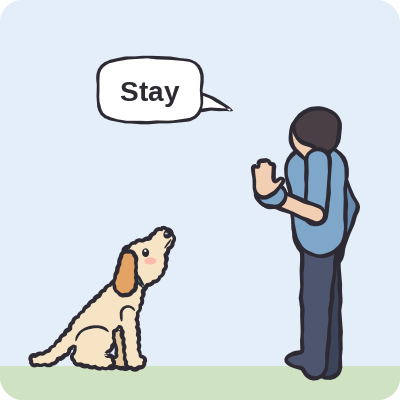
On “Stay,” she holds that position in that spot until you come back and say “Free.” Opening the front door, clipping the leash on before she jumps out of the car, when visitors arrive — a dog who can stay is protected from dangerous bolting.
Assessment: where is your dog now?
A visiting trainer might check something like this at home before starting.
Has the family agreed on a release word (“Free,” for example)?
→If not, teach the release word first (step 1). Without a clear end, a dog learns she can get up whenever she likes.
Does she sit (or lie down) on one cue?
→If not, teach sit or down first. For longer stays, some dogs find down more comfortable.
Right in front of you, how many seconds can she hold still?
→Start below that number. Never ask for longer than she can do.
Does she get up the moment you take a step?
→Leave distance for later; build time right in front of her first.
If you ask her to wait before her meal, does she growl, hover over the bowl, or freeze?
→If so, stop asking for a stay before meals and talk to a behavior professional (see “When to see a vet or behavior professional” below).
The cue
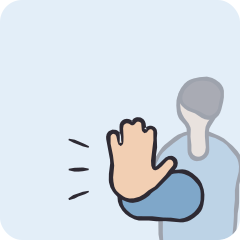
The hand signal is a flat palm facing her at chest height — a “stop” hand. The release word “Free” gets no hand signal: lowering your hand could look like the release and bring her to her feet. Choose your release word before you start teaching stay.
How to signal
- Voice
Say “Stay” once. Don’t keep repeating it while she waits. Always finish with “Free,” in a bright voice.
- Hand
As you say “Stay,” hold a flat palm toward her at chest height. Treats during the stay are brought to her mouth by you — don’t call her to you for them.
- Leash
No leash needed indoors. Outside, the leash always stays in your hand, and you only step away as far as it allows while slack.
- Body
At first, stand still in front of her. When you add distance, take one step back and come straight back. Treats and the release both happen after you’ve returned to her.
Teaching steps
- 1
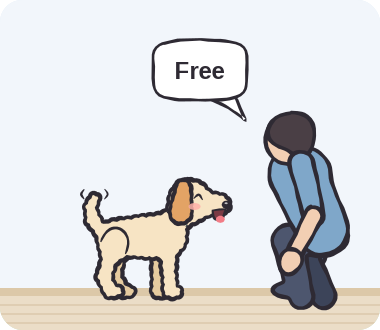
Start with the word that ends it At home, quiet
Teach the release word
When your dog sits, wait a second, bring a treat to her mouth, then say “Free” right away and clap or take a few steps back to get her moving.
A good sign to move onWith repetition, she starts to get up on “Free”
- 2
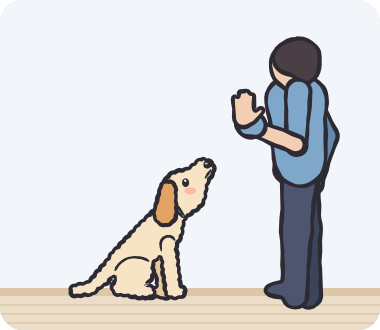
Right in front of her, short at first At home, quiet
Build time, right in front of her
When she sits: “Stay” + flat palm. Two seconds → treat to her mouth → “Free.” Add a few seconds at a time.
A good sign to move on10 seconds right in front of you, 8 out of 10 times (our rule of thumb)
- 3
A different length each time At home, quiet
Mix up the length
Three seconds, eight, two, five… a different length every time, so your dog can’t predict when it will end.
A good sign to move onRight in front of you, mixed lengths, 8 out of 10 times
- 4
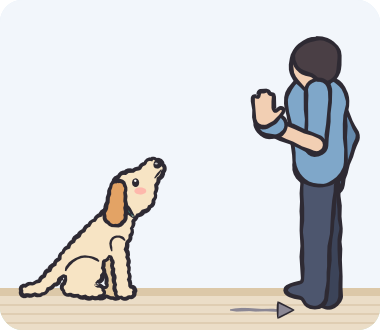
One step away, then straight back At home, small distractions
Add distance (and shorten the time again)
“Stay” → one step back → straight back to her for a treat → “Free.” Then two steps, three. Change direction, too: to the side, diagonally, backward. If she follows when you step back, start with a slight lean to the side, then one step sideways (see the troubleshooting below).
A good sign to move onYou step about 10 ft (3 m) away and come straight back, 8 out of 10 times
- 5
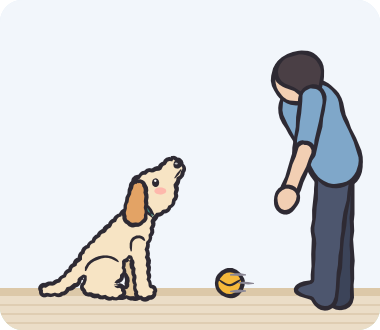
Small temptations first At home, small distractions
Add distractions (and shorten time and distance again)
Clap in front of her, crouch down, roll a ball slowly past, drop a treat on the floor. If she stays put, “Yes.”
A good sign to move onShe stays put even when you drop a treat, 8 out of 10 times
- 6
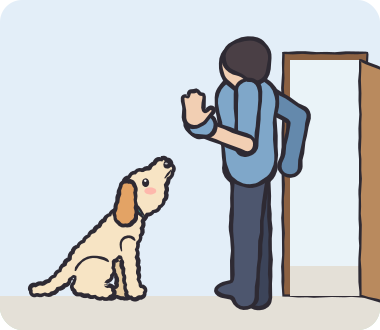
Open the door a little at a time Yard, doorstep, outside the house
At the front door
Leash on at the front door: “Stay” → hand on the doorknob → open a crack → close → back to her for a treat → “Free.” Open it a little wider each time.
A good sign to move onShe waits with the door wide open, 8 out of 10 times
- 7
Outside, keep hold of the leash Around distractions
With visitors and distractions on walks
The doorbell, visitors, people passing on a walk. Start with short stays of a few seconds. Outside, never let go of the leash.
A good sign to move onFive seconds in that situation, 8 out of 10 times
When to reward
Just right
“Yes” → treat to her mouth while she’s still staying. Then, at the very end, “Free.” Reward her before she moves.
Too late
Praising her once she’s up — or only producing a treat after “Free.” Then moving (the end) pays better than staying.
If a trainer came to your home: the first session and the first homework
Here is one example of how a visit from an in-home dog trainer might go, put together by BAUDOG.
- Today: the family agrees on a release word, and you teach it (step 1). Next, ten reps of a two-second stay right in front of her → treat to her mouth → “Free.” The trainer demonstrates mixing up the seconds, then hands over to you.
- Homework (for example): twice a day, 3–5 minutes each, no more than ten reps per session. Two to ten seconds right in front of her, in a random order. Raise only one of time, distance or distractions at a time. Always finish with “Free.”
- What gets checked next visit: ten reps of a 10-second stay right in front of you. Our rule of thumb is 8 out of 10; then adding distance becomes the next homework. If she isn’t there yet, halve the seconds and give it another week.
Choosing a release word
A stay needs a clear beginning and a clear end. The American Kennel Club (AKC) explains that without a release word, a dog learns she can move whenever she likes. The word itself doesn’t matter: Cornell University’s College of Veterinary Medicine lists “okay,” “break” and “free” as three common ones. BAUDOG uses “Free.”
The AKC recommends using your release word only to mean “you can move now,” and warns that “okay” comes up so often in everyday speech that it’s easy to release your dog by accident. If “okay” slips out of your mouth all day, a less common word like “Free” or “Break” is one option (our suggestion). Everyone in the family should use the same word.
When you say the release word, get her moving: clap, or take a few steps back (the AKC, Cornell and Dogs Trust all describe this). The AKC says that once a dog understands the release word, she understands stay better, too.
“Wait” vs. “Stay”: what’s the difference?
An article from Cornell University’s College of Veterinary Medicine describes trainers who teach the two separately. “Wait” means pause briefly — at a door, for example — and another cue or the release follows soon; the position doesn’t matter. “Stay” means hold this position, in this spot, until I come back to you.
Whether you use two words is up to you. With one word, make “Stay” mean “until I come back,” and for a brief pause at doors, use the front-door method below.
Waiting at the front door — even without a cue
Dogs Trust says you don’t have to say “Sit” or “Stay” at the door at all. With her leash on, stand at the closed door and praise her when she’s calm (four paws on the floor, leash slack). Put your hand on the handle, open the door a little, and praise her if she stays calm. If she tries to rush out, quietly close the door, wait for her to settle, and try again. Getting to go out is the best reward of all.
If the front door is too exciting, practice at a less exciting door first (an inside door, a cupboard), then come back to the front door.
Does my dog need to wait before eating?
You don’t need to make her wait for food to show her who’s boss. The American Veterinary Society of Animal Behavior (AVSAB) says ideas like “the leader eats first” aren’t supported even by research on wolves.
That said, mealtime is a great daily training opportunity. Stand holding the bowl; when she sits, start lowering it; if she stands, raise it again. Once it’s on the floor, “Free” means she can eat (the Say Please by Sitting practice). The wait can be short.
A dog who growls, hovers over the bowl or freezes when asked to wait for her food is guarding it. Don’t scold her or take the bowl away. Stop asking for a pre-meal stay and talk to a professional.
Stay outside: keep the leash in your hand
Even once her stay is solid, keep the leash in your hand outdoors. Often the rules expect it anyway: New York City’s Health Code, for example, requires dogs in public places to be restrained by a leash no longer than six feet, and the UK Highway Code advises keeping a dog on a short lead on the pavement or road. Outside, stay is for waiting beside you, leash in hand, at the curb or at a crossing. Check the rules where you live.
Stays fall apart when you’re not watching
In one small study, 16 dogs were told to lie down by their owners and then watched for a minute. They stayed down best when the owner was watching them, and broke more often when the owner read a book, watched TV, turned their back or left the room. Dogs seem to read eye contact and the direction of our face and body to tell whether we’re paying attention. Looking at your phone may work the same way as reading or watching TV (phones weren’t tested).
Early on, keep your eyes on her. Turning your back and going out of sight are the hardest parts of stay. Save them for last.
A good sign to move on
- Once she can stay 10 seconds right in front of you, 8 out of 10 times, move on to adding distance (our rule of thumb — the same as the Building a Stay practice)
- Raise only one of time, distance or distractions at a time. When you raise one, ease off the other two
- In a new place, shorten both time and distance again (to a dog, a stay somewhere new feels like a different stay)
- If she struggles, go back one step (our rule of thumb: she breaks twice in a row)
If it isn’t working
She follows me when I step away
When you add distance, shorten the time again. Take one step back and come straight back (the RSPCA also suggests starting with a single step). If she still follows, the backward step itself may look like “come with me” (AKC). Start with a slight lean to the side, then one step sideways (the Dogs Trust method). Treats and the release always happen after you’re back with her.
She gets up before I say “Free”
Don’t scold. Calmly put her back where she was and start again with a shorter stay. Say “Free” just before she’s likely to move, so more reps end in success. Breaking usually means the stay was too long, she’s tired, or your movement set her off.
How long should a dog be able to stay?
There’s no set number. As a reference point, in the AKC’s Canine Good Citizen test, the dog is left in a sit or down on a stay while the handler walks 20 feet (about 6 m) away and comes back; the dog has to remain in place. At home, the goal is however long the real situation takes: until the front door is opened and closed, or until the leash is clipped on.
I keep saying “Stay, stay, stay”
Say “Stay” once. Dogs Trust also recommends not repeating cues, so your dog learns to respond the first time. To tell her she’s doing well, use a treat to her mouth, not more words.
She won’t stay outside
In a new place, shorten time and distance again. Dogs Trust recommends choosing places that get harder gradually: your yard → an empty park → somewhere with people or dogs in the distance → a bit closer. Use better treats outside than at home.
Can adult or senior dogs learn to stay?
Yes, the same way. For senior dogs or dogs with sore joints, holding a sit can be uncomfortable — ask for a down on a mat instead.
Prescription: a suggested order
BAUDOG’s recommended order. The steps above get stay started; these two practices take it from there.
- ExerciseBuilding a Stay: Duration, Distance, Distraction — One at a Time, Up to the Front Door and GuestsDoable at home (Steps 1–3 at home)The full method for building stay — time, distance and distractions, one at a time — all the way to the front door, visitors and walks.Read →
- ExerciseSay Please by SittingDoable at home (Steps 1–3 at home)Before meals, walks and doors, sitting and waiting on her own gets her what she wants. She learns to wait even without a cue.Read →
In the moment: do / don’t
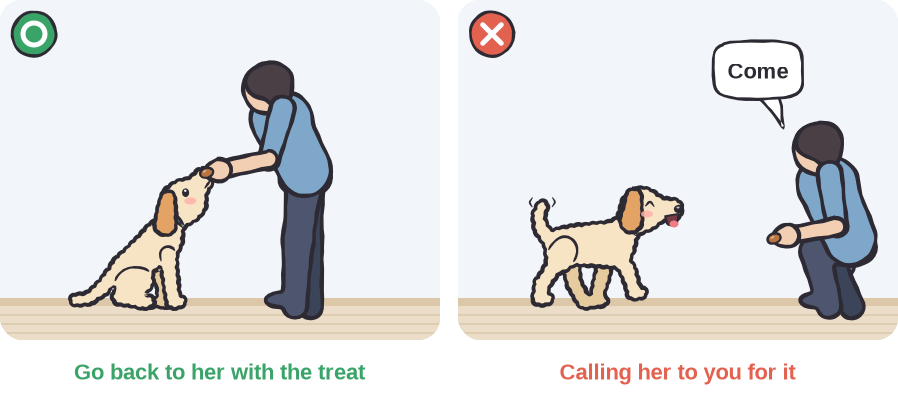
Do
- Choose the release word “Free” before you teach stay
- Bring treats to her mouth during the stay
- Treats and “Free” only after you’re back with her
- Raise only one of time, distance or distractions at a time
Don’t
- Letting the stay fizzle out without “Free”
- Building time and distance at once
- Scolding her for moving, or barking “STAY!” again
- Asking for a stay outside and letting go of the leash
When to see a professional
- Asked to wait before meals, she growls, hovers over the bowl, freezes or tries to bite. This is food guarding. Don’t scold; talk to a behavior professional (a veterinary behaviorist or certified trainer)
- While staying, she keeps yawning, licking her lips, tucking her tail, pinning her ears back or looking away. These are signs of anxiety or stress. Make the exercise easier (shorter time, less distance); if it continues, talk to a professional
The skills behind this command
 Core skill Impulse Control Waiting for “Free” even when she wants to move or go and get something. Stay builds this skill more directly than any other cue.
- ExerciseBuilding a Stay: Duration, Distance, Distraction — One at a Time, Up to the Front Door and GuestsDoable at home (Steps 1–3 at home)Read →
- ExerciseSay Please by SittingDoable at home (Steps 1–3 at home)Read →
Sources
- American Kennel Club — How to Teach Your Dog to Stay
- American Kennel Club — Teaching Your Dog a Release Word
- American Kennel Club — The Three Ds of Dog Training: Duration, Distance, and Distraction
- Dogs Trust — How to train your dog to stay
- Dogs Trust — Teach your dog to be patient at the door
- RSPCA — How to train a dog to stay
- Cornell University College of Veterinary Medicine (Riney Canine Health Center) — Training ‘stay’ vs. ‘wait’
- AVSAB — Position Statement on the Use of Dominance Theory in Behavior Modification of Animals
- AVSAB — Position Statement on Humane Dog Training (2021)
- ASPCA — Food Guarding
- RSPCA — Understanding your dog’s body language
- AKC Canine Good Citizen Evaluator Guide (PDF)
- Schwab & Huber (2006). Obey or not obey? Dogs (Canis familiaris) behave differently in response to attentional states of their owners. Journal of Comparative Psychology 120(3):169–175
- New York City Health Code Article 161, §161.05
- The Highway Code (UK) — Rules about animals, Rule 56