 BAUDOG The dictionary of dog–human communication
Contents
When to use this exercise
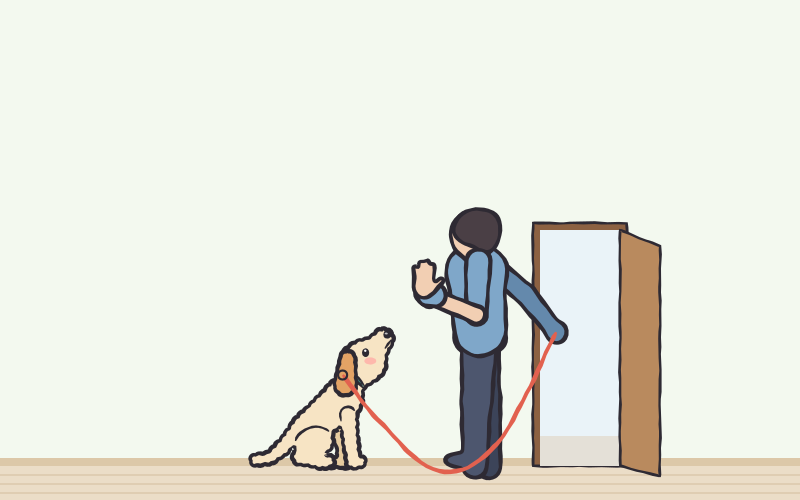
Opening the front door, a visitor arriving, waiting for dinner, pausing on a walk (on leash). Your dog holds a sit or down until she hears “Free.” You build three things — how long she waits (duration), how far away you are (distance) and what’s going on around her (distraction) — and you raise only one at a time. It grows self-control and calm. Start in a quiet room at home, then take it to the front door and to guests.
GoalYour dog holds a sit or down from “Stay” until “Free” — with duration, distance and distraction each built up one at a time.
Assessment: what a trainer might check on the first visit
Before starting, a visiting trainer might check something like these three things at home.
Does she sit (or lie down) on one cue?
→If not, firm up sit and down first. If sitting looks uncomfortable for her, practice the stay in a down.
Has the family agreed on a release word (“Free” or similar)? Or does she just get up when she feels like it, so the stay fizzles out?
→If there’s no release word yet, start by teaching that “Free” means she can get up and move.
With you right in front of her, how many seconds can she hold still?
→If she pops up after 2–3 seconds, start at 1 second. If she already holds 5 seconds or more, keep step 1 short and move on to mixing the lengths.
What you need
- A sit (or down) she does on one cue
- Small treats
- One release word the whole family uses — for example, “Free”
How to signal
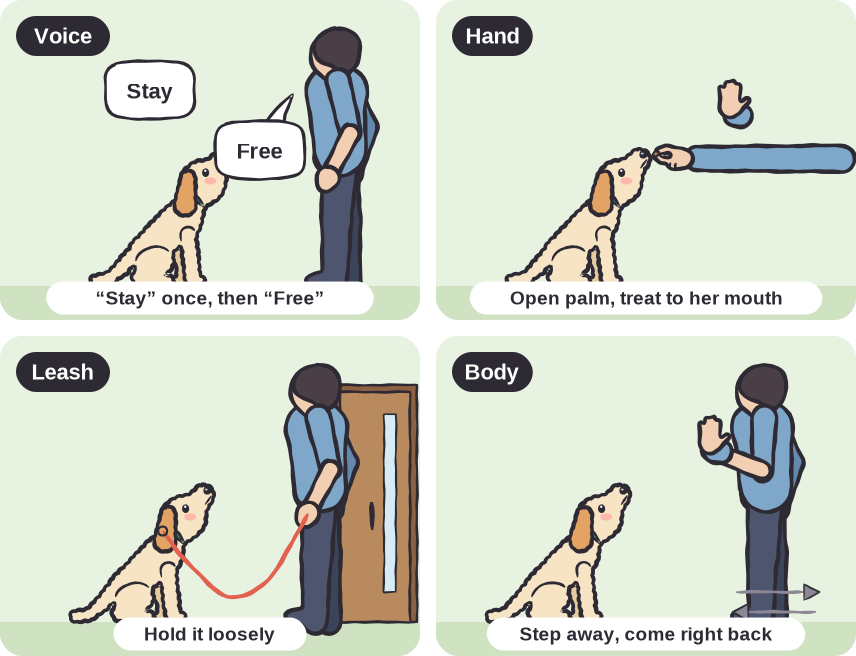
- Voice
Say “Stay” once. Always end with “Free” — the stay lasts until you say it. Pick a release word you don’t use in everyday chat — the AKC points out that “okay” comes up so often in conversation that it can release her by accident.
- Hand
Show her a flat palm, like a “stop” sign. While she holds, bring the treat to her mouth.
- Leash
Indoors, no leash. At the front door and outside, keep her leashed and hold the leash, loose. Leash rules vary by place: New York City, for example, requires a leash in public, and in England and Wales some public areas are covered by orders that require a lead. Check your local rules. Never use the leash to hold her down in place.
- Body
Start standing right in front of her. When you build distance, take one step back and come straight back. Always go back to her before you reward.
Today’s session
With the trainer, you work on step 1.
Step 1Build duration(At home, quiet)
First, the trainer shows you how to teach the release: treat, then “Free,” and encourage your dog to get up and move — a few times. Then: your dog sits → “Stay” → 2 seconds → treat to her mouth → “Free.” The trainer demonstrates stretching the time in a mixed-up pattern (2 seconds, 4, 3, 6…), then you do 10 reps. The trainer watches for two things and fixes them on the spot: are you getting the treat to her before she stands up, and are you ending every rep with “Free”?
Homework until the next visit
- How often
- Twice a day
- How long
- 3–5 minutes each
- How much
- Up to 10 reps per session
A good sign she’s ready10 seconds with you right in front of her, 8 out of 10 times (our rule of thumb)
What the trainer checks next visit
In front of the trainer: a 10-second stay with you right in front of her, 10 times.
If she canShe holds 8 out of 10 → next stage: step 2 (add distance, with short stays again) becomes the new homework.
If not yetHalve the time and do another week. Give more treats during the stay (every 2 seconds, for example).
Next stages: steps
- 1
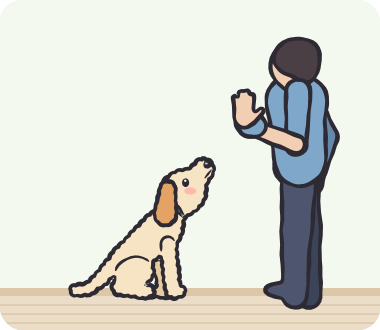
First, just time — right in front of her At home, quiet
Build duration
Ask for a sit, then “Stay.” Wait 2 seconds, bring a treat to her mouth, then “Free.” Work up to 3, 5 and 10 seconds — and mix the lengths so she can’t predict them (2 seconds after a 5, for example).
A good sign to move on10 seconds with you right in front of her, 8 out of 10 times (our rule of thumb)
- 2
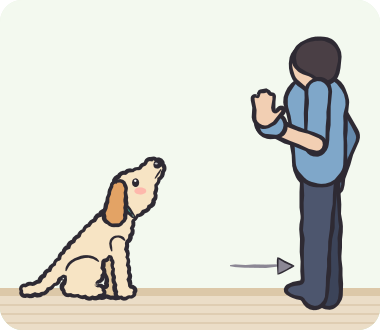
Step back, then come straight back At home, small distractions
Add distance (keep stays short again)
“Stay” → one step back → straight back to her with a treat → “Free.” Build to two steps, then three. Vary the direction you move, too: to the side, on the diagonal, backward. While you’re building distance, keep each stay short. Stepping out of her sight is especially hard — save it for last.
A good sign to move onYou go 3 m (10 ft) away and come straight back, 8 out of 10 times (our rule of thumb)
- 3
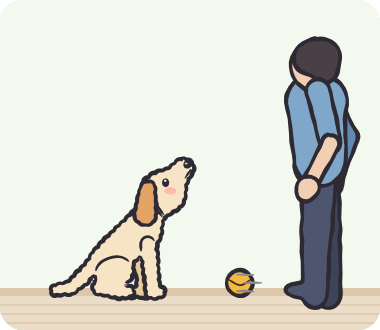
Even with something tempting going on At home, small distractions
Add distractions (keep time and distance short again)
In front of her: crouch down, clap your hands, roll a ball slowly, drop a treat on the floor. If she holds still, go back to her and reward. Drop the treat where you can quickly cover it with your foot, so she can’t help herself if she breaks (our tip). While you’re adding distractions, keep time and distance short.
A good sign to move onShe stays put even when you drop a treat, 8 out of 10 times
- 4
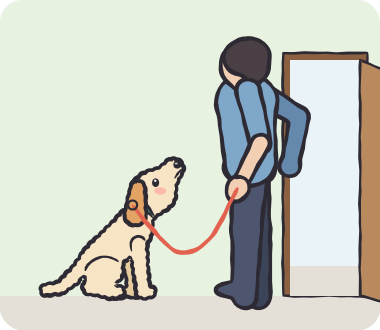
Open the door a little at a time Yard, doorstep, outside the house
At the front door
Leash on, “Stay” at the front door. Put your hand on the handle → if your dog holds, reward → open the door just a crack → close it → reward → “Free.” Open it a little wider each time. If she tries to dart out, quietly close the door, wait until she’s calm, and start again. If the front door is too exciting, practice at a less exciting inside door first.
A good sign to move onShe holds while you open the door all the way, 8 out of 10 times
- 5
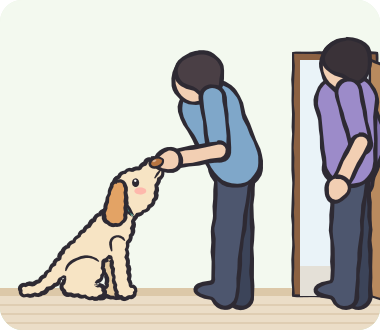
For the real thing, start short Around distractions
With guests and distractions outside
Rehearse first: a family member or friend plays the guest, going outside and knocking or ringing the bell, before you try it with real visitors. Then the doorbell, real guests, and people passing on walks, always starting with short stays. Outside, use better treats than usual.
A good sign to move on5 seconds in that situation, 8 out of 10 times (our rule of thumb)
Timing
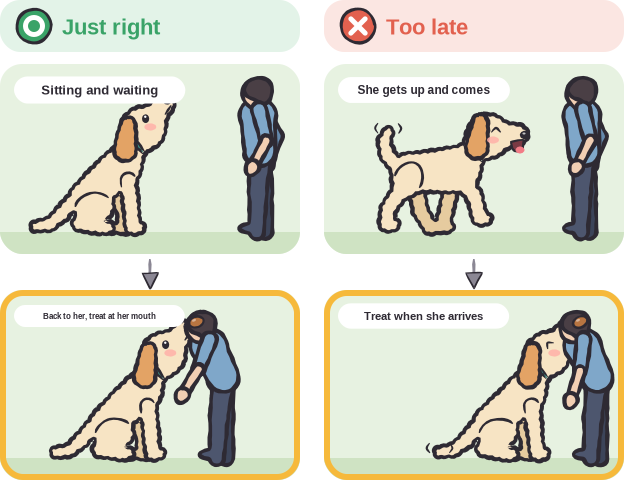
Just right
While she’s holding: “Yes” → treat to her mouth. At the end, “Free” and she can move.
Too late
Rewarding after your dog stands up, or calling her to you from across the room and rewarding that. Getting up — the end of the stay — is what earns the reward.
Reward while she’s still in position, after you’ve gone back to her. Dogs Trust and the RSPCA in the UK both say to reward while the dog is still sitting or lying down. The American Kennel Club (AKC) says to reward the stay, not the release, and to always go back to your dog before releasing — never release from across the room. If you see signs she’s about to break, reward her before she does (RSPCA): set her up to win.
How much and how often
3–5 minutes a session, up to 10 reps, about twice a day. Once you reach the front-door and guest steps, use the stay every day as you go in and out and when people visit.
If it isn’t working
She gets up straight away
Go back a step and shorten the stays. Give treats more often during the stay (every 2 seconds, for example). She may also be tired or bored because the session ran too long — get a short stay right, and end the session there.
She moves before I say “Free”
Watch for the moment just before she’d get up: reward a beat earlier, then say “Free,” so the rep ends in success. Stretch it out gradually. If she does move, don’t scold — just start again with a shorter stay.
She stays at home but not outside
She may think “Stay” is something that only happens indoors. In a new place, go back to short time and short distance. Widen the places one at a time: the yard → an empty park → somewhere people and dogs are in view but far away → a bit closer.
In what order should I build duration, distance and distraction?
We go duration → distance → distraction — the same order as the step-by-step guides from Dogs Trust and the RSPCA. The AKC’s stay article recommends duration, then distraction, then distance last, and says to build duration to at least 30 seconds before adding distance or distractions — longer than our 10-second rule of thumb. The AKC’s own 3 Ds article, on the other hand, leaves distraction for last, so even within the AKC the order differs. What both AKC articles agree on — and what we build on — is raising only one D at a time and making the others easier while you do.
Stay or wait — which should I use at the door?
Some trainers use two cues. In AKC’s definition, “wait” means hold on for a moment, while “stay” means hold this position until released. An article from the DogWatch newsletter, reprinted on the website of Cornell University’s College of Veterinary Medicine, describes “wait” for quick pauses, like going through a door, and “stay” for holding until you come back, like sitting out of the way while guests come in. Cornell’s article adds that the exact words don’t matter, as long as each one means one thing. Either way, every stay ends with your release word. This page uses “Stay” throughout.
What’s the difference between “Stay” and “Sit”?
“Sit” is the cue to get into a position. “Stay” means keep that position until “Free.” Move on to the stay once sit (or down) is reliable. For how to teach the word itself, see the Stay command page.
She gets too worked up — or barks or seems worried — when guests arrive
Don’t ask for a long stay in the middle of all that. While you’re still training, let her settle on her bed in a room visitors won’t use, with a long-lasting chew, and bring her in once she’s calm and your guests are happy to meet her. Barking at visitors can be excitement, but it can also mean she’s anxious about them. If she struggles with visitors, or you’re struggling to cope, get help from a qualified behavior professional (in the UK, an accredited behaviourist).
How long and how far should a stay get, in the end?
There’s no fixed number for everyday life. For reference, in the AKC Canine Good Citizen test the dog is on a 20-foot (6 m) line; the handler says “Stay,” walks to the end of the line, turns, and comes back, and the dog must remain in place (changing position is allowed) until released. That’s a good longer-term goal once all five steps are solid.
Avoid
- Increasing time and distance at the same time
- Repeating “Stay!” more sharply, or scolding, every time she breaks
- Letting the stay fizzle out instead of ending it with “Free”
- Calling her to you from a distance and rewarding that (coming when called gets rewarded, not staying)
A good sign to move on
- Steps 1, 2 and 3 (at home): she holds until “Free” 8 out of 10 times at that step (our rule of thumb)
- Step 4 (front door): she holds while you open the door all the way, 8 out of 10 times
- Step 5 (guests and outside): 5 seconds in that situation, 8 out of 10 times
- Raise only one of duration, distance or distraction at a time. If she struggles, go back one step — our rule of thumb is two misses in a row
Sources
- Dogs Trust (UK) — Teaching your dog to stay
- RSPCA (UK) — How to train your dog to stay
- American Kennel Club — How to Teach Your Dog to Stay
- American Kennel Club — The Three Ds of Dog Training: Duration, Distance, and Distraction
- Battersea Dogs & Cats Home (UK) — How to teach your dog to stay
- Cornell University College of Veterinary Medicine (Riney Canine Health Center) — Training ‘stay’ vs. ‘wait’ (reprinted from the DogWatch newsletter)
- Dogs Trust (UK) — How to train your dog to be patient in doorways
- Dogs Trust (UK) — How to prepare your dog for visitors
- Dogs Trust (UK) — Top ten dog training tips
- American Kennel Club — Canine Good Citizen Test Items
- New York City Health Code, Article 161 (Animals), §161.05
- GOV.UK — Controlling your dog in public: Public Spaces Protection Orders
- AVSAB — Position Statement on Humane Dog Training (2021)