 BAUDOG The dictionary of dog–human communication
Contents
When to use this exercise
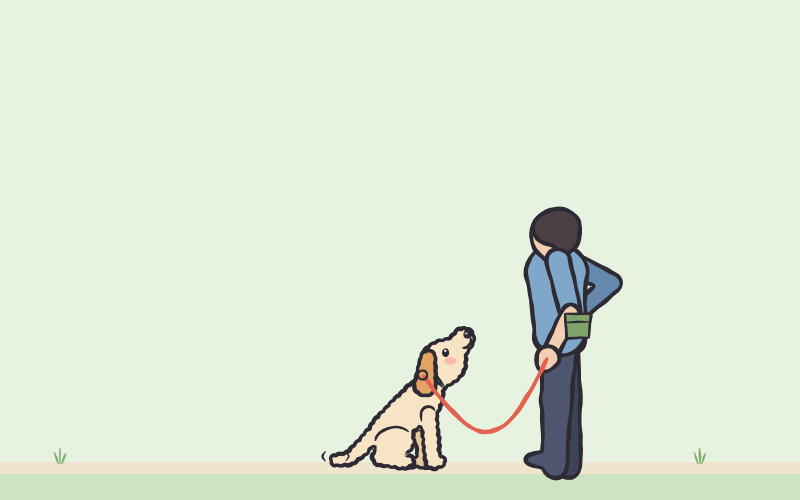
This exercise has no cue. You don’t say her name or “Watch me.” The moment your dog looks up at you on her own, you say “Yes.” Repeat that, and you get a dog who checks in with you now and then without being called. The Name Game builds “turn when I call you”; check-ins build “come back to me before I have to call.” Use it for dogs who pull, don’t listen on walks, bark at other dogs or people, or jump up. It builds Focus.
GoalWithout being called, your dog glances up at you now and then. On walks, after she looks at something interesting, she looks back at you.
Assessment: what a trainer might check on the first visit
A visiting trainer might start by checking these three things.
In a quiet room, if you wait for a minute without saying anything, how many times does your dog look at you?
→Zero or once: start at step 1, rewarding even a small turn of her head toward you. Lots of times: keep step 1 short and move on to the front of the house.
When she does look at you, does the family notice straight away and reward it?
→Most people miss the moment. Make “she looks, we reward” a family rule.
On walks, does she go the whole way without ever looking at you?
→That’s your starting point. Begin the outdoor steps at the quietest spot in front of your house.
What you need
- Small treats she can finish quickly, in a pouch (for the outdoor steps, something better)
- A marker word she already knows — “Yes” means a treat is coming (see Charging Your Marker Word)
How to signal
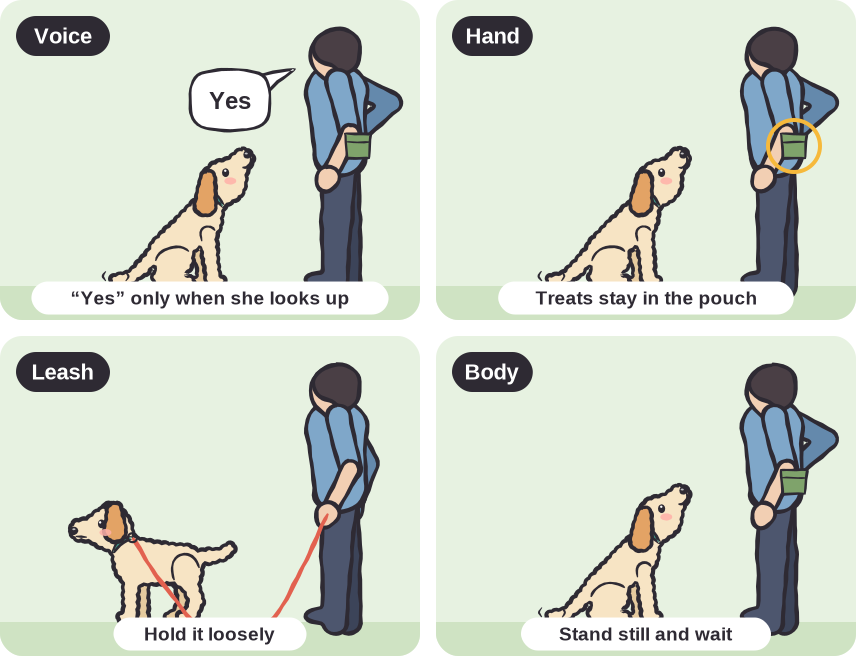
- Voice
No cue. Not her name, not “Watch me.” Only “Yes” at the moment she looks up.
- Hand
Treats stay in the pouch. Don’t show them to lure her. When she looks up, take one out and give it by your leg.
- Leash
Outside, hold it loosely, long enough for her to look around freely. Never use it to turn her toward you.
- Body
Stand still and wait quietly. Don’t lean down to peer into her face or wave your hands to get her attention.
Today’s session
With the trainer, you work on step 1.
Step 1Wait in a quiet room(At home, quiet)
In a quiet room, the trainer demonstrates and shows you what “she just looked” looks like. Then you take over: stand still, say nothing, and when your dog looks at you, “Yes,” then a treat by your leg. For the first few, the trainer says “now” to help you catch the moment. Waiting without saying anything is the hardest — and most important — part. It takes about 3 minutes.
Homework until the next visit
- How often
- Twice a day
- How long
- About 3 minutes each
- How much
- Up to 15 treats per session
A good sign she’s readyIn a quiet room, she looks up 5 or more times in a minute without a cue
What the trainer checks next visit
Count together how many times she looks up in one minute in a quiet room. Then step out of the front door and try it in front of the house.
If she can5 or more times a minute in the quiet room → next stage: step 2 (yard, doorstep, front of the house) becomes the new homework.
If not yetAnother week in the quiet room. Check together how fast your “Yes” is (the instant she looks?) and that you aren’t showing her the treats.
Next stages: steps
- 1
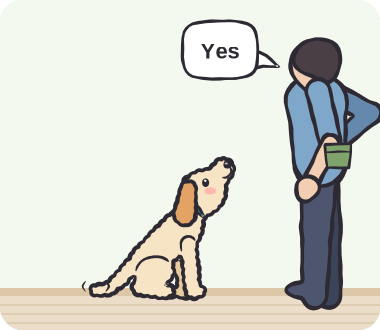
Wait without a word At home, quiet
Wait in a quiet room
Stand in a room and wait without saying anything. When your dog looks at you, “Yes,” then a treat by your leg. At first, even a slight turn of her head toward you counts.
A good sign to move onShe looks up 5 or more times a minute
- 2
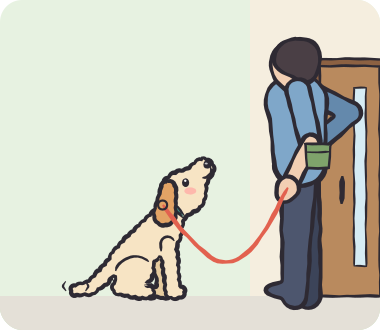
Outside starts in front of your house Yard, doorstep, outside the house
Yard, doorstep, front of the house
With her leash on, stand in front of your house. After she has looked around, if she looks up at you, “Yes,” then a treat. Outside, use better treats than usual.
A good sign to move onShe looks up within about 10 seconds of you stopping, 8 out of 10 times
- 3
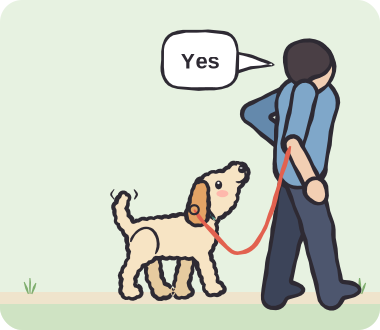
Reward the look on the move, too Quiet street
On a quiet street
Stop partway through a walk and wait; when she looks up, reward. Once that’s going well, reward glances while you’re walking, too.
A good sign to move onShe looks up on her own 5 or more times during 5 minutes of walking
- 4
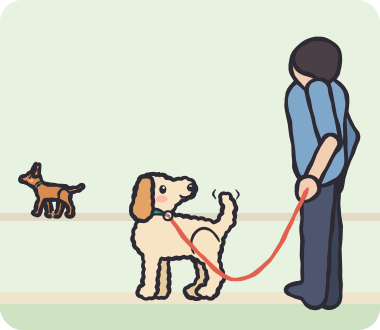
She looks, then she looks back at you Around distractions
Near distractions
Stop somewhere you can see other dogs or people in the distance. When your dog looks at them and then looks back at you, “Yes,” then a treat. As that gets easy, move a little closer. If she stops taking treats or can’t take her eyes off them, you’re too close — go back to where there’s plenty of distance.
A good sign to move onAfter looking at the distraction, she looks back at you within about 5 seconds, 8 out of 10 times
Timing
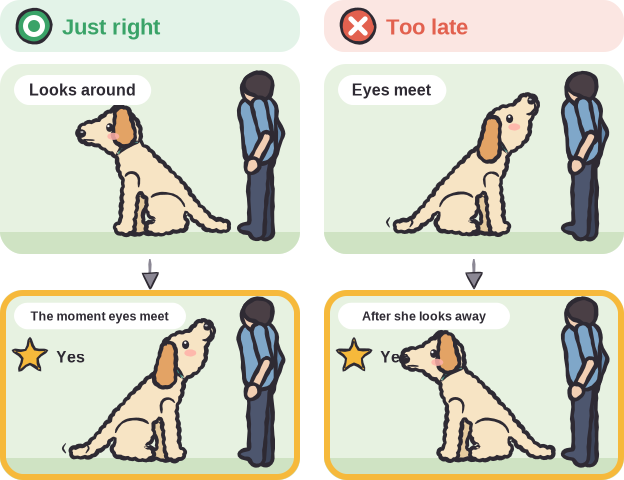
Just right
“Yes” the instant her eyes reach your face. Then the treat.
Too late
Saying it after she has already looked away. Or chatting to her (“Good girl, aren’t you clever”) after she looks, and bringing out the treat some time later.
Researchers use exactly this setup. In a study that measured how quickly 145 Border Collies made eye contact with a person, the experimenter stood still and waited, then clicked and tossed a treat the instant the dog made eye contact on her own. In that study, dogs who had done clicker training before were faster to make eye contact (it only looked at Border Collies).
How much and how often
About 3 minutes, twice a day. Once you reach the outdoor steps, sprinkle about 5 minutes of stop-and-wait into your walks.
If it isn’t working
She never looks up
Reward from the moment her head turns even slightly toward you. When that’s easy, wait until her face comes up near your eyes, raising the bar a little at a time. Some dogs find direct eye contact uncomfortable; for them, a look in your direction is enough (our suggestion).
She stares at me and won’t walk on
After you reward, toss the next treat a little way ahead and walk on with “Let’s go.” Alternate looking up and walking.
Outside she never looks at me
Use better treats outside. Go back to the quietest spot in front of your house and wait a little longer. Don’t practice in busy places yet.
How is this different from teaching “Watch me” or “Look”?
Teaching her to look on a cue is useful too — Dogs Trust suggests practicing “Look” before a walk. This exercise builds looking at you without a cue. For turning to you when called, use The Name Game. You can do both side by side.
Do I have to use treats forever?
Keep saying “Yes.” Once you’re on the outdoor steps, she doesn’t need a treat every time. Being allowed to go and sniff can be a reward too.
Avoid
- Saying “Watch me” or the dog’s name over and over to get her to look (this exercise has no cue)
- Holding a treat in front of your face to make her look up
- Pulling the leash to turn her toward you
A good sign to move on
- Step 1 (quiet room at home): she looks up 5 or more times a minute without a cue
- Step 2 (front of the house): she looks up within about 10 seconds of you stopping, 8 out of 10 times
- Step 3 (quiet street): she looks up on her own 5 or more times in 5 minutes of walking
- These counts and seconds are our rules of thumb — there are no official numbers
- If she struggles, go back one step (our rule of thumb: two misses in a row)
Sources
- Dogs Trust — Dog walking problems: pulling on lead (follow-on walking skills: Check in)
- San Francisco SPCA — Name Recognition and Attention
- Whole Dog Journal — Train Your Dog to “Check In”
- American Kennel Club — How to Train a Deaf Dog
- AVSAB — Teaching Name Recognition (Maxwell, 2017)
- Wallis, Range, Müller, Serisier, Huber & Virányi (2014). Lifespan development of attentiveness in domestic dogs: drawing parallels with humans. Frontiers in Psychology 5:71
- Cattle Dog Publishing (Eileen Anderson) — Training Series: Teaching Eye Contact to a Dog
- Dogs Trust — Teach your dog to walk nicely on a lead
- Battersea — How to teach your dog to walk on a lead