 BAUDOG The dictionary of dog–human communication
Contents
- In short
- When it happens
- How your dog feels
- What kind of jumping is it? Three questions
- If a trainer came to your home: the first session and the first homework
- What to do today: make jumping impossible first
- When “just ignore it” isn’t the answer
- Teach a different greeting: four on the floor, sit, or a hand touch
- Should I say “Off” or “Down”?
- It gets worse before it gets better
- Jumping on people on walks
- Starting with a puppy — will she grow out of it?
- The missing core skill
- Exercises
- In the moment: do / don’t
- When to see a professional
- Sources
In short
Your dog isn’t jumping to be the boss. She wants to get close to your face to say hello, and she wants your attention. If jumping keeps getting a reaction — petting, talking, a sharp “No!” or “Get down!”, a push away — she learns that jumping is how you get people to respond. Fixing it rests on two things. Before guests arrive, set things up so she can’t jump: a leash, a gate or a closed door. And let people come closer — and drop treats on the floor — only while all four of her paws are on the ground. Get the whole family doing the same thing. Expect the jumping to get worse for a little while when it stops working — keep going, and it fades.
When it happens
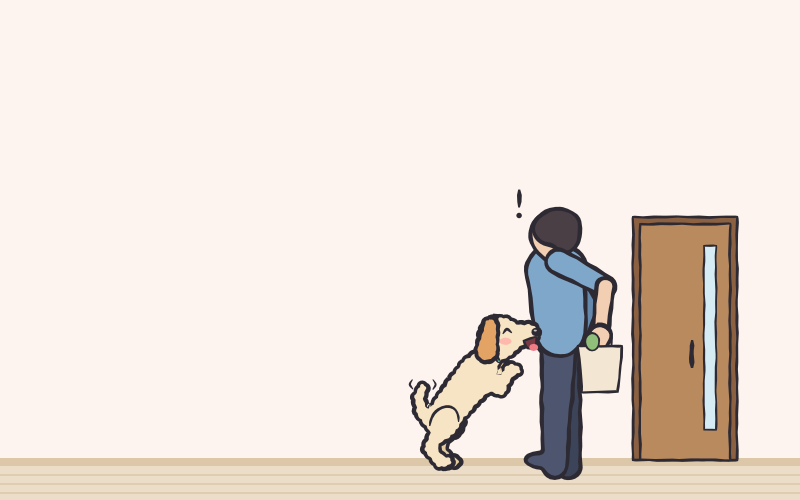
- You come home and your dog jumps all over you again and again at the front door
- She jumps on guests, muddying their clothes or nearly knocking a child over
- On walks, she lunges up at people as they pass
- She leaps at any hand holding a treat or a toy
How your dog feels
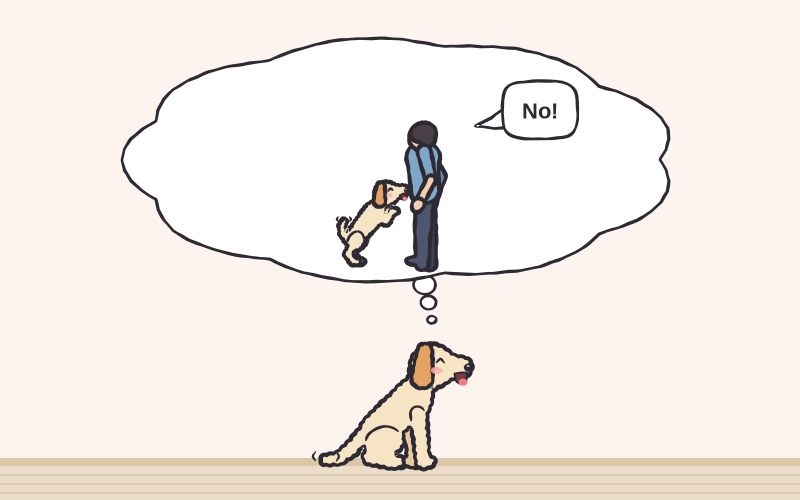
Dogs greet each other face to face. Our faces are a long way up, so to get close, a dog has to jump. The excitement of someone she loves coming home, or a visitor at the door, comes out as bouncing too.
When she jumps, people look at her, talk to her and touch her. Repeat that often enough and jumping becomes her way of getting people to respond. Telling her “No!” or “Get down!” and pushing her away usually count as attention too — and some dogs take a push as the start of a wrestling game.
Not all jumping is happy, though. Dogs also jump when they’re anxious, when they’re frustrated because they can’t reach something they want, or when a stranger worries them and they’re trying to say “go away.” If you see a stiff body, ears pinned back or a tucked tail along with the jumping, it isn’t a happy greeting.
You may read that dogs jump because they think they’re in charge. The American Veterinary Society of Animal Behavior (AVSAB) says otherwise: dogs jump on people not to gain rank, but because jumping gets them attention.
What kind of jumping is it? Three questions
Why she jumps changes where you start. Watch for these three things.
- When she jumps, is her body loose and her tail wagging? That’s happy, attention-seeking jumping — start with the steps on this page. If you see a stiff body, ears pinned back or a tucked tail as well, fear or anxiety is in the mix. Before any training, avoid the situations that worry her and talk to a behavior professional (see “When to see a professional” below).
- Who does she jump on, and when? Coming home, visitors, people passing on walks, a hand holding food. Build the training around the situation that happens most. Also check whether anyone in the family pets her or picks her up when she jumps.
- Does she seem reluctant to sit, or dislike being touched? Some dogs jump because they’re in pain, and some find sitting uncomfortable. If so, see your vet first.
If a trainer came to your home: the first session and the first homework
Here is how we’d expect the first in-home session to go — one example, not a fixed script. A trainer might play the visitor: ring the doorbell, walk in, and watch how many seconds it takes before your dog’s front paws leave the floor, and how the family reacts when they do.
- Today: with your dog on leash, a family member walks toward her. If all four paws stay on the floor, they keep coming and drop a treat on the floor. If her front paws lift, they take one step back (step 1 of Four on the Floor Greetings). The trainer shows how, then each family member takes a turn — 10 approaches each, for example.
- Homework: every time you come home, open the door and roll a few treats onto the floor first, then say a quiet hello while she’s sniffing them up. Once a day, a short session of about 5 minutes: 10 approaches and retreats. Everyone in the family follows the same rule — while she’s jumping, no looking, no talking, no touching. On days you’re expecting visitors, put her leash on before they arrive.
- Next visit: the trainer walks in through the front door again. Can she greet them with four paws on the floor? Our rule of thumb: once she has gone 5 days in a row without jumping when someone comes home, and greets the trainer with four on the floor, the next homework moves up a level — a family member plays the visitor, starting from the doorbell. If not, it’s back to approach-and-retreat, and the trainer helps you fine-tune when to step back.
What to do today: make jumping impossible first
Until the training takes hold, cut down the chances to jump. Every jump she gets away with is practice.
- Before guests arrive, put her on a leash indoors — Battersea suggests a light houseline (a thin leash with no handle loop) clipped on before visitors come, so the leash doesn’t become a signal that guests are here. Or keep her in another room or behind a baby gate until your guests have settled, with a long-lasting chew to keep her busy.
- Ask guests in advance to talk to her only when all four paws are on the ground.
- If she jumps on you, fold your arms and turn your head away: no looking, no talking, no touching. The moment all four paws are back on the floor, turn back and praise her.
- If she keeps jumping even though you’ve turned away, calmly step out of the room or behind a door for a moment, then come back and try again.
- Scatter treats on the floor. With her nose pointing down, it’s much harder to jump. Use this when you come home and when guests walk in.
- If she grabs your sleeve or clothes, keep still rather than pulling away — pulling turns it into tug-of-war.
When “just ignore it” isn’t the answer
Not reacting to jumping can work for a small dog jumping up at a family member for attention. Battersea says it isn’t suitable for large or anxious dogs, or when the dog is with strangers, children or anyone unsteady on their feet — someone could be knocked over and hurt.
In those situations, don’t wait it out: use a leash or a gate so she can’t reach people in the first place. If you have children and she’s likely to jump, keep her on a leash or in a separate room around them, even indoors.
Teach a different greeting: four on the floor, sit, or a hand touch
“Don’t jump” doesn’t tell your dog what to do instead. Choose the greeting you want, and make that the thing that earns attention. Common choices include standing with four paws on the floor, sitting, and touching her nose to your palm. If sitting is hard for her, four paws on the floor is plenty.
- Start somewhere calm and familiar — inside your home or in the yard — after she’s been out for a walk and a potty break and is relaxed.
- With your dog on leash, ask a family member or friend she’s comfortable with to walk toward you from a little way off. As they get close, before she jumps, give the cue for the greeting you’ve chosen (a sit, for example). The moment she does it, bring a treat to her mouth or drop it on the floor.
- If she ignores the cue or won’t take the treat, the helper is too close. Have them start farther away.
- If she jumps anyway, you both go quiet. Repeating “sit” won’t get through while she’s that excited. Have the helper move away, and praise her the moment all four paws are back down.
- Once she can stay calm, the helper can stroke her shoulder or chest. A hand coming over the top of her head makes jumping hard to resist.
- When she’s got it, swap helpers. She may slip back a little at first, but she’ll soon remember. Then widen the places bit by bit: in front of the house, then the park.
- Drop treats on the floor before the helper arrives, so she gets rewarded before she has a chance to jump. As she learns, use fewer treats a little at a time, until the greeting itself is the reward.
Should I say “Off” or “Down”?
Most of the time, say nothing: turning away and rewarding four paws teaches more than any word. But if you want a cue, don’t use “Down” if “Down” means lie down. Shelters such as the San Francisco SPCA and SPCA Cincinnati, and the AKC, suggest keeping “Down” for lying down and using a different word — “Off,” for example — for getting off people or furniture. Whatever word you use, the reward still comes the moment all four paws touch the floor.
It gets worse before it gets better
When jumping that always used to work suddenly stops working, many dogs try harder for a while — bigger, more frantic jumps — to see if that gets a response. Dogs Trust and Battersea both describe this brief increase as a normal part of learning. This is exactly the point to keep going.
The fastest way to undo the progress is the occasional exception. If someone sometimes says “Oh, go on then” and pets her when she jumps, she’ll keep trying. Tell the family and regular visitors the rules before they walk in.
Jumping on people on walks
Outside, hold the leash short enough that she can’t reach people as they pass. Leash rules vary by place: New York City, for example, requires dogs in public places to be on a leash no longer than 6 feet (about 1.8 m). And in England and Wales it’s against the law to let a dog be dangerously out of control — which, according to GOV.UK, includes a dog that makes someone worried it might injure them, even if it never touches them. Check your local rules.
If she’s about to jump, don’t yank her down by the leash. Instead, step back a few paces away from the person, or call her away. Pulling on her collar or harness to get her down can hurt, and she may link that pain to you or to the equipment.
Some dogs jump at their own owner on walks out of frustration: on leash, they can’t go and greet, sniff or move away. Keep the leash as loose as you can and reward calm moments with four paws on the ground.
She doesn’t have to say hello to strangers at all. As people pass, keep her attention on you with treats or a toy.
Starting with a puppy — will she grow out of it?
Puppy jumping is cute, but ask yourself whether you’ll still want it when she’s fully grown. If not, it’s easier for her to learn while she’s small. From the day she comes home, the whole family greets her only when all four paws are down.
We wouldn’t count on age to fix it. A large UK study (Generation Pup) asked owners about their dogs at 6, 9, 12, 15 and 18 months — about 1,700 dogs at 6 months, fewer at each later age. Jumping up was one of the four problems owners reported most often at every age, and unlike barking, leash pulling and recall problems, the share of dogs reported for jumping up at people didn’t change significantly over that year. It was only ever a small share — about 5–8% of dogs.
The missing core skill
Exercises
Our suggested order. Start with Four on the Floor Greetings; you can work on the others alongside it. All of them can start indoors.
- ExerciseFour on the Floor: Teaching Your Dog to Greet People PolitelyDoable at home (Steps 1–2 at home)People come closer only while all four paws are on the floor — this turns jumping directly into a greeting.Read →
- ExerciseSay Please by SittingDoable at home (Steps 1–3 at home)Sitting becomes her way of asking. Builds a sit before every hello.Read →
- ExerciseHand Target: How to Teach Your Dog “Touch” — and Use It for Recall and Passing Other DogsDoable at home (Steps 1–3 at home)A nose touch to your palm gives her a greeting that goes to your hand instead of your face.Read →
- ExerciseRelaxing on a Mat: How to Teach Your Dog to SettleDoable at home (Steps 1–4 at home)Teaches her to wait and relax on a mat while guests are over.Read →
- ExercisePlay and Pause: Teach Your Dog an “Off Switch” With TugDoable at home (Steps 1–3 at home)Practice for switching back to calm on cue, even in the middle of excitement.Read →
- ExerciseBuilding a Stay: Duration, Distance, Distraction — One at a Time, Up to the Front Door and GuestsDoable at home (Steps 1–3 at home)Gradually stretches how long she can wait at the door or when guests arrive.Read →
- ExerciseLeave It Practice: From a Closed Fist to Food on the SidewalkDoable at home (Steps 1–3 at home)Practice for backing off from what’s in your hand instead of leaping at it.Read →
- ExerciseCheck-Ins: Teach Your Dog to Look at You Without Being AskedDoable at home (Step 1 at home)Rewards her for looking up at you on her own — looking instead of jumping.Read →
- ExerciseCharging Your Marker Word: How to Teach Your Dog That “Yes” Means a RewardDoable at home (Steps 1–4 at home)Lets you tell her “Yes!” at the exact moment her paws touch the floor.Read →
In the moment: do / don’t
Do
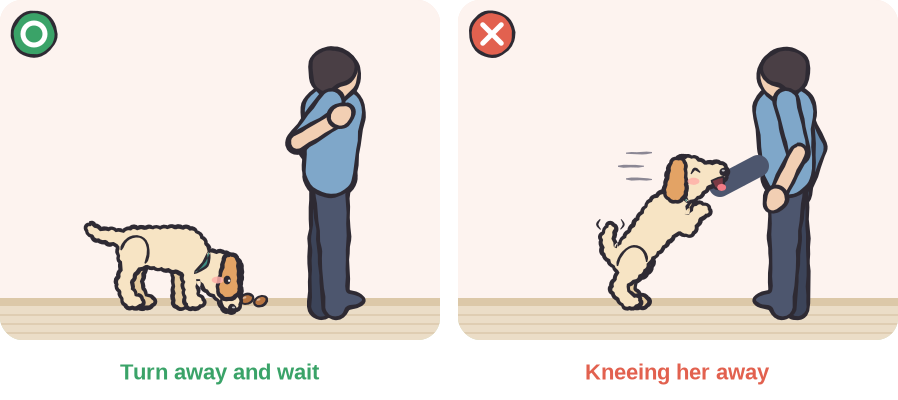
- Say “Yes!” the moment all four paws touch the floor, and drop a treat on the floor
- Put a leash on her indoors before guests arrive (or use a gate or a door)
- If she jumps, fold your arms and turn away; turn back when four paws are down
- When you come home, roll a few treats onto the floor before you step in
Don’t
- Knee her in the chest, step on her back feet or grab her front paws
- Keep shouting “No!” or “Get down!”, or push her away
- Yank her down by the leash or collar
- Pet her or pick her up while she’s jumping — or let it go “just this once”
When to see a professional
- She’s reluctant to sit, or dislikes being touched — some dogs jump because they’re in pain. See your vet
- She jumps with a stiff body, ears pinned back or a tucked tail — this jumping comes from fear or anxiety, and changing how she feels comes first. Talk to your vet or a qualified behavior professional
- She puts her teeth on people or bites while jumping — this can cause injuries, so don’t try to fix it alone. Talk to your vet or a qualified behavior professional
Go to the root
Don’t stop at the quick fix. Growing the skill underneath makes other problems lighter too.
 Core skill Impulse Control
- ExerciseFour on the Floor: Teaching Your Dog to Greet People PolitelyDoable at home (Steps 1–2 at home)Read →
- ExerciseSay Please by SittingDoable at home (Steps 1–3 at home)Read →
- ExerciseHand Target: How to Teach Your Dog “Touch” — and Use It for Recall and Passing Other DogsDoable at home (Steps 1–3 at home)Read →
Sources
- Dogs Trust — How to stop your dog jumping up at people
- Battersea — How to train your dog not to jump up
- Best Friends Animal Society — How to Stop Dogs From Jumping on People
- ASPCA — Jumping Up on Walks
- American Kennel Club — How to Stop Your Dog From Jumping Up on People
- Woodgreen Pets Charity — How to train a dog not to jump up
- Peninsula Humane Society & SPCA — Jumping-Up (PDF)
- San Francisco SPCA — Down Command (PDF)
- SPCA Cincinnati — Teaching Your Dog Down (PDF)
- American Kennel Club — Mind Your P’s and Q’s, Part 3
- AVSAB — Position Statement on the Use of Dominance Theory in Behavior Modification of Animals
- AVSAB — Position Statement on Humane Dog Training (2021)
- MSD Veterinary Manual (Pet Owner Version) — Behavior Problems in Dogs
- Kinsman et al. (2025). Owner-perceived undesirable behaviours in young dogs and changes with age. Animals 15(8):1163
- GOV.UK — Controlling your dog in public
- legislation.gov.uk — Dangerous Dogs Act 1991, section 3 (England and Wales)
- New York City Health Code Article 161, §161.05