 BAUDOG The dictionary of dog–human communication
Contents
When to use this exercise
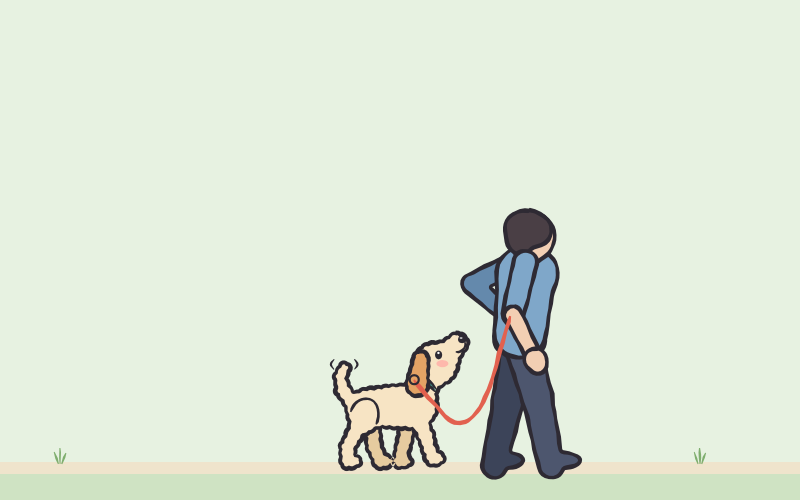
This is everyday walk training. When the leash is loose, you move forward; when it goes tight, you stop. And being beside you is where the treats come from. Those two things swap “pulling gets me there” for “a loose leash gets me there.” Use it for dogs who pull, scavenge on walks, bite the leash, charge toward other dogs, or plant their feet to go their own way. It builds Focus and Impulse Control. The finished skill happens outside, but you start indoors.
GoalYour dog walks somewhere near your side with the leash loose (hanging in a J). If it does go tight and you stop, she comes back on her own and lets it go slack.
Assessment: what a trainer might check on the first visit
A visiting trainer might start by checking these three things.
When the leash goes tight and you stop, does your dog turn back — or pull harder?
→If she turns back, keep step 1 short and move on to step 2. If she pulls harder, take your time with step 1 (indoors, making your side the best place to be).
Do the harness and leash fit? (you can slide a finger comfortably under the straps, she can’t slip out, nothing rubs behind her front legs, the leash isn’t too long)
→If not, change them before you start. If she’s pulling on a collar alone, switch to a harness first.
Where on the walk does she pull hardest? (right out of the door, toward smells and grass, when she sees another dog)
→That’s the last place in the steps. Until then, avoid it on practice walks or keep it short.
What you need
- A well-fitting harness that keeps pressure off her neck (a Y-shaped harness with both a front and a back clip gives you extra support)
- A standard leash about 1.2–2 m (roughly 4–6½ ft) long — not a retractable one
- Small, soft treats she can swallow quickly, in a pouch (for the outdoor steps, something better)
- A marker word she already knows — “Yes” means a treat is coming (see Charging Your Marker Word)
How to signal
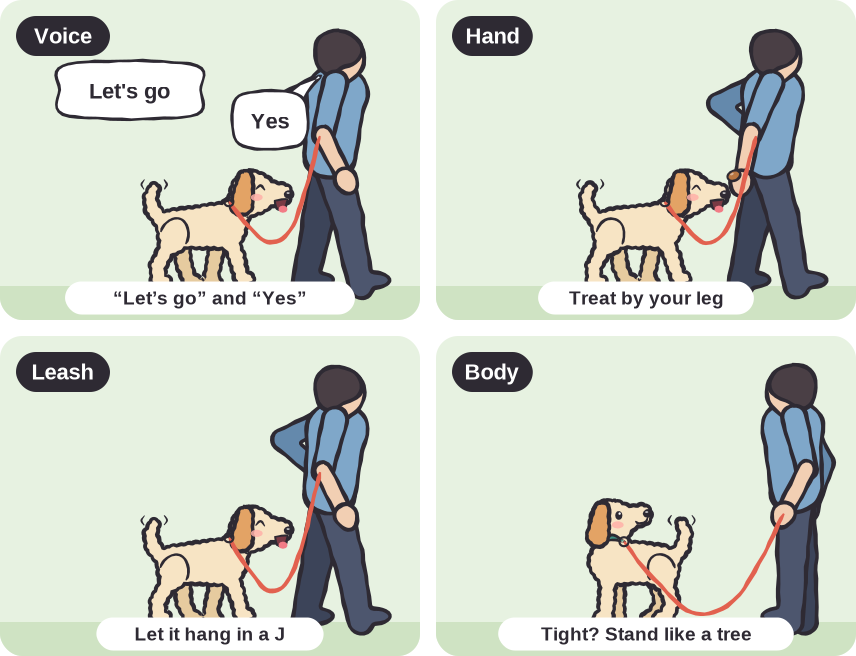
- Voice
“Let’s go” as you set off. “Yes” the moment she’s at your side. When the leash goes tight, stop in silence. No “No!”
- Hand
Hold the leash handle around your belly button, arms relaxed, not stretched out in front. Give treats by your leg on her side, never in front of your body.
- Leash
Tight leash, you stop. Don’t pull back or yank. Loose leash, you walk. Hold it at a length where it always hangs in a J.
- Body
Stand tall. When you stop, stop dead, like a tree. Pick one side for her — left or right — and stick to it.
Today’s session
With the trainer, you work on step 1.
Step 1Indoors: be at my side(At home, quiet)
The trainer demonstrates indoors, then hands over to you. With harness and leash on, you walk slowly around the living room or hallway, and every time your dog comes to your side: “Yes,” then a treat by your leg. At first, reward every step or two. The trainer fixes, on the spot, the two common slips: handing treats out in front of your body, and stretching your arm out so the leash goes tight. Once that’s going well, you try a little of step 2 — stopping dead when the leash tightens. It takes about 5 minutes.
Homework until the next visit
- How often
- Twice a day
- How long
- About 5 minutes each
- How much
- Indoors. Keep everyday walks separate, and short is fine
A good sign she’s readyIndoors, when you stop on a tight leash, she turns back and lets it go slack within about 3 seconds, 8 out of 10 times
What the trainer checks next visit
Indoors, with the trainer, stop 10 times. Then step outside and walk a few yards in front of the house.
If she canIf the leash went loose within about 3 seconds in 8 out of 10 stops indoors → next stage: step 3 (in front of your house) becomes the new homework.
If not yetAnother week of the indoor steps. Look together at where you give the treat (by your leg?) and when you stop (the instant it goes tight?).
Next stages: steps
- 1
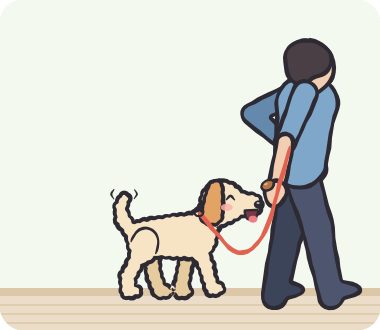
Treats go by your leg At home, quiet
Indoors: be at my side
Walk slowly around the house; every time your dog comes to your side, “Yes,” then a treat by your leg. At first, every step or two. Leash on or off, either is fine.
A good sign to move onShe walks 10 steps at your side indoors
- 2
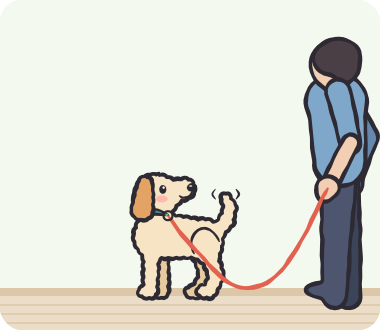
Tight leash, stop. Loose leash, walk At home, small distractions
Indoors: tight leash, I stop
Walk around the house on leash, with a small distraction such as a toy on the floor. When the leash goes tight, stop. When she turns back and it goes slack, “Yes,” then “Let’s go” and walk on.
A good sign to move onWhen you stop, she turns back and the leash goes slack within about 3 seconds, 8 out of 10 times
- 3
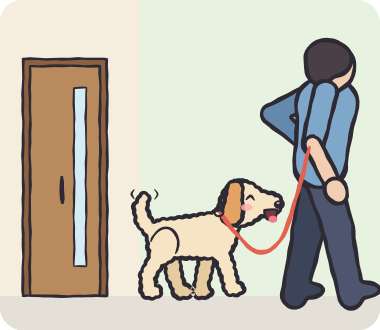
Outside starts with a few yards in front of your house Yard, doorstep, outside the house
In front of your house
Do the same thing walking back and forth for a few yards in front of your house. You can start with a few minutes of sniffing on a release cue like “Off you go” before the practice walking. Outside, use better treats than indoors.
A good sign to move on10 steps without the leash going tight, 8 out of 10 times
- 4
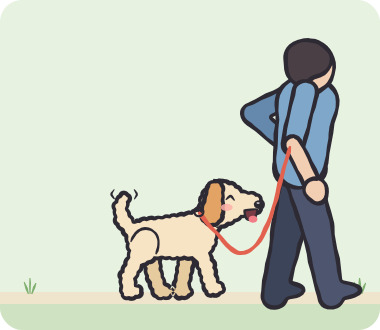
Slowly space out the rewards Quiet street
On a quiet street
Do the same on a quiet street near your home, slowly spacing out the rewards. If you stop and she doesn’t turn back, walk a couple of steps in the opposite direction to bring her attention back.
A good sign to move on20 steps without the leash going tight, 8 out of 10 times
- 5
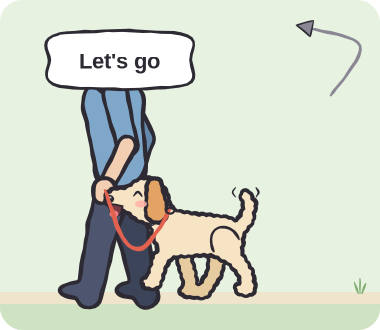
Turn before she pulls Quiet street
Change direction
When she looks about to pull, before she does, say “Let’s go” cheerfully and turn the other way. When she follows, “Yes.”
A good sign to move onShe follows straight away when you turn
- 6
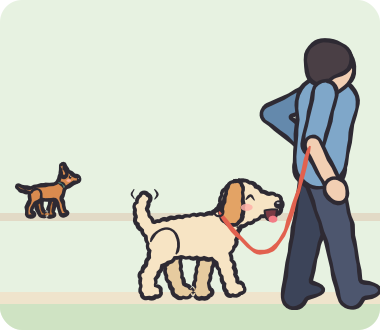
In hard places, reward more often Around distractions
Near distractions
At the park entrance, or on a street where other dogs are in sight. Start well away from the distraction and reward more often again. If she stops taking treats, you’re too close.
A good sign to move on10 steps near the distraction without the leash going tight, 8 out of 10 times
Timing
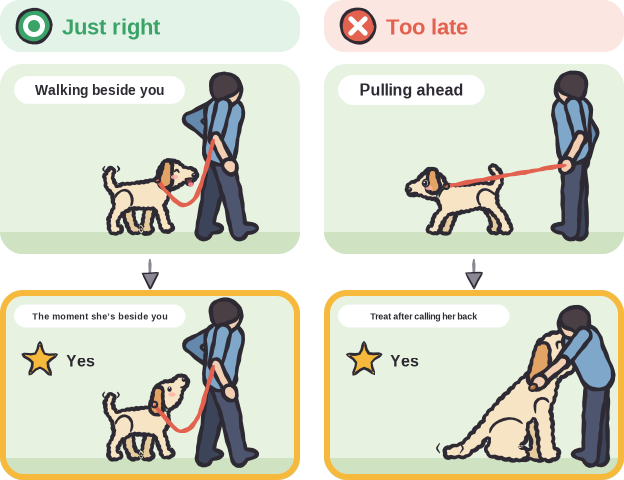
Just right
The instant the leash goes slack and your dog is at your side: “Yes,” then a treat by your leg.
Too late
She pulls out in front, then you call her back and give a treat (now getting ahead is what earns treats).
Stopping has to happen the instant the leash tightens, too. The San Francisco SPCA warns that unless you stop the moment your dog starts to pull, you are rewarding the pulling. If you let her tow you a few steps before you stop, those steps were her reward for pulling.
How much and how often
About 5 minutes, twice a day. Once you reach the outdoor steps, use the first few minutes of a walk (after sniffing time) for practice, and keep practice walking to 10 minutes or less at a time.
If it isn’t working
We keep stopping and hardly get anywhere
Outside is still too hard for now. Do more of the indoor and front-of-house steps. If she has energy to burn, play with her at home first, or do a sniffing game for treats before you set off. Walks taking longer while she learns is normal.
She pulls really hard only at the start of the walk
That’s excitement about going out. With the leash on, don’t open the door until she settles. Some dogs get wound up as soon as the leash appears — PDSA suggests bringing the leash out often through the day — picking it up, putting it down, even clipping it on for a moment — so it stops meaning “we’re leaving right now.” Give her the first few minutes outside as sniffing time on “Off you go,” then start practice walking.
She only stays at my side if she can see the treat
Keep treats in a pouch and bring one out after she’s at your side. Showing her the treat to lure her is only for the first few reps of step 1. Then start spacing out the rewards.
Do I have to use treats forever?
Keep saying “Yes.” Space out the treats a little more at each step. Being allowed to go and sniff is also a big reward for a dog.
She was doing well, and now at around a year old she pulls again
That’s not unusual. Battersea notes that progress often dips during adolescence. Go back a step and reward more often.
How long does loose leash walking take?
There’s no fixed timeline. Battersea says many puppies show progress within a few weeks, while adult dogs with a long history of pulling may take longer. Judge it by whether she has passed the current step, not by the calendar.
Does she have to stay right by my side?
The goal here is a loose leash. If she’s a little ahead or behind but the leash is slack, that’s fine. Walking tight at your side on cue (heel) is a separate skill, covered on the command page.
Which side should she walk on?
Either side is fine — Battersea’s advice is to choose one side and stick to it, and to give treats by your leg on that side.
Avoid
- Jerking or pulling back on the leash
- Following her on a tight leash (if even one person in the family does it, the pulling stays)
- Choke chains, prong collars, shock collars or anything that tightens around her neck
- Training on a retractable leash (the harder she pulls, the further it goes)
A good sign to move on
- Steps 1–2 (indoors): when you stop on a tight leash, it goes slack within about 3 seconds, 8 out of 10 times
- Steps 3–6 (front of the house → quiet street → near distractions): she covers that step’s number of steps without the leash going tight, 8 out of 10 times
- The step counts, seconds and 8 out of 10 are our rules of thumb — there are no official numbers
- If she struggles, go back one step and shorten the session (our rule of thumb: two misses in a row)
Sources
- Battersea — How to teach your dog to walk on a lead
- Dogs Trust — Teach your dog to walk nicely on a lead
- Dogs Trust — Dog walking problems: pulling on lead
- PDSA — Training dogs not to pull
- San Francisco SPCA — Loose-Leash Walking
- RSPCA — Teach your dog to walk nicely on a lead
- Dogs Trust — How to train your dog to wear a harness
- AVSAB — Position Statement on Humane Dog Training (2021)