 BAUDOG The dictionary of dog–human communication
Contents
- In short
- When it happens
- How your dog feels
- First, is it pain or just not used to it?
- If a trainer came to your home: the first session and the first homework
- The order: face → lips → finger → toothbrush
- How to brush: the outside surfaces, along the gumline
- How often should you brush, and for how long?
- Is it okay to never brush your dog’s teeth?
- Do 80% of dogs really have dental disease by age 3?
- Can dental chews or wipes replace brushing?
- Already has tartar? What about anesthesia-free cleaning?
- Starting with a puppy, an adult or a senior dog
- The missing core skill
- Exercises
- In the moment: do / don’t
- When to see a professional
- Sources
In short
Your dog isn’t being difficult. The mouth is a place many dogs don’t like being handled, and if she has been held still while a brush was pushed in, the brush itself now predicts something unpleasant. Sore teeth or gums make it worse. So look first: bad breath, red or bleeding gums, brown tartar? See your vet before you train. If her mouth looks healthy, stop holding her and rebuild in small steps — touch her face, then a treat — until you can brush the outside of her teeth. The goal is brushing every day, which is what veterinary dental guidelines recommend.
When it happens
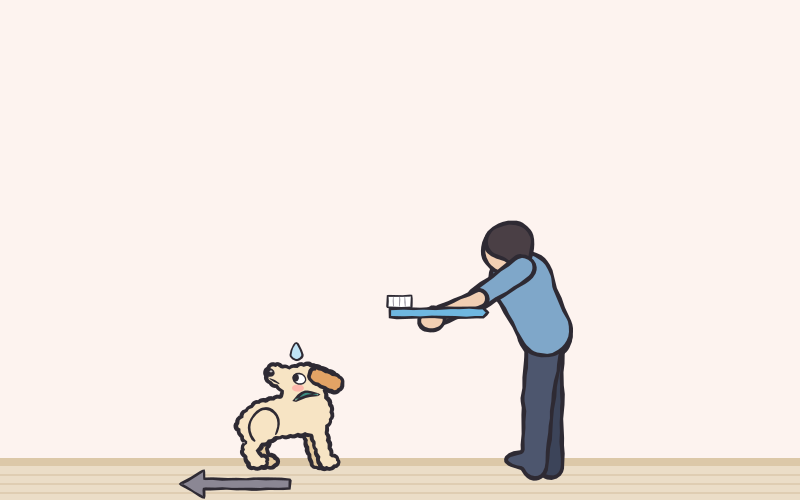
- Your dog runs or hides the moment the toothbrush comes out
- She turns her head away or pushes your hand off with a paw when you touch her mouth
- She chomps on the brush or clamps her mouth shut
- Holding her still turns into a wrestling match, or she growls
- She let you brush when she was a puppy, but now she fights it more and more
How your dog feels
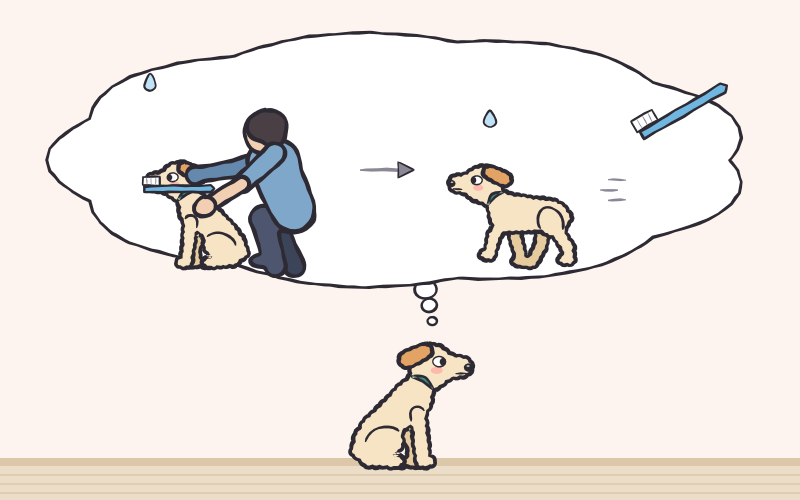
For many dogs, the mouth is a sensitive spot, like the paws and ears. A hand comes in fast, her lips are pried open and something hard goes in. She doesn’t know what is about to happen, and if she is being held, she can’t get away.
After even one experience like that, the toothbrush — or just the way you reach for it — becomes a warning that something unpleasant is coming. She runs at the sight of it because she remembers what comes next.
Dogs tell us “I don’t like this” with their bodies: turning the head away, a quick lick of the nose, a yawn, going stiff, showing the whites of the eyes. If those signals are missed and brushing carries on, many dogs learn to say it louder — with a growl or a snap.
Then there is pain. Gum disease and broken teeth are hard to spot from the outside, and WSAVA’s dental guidelines note that dogs often keep eating even when their dental pain is severe. If your dog has suddenly started hating having her mouth touched, think about pain first.
First, is it pain or just not used to it?
Where you start depends on why she objects. Check these three things.
- Strong bad breath, red gums, gums that bleed, brown tartar, more drooling, chewing on one side, or turning down hard food? If you see any of these, have your vet look in her mouth before you train. Brushing inflamed gums hurts, and it will make her hate brushing even more. The American Veterinary Dental College’s owner advice says the same: a dog that often resists brushing may have painful areas in her mouth.
- How far can you go before she objects? Touch around her mouth (cheeks, chin) → lift her lip → touch a tooth with your finger → show her the brush. The furthest point she can handle with a loose, relaxed body is where your training starts.
- Have you ever held her down to brush? Does she run at the sight of the brush? Then put the brush away for now and rebuild from your hand touching her face.
If a trainer came to your home: the first session and the first homework
Here is how we’d expect a visit from an in-home trainer to go — one example, not a fixed script. Toothbrushing practice starts indoors, where you normally brush, and it finishes there too.
- Today: first, the trainer looks with you at her breath and gums. If there are signs of pain, they’ll suggest seeing your vet before training. If not: touch her cheek or chin for one second → take your hand away → treat (the Touch Then Treat practice). The trainer shows you how to read her “I don’t like this” signals on the spot. You’ll also let her lick a little dog toothpaste off your finger to see whether she likes the flavor.
- Homework: once or twice a day, 1–2 minutes each. Up to 10 rounds of a one-second touch around her mouth → treat. On days that’s easy, add lifting her lip for one second → treat. No toothbrush yet. Everyone in the family: no holding her still, and let go the moment she signals.
- Next visit: can you lift her lip and touch her canine tooth (the big fang) with a finger for one second while her body stays relaxed? Our rule of thumb: 8 out of 10 times, and the next homework becomes rubbing her teeth with a finger and toothpaste. If she still objects, another week on her face and lips.
The order: face → lips → finger → toothbrush
Raise only one thing at a time — where you touch, how long, or what you use. Keep sessions short and stop while she’s still comfortable. Our rule of thumb: move on once she manages the current step 8 out of 10 times without any “I don’t like this” signals. If she signals, go back one step — again a rule of thumb: two signals in a row. There’s no set number of days to the toothbrush. WSAVA’s owner toolkit says it can take a few weeks of daily practice, to go at your dog’s pace, and if she’s too uncomfortable, to stop and try again the next day. This order — stroke her face, lift her lip, touch the canine tooth, rub along the gumline, then the brush — follows the same toolkit.
No hitting, scolding or holding her down. Getting it over with by force usually means she resists even more next time.
- Touch her face: touch her cheek, chin or the side of her mouth for one second → take your hand away → treat. The touch comes first, the treat after.
- Lift her lips: lift her lip from the side for one second until you can see her canine and back teeth → treat. Slowly build to 2 seconds, then 3.
- Make the toothpaste a treat: let her sniff a dog toothpaste, then lick it off your finger. If she loves the flavor, it becomes a reward in itself.
- Rub with a finger: lift her lip and touch her canine tooth with a finger → treat. Once that’s easy, gently rub along the line where tooth meets gum with a finger and toothpaste (or a finger brush). Each day, add one more tooth.
- Make the brush good news: show her the brush → put it away → treat. Let her lick toothpaste off the brush.
- One tooth with the brush: a few gentle strokes on the outside of a canine tooth → a really good treat → done for today.
- Add one tooth a day: canines → the outsides of the back teeth → the front teeth. Once you can reach the outside of the back teeth under her upper lip, you’re ready for daily brushing. If she starts objecting when the brush comes in, go back to touching one tooth at a time with the brush.
- If she knows a chin rest, brush only while her chin is resting, and stop when she lifts it (see the Chin Rest practice). She gets a way to say “wait a moment,” which makes brushing easier to keep up. Dogs Trust’s guide to cleaning your dog’s teeth starts with teaching a chin rest, too.
How to brush: the outside surfaces, along the gumline
Hold the brush at about a 45-degree angle to the line where tooth meets gum, and move it in small circles. The outside (cheek side) of the teeth matters most. The World Small Animal Veterinary Association (WSAVA) recommends starting by brushing the outside surfaces with her mouth closed. You don’t need to open her mouth wide — just lift her lip and brush the outsides.
Gum disease is more common in the back teeth than the front, and in the upper teeth more than the lower. Reaching the outsides of the back teeth under her upper lip is the finish line for this training.
Choose a soft dog toothbrush that suits the size of her mouth. A finger brush is handy partway through the training.
Never use human toothpaste. Dogs can’t spit, so they swallow it. Human toothpastes often contain foaming detergents, abrasives and fluoride, and they aren’t made to be swallowed. Some also contain the sweetener xylitol, which can cause a sudden drop in a dog’s blood sugar and, depending on the amount, liver damage. Use a dog toothpaste, made to be swallowed.
How often should you brush, and for how long?
Aim for every day. WSAVA’s guidelines say once a day is ideal, and the American Animal Hospital Association (AAHA) says brushing needs to be daily to be of benefit. The American Veterinary Medical Association (AVMA) says daily is best, but brushing several times a week can still be effective. Sources disagree on whether every other day or three times a week is enough. If in doubt, aim for daily.
Daily matters because plaque comes back fast. WSAVA’s guidelines say plaque forms within 24 hours and starts turning into tartar within 3 days. They also note that if brushing stops for as little as a month, gum inflammation goes back to the level of dogs who get no care at all.
Once she’s used to it, brushing takes less than 2 minutes (WSAVA owner toolkit). Our view: while you’re still training, one spot for a few seconds a day is fine. Keeping it daily matters more than making it long.
Is it okay to never brush your dog’s teeth?
Brushing is the most reliable home care there is, and nothing else does the same job. If she won’t accept a brush yet, keep training at her pace and, in the meantime, see the options below — wiping her teeth, VOHC-accepted chews — as partial help, not a replacement. Ask your vet to check her mouth, too: if her gums are already sore, brushing can wait until they’ve been treated.
If she shows signs of being worried, or you’re stuck, Dogs Trust advises speaking to your vet or a qualified behaviorist. That’s a better next step than holding her down.
Do 80% of dogs really have dental disease by age 3?
You’ll often read that “80% of dogs have dental disease by age 3.” How big the number is depends heavily on how you count, and we couldn’t trace the original source of that exact wording. The closest figure we found is in the MSD (Merck) Veterinary Manual: up to 80% of dogs have some level of periodontal disease by age 2. That figure goes back to a veterinary dentistry textbook from 1997.
Newer research gives very different numbers. Among 22,333 dogs randomly selected from UK veterinary practice records, 12.5% were diagnosed with periodontal disease during 2016 — and the researchers themselves say this is probably an underestimate, because some cases are missed at check-ups. In contrast, a US study that examined and scored the mouths of 445 adult dogs in commercial breeding facilities found periodontal disease in 86.3%. Counting diagnoses written in records versus looking in every mouth and including mild gingivitis (redness along the gum edge) — and studying different groups of dogs — makes that much difference.
The same UK study found higher rates in small breeds, such as toy poodles (26.0%) and Yorkshire terriers (22.2%). The study only counted how common it was, but our advice is to start getting small dogs used to brushing especially early.
Can dental chews or wipes replace brushing?
Chews, treats and dental diets don’t replace brushing. WSAVA’s guidelines call brushing the gold standard and note that chew products don’t clean the canine and front teeth effectively. In one study of 22 dogs, daily brushing was more than three times as effective at controlling plaque as a daily dental chew or dental diet. Use chews as an extra, not instead. Products that meet set standards for reducing plaque or tartar carry the Veterinary Oral Health Council (VOHC) seal.
Gauze and wipes struggle to clean below the gumline, and WSAVA’s earlier guidelines didn’t recommend them (the new guidelines add that well-formulated wipes can be effective). Think of them as a stepping stone for a dog who doesn’t accept a brush yet.
Avoid anything too hard — cow hooves, dried bones, hard nylon toys, antlers. The AVDC advises against them because they can break teeth or damage gums.
Already has tartar? What about anesthesia-free cleaning?
Hard brown tartar can’t be brushed off — brushing only removes plaque. Removing tartar is a job for your vet.
Anesthesia-free cleaning only scrapes tartar from the visible surfaces. It can’t clean or check below the gumline, where gum disease does its damage. The American Veterinary Dental College (AVDC) calls it purely cosmetic and not an effective way to prevent dental disease, and WSAVA’s dental guidelines committee strongly opposes it. If you’re worried about tartar, talk to your vet.
Even after a professional cleaning, plaque comes straight back unless you brush at home every day.
Starting with a puppy, an adult or a senior dog
With a puppy, you can start touching around the mouth and lips → treat from the day she comes home (see the Puppy Socialization practice). Full brushing with a toothbrush can wait until her adult teeth are in — around 6 to 7 months is a common guide. Puppy teeth start to fall out at around 4 to 5 months, and all 42 adult teeth are in by about 7 months. Teething can make her mouth sore, so don’t scrub; you don’t want brushing to become a bad memory.
Adult and senior dogs can learn in the same order. But if her gums are already inflamed, brushing will hurt and make her dislike it more, so it’s worth having your vet check her mouth before you begin.
The missing core skill
Exercises
- ExerciseTouch Then Treat: Help a Dog Who Hates Being Handled Learn to Enjoy ItDoable at home (Steps 1–5 at home)Even when a sensitive spot is touched, her body stays relaxed and she looks to you for the next treat.Read →
- ExerciseChin Rest Training: Teach Your Dog a “Start Button” for Grooming and Vet CareDoable at home (Steps 1–5 at home)She offers her chin to your palm or a towel on her own, and keeps it there for a few seconds up to about 10. While her chin is down, she’s comfortable being touched.Read →
- ExercisePuppy Socialization: How to Make New Things Good ExperiencesStart at home, finish outside (Steps 1–2 at home)When she meets a new person, object or sound, she approaches on her own or watches calmly. When she’s touched, she looks at you expecting a treat.Read →
In the moment: do / don’t
Do
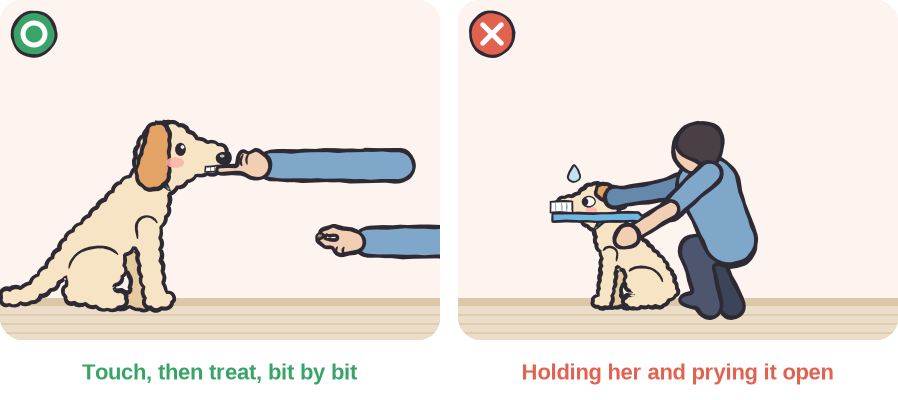
- Touch her face → take your hand away → treat. Touch first, treat after
- Let go the moment she signals (turns away, licks her nose, goes stiff)
- Keep it daily, even if it’s one spot for a few seconds
- Show the brush, then treat — make the brush a sign that good things are coming
Don’t
- Hold her down and pry her mouth open
- Scold her for growling or snapping
- Use human toothpaste
- Try to brush every tooth in one go
When to see a professional
- Strong bad breath, red or swollen gums, bleeding gums or tartar — these can mean gum disease
- More drooling, trouble eating, chewing on one side, turning down hard food, or pain when you touch her mouth
- A broken, discolored or loose tooth, or swelling on her face (for example, below the eye)
- She has suddenly started hating having her mouth touched — pain is a possibility
- She growls or snaps when you touch her mouth. Have your vet check for pain, then work with a qualified behavior professional who doesn’t use punishment
Go to the root
Don’t stop at the quick fix. Growing the skill underneath makes other problems lighter too.
 Core skill Comfort with Handling
- ExerciseTouch Then Treat: Help a Dog Who Hates Being Handled Learn to Enjoy ItDoable at home (Steps 1–5 at home)Read →
- ExerciseChin Rest Training: Teach Your Dog a “Start Button” for Grooming and Vet CareDoable at home (Steps 1–5 at home)Read →
- ExercisePuppy Socialization: How to Make New Things Good ExperiencesStart at home, finish outside (Steps 1–2 at home)Read →
Sources
- WSAVA Global Dental Guidelines (Niemiec et al., 2026). Journal of Small Animal Practice
- WSAVA Global Dental Guidelines (2017 English PDF)
- WSAVA Global Dental Committee — Toothbrushing Toolkit (for owners)
- AAHA (2019) Dental Care Guidelines for Dogs and Cats
- AVMA — Pet dental care
- AVDC — Position Statement: Dental Scaling Without Anesthesia (2024)
- AVDC — Home Care for Dogs (2014 owner page, archived as a PDF by the MVMA)
- Dogs Trust — Cleaning your dog’s teeth (dog dental hygiene)
- Cornell Riney Canine Health Center — Periodontal disease
- MSD Veterinary Manual — Periodontal Disease in Small Animals
- MSD Veterinary Manual (owners) — Dental Disorders of Dogs
- MSD Veterinary Manual (owners) — Dental Development of Dogs
- MSD Veterinary Manual — Xylitol Toxicosis in Dogs
- ASPCA — People Foods to Avoid Feeding Your Pets
- VOHC (Veterinary Oral Health Council) — About
- O’Neill et al. (2021). Epidemiology of periodontal disease in dogs in the UK primary-care veterinary setting. Journal of Small Animal Practice 62:1051–1061
- Stella, Bauer & Croney (2018). A cross-sectional study to estimate prevalence of periodontal disease in a population of dogs in commercial breeding facilities in Indiana and Illinois. PLOS ONE 13:e0191395
- Dogs Trust — How to have a happy vet visit with your dog
- RSPCA — Understanding your dog’s body language
- Klebba, K. (AVSAB handout) — Cooperative Care: When to touch and poke?
- AKC — Dog Training Duration, Distance, Distraction (the 3 Ds)
- Karen Pryor — The Ten Laws of Shaping (Karen Pryor Clicker Training)