 BAUDOG The dictionary of dog–human communication
Contents
When to use this exercise
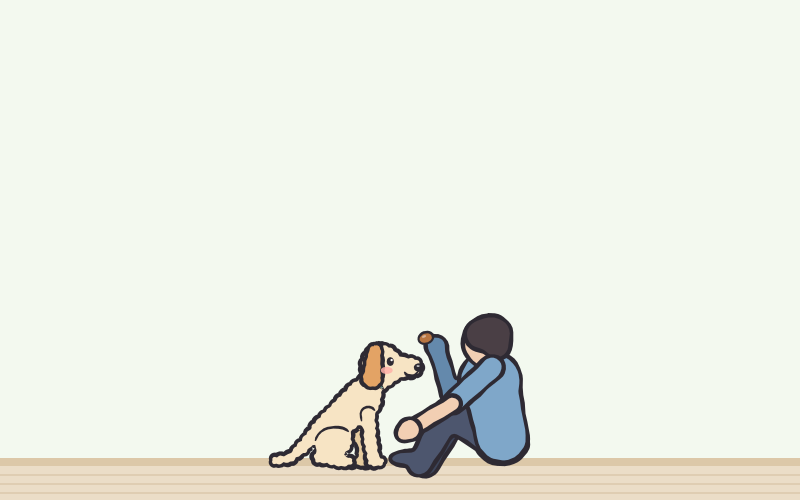
This is the groundwork for nail trims, toothbrushing, grooming and eye drops. It’s for the dog who turns her head away, pulls back her paw or goes stiff when you touch her feet or mouth. You turn those places into “being touched there means something good is coming.” Instead of holding her and getting it over with, you go a little at a time while she stays relaxed. It builds Comfort with Handling, and you can practice a little every day in a quiet room at home.
GoalEven when a sensitive spot is touched, her body stays relaxed and she looks to you for the next treat.
Assessment: what a trainer might check on the first visit
A visiting trainer might check these before starting.
Lightly touch her shoulder, back, chest, paws, mouth, ears and tail in turn. How far can you go before she objects?
→Where she’s comfortable is step 1. The spot just before she starts to object is where step 2 begins.
What signals does she give when touched? (Turning her head away, a quick lick of the nose, yawning, going stiff, the whites of her eyes showing, ears pinned back)
→Make sure everyone in the family reads these as “please stop.” The rule of this practice: when she signals, take your hand away at once.
Does she ever growl, show her teeth or try to bite when touched? Has she recently started disliking being touched?
→If so, have your vet check for pain or illness before you start. If the growling or snapping continues, make a plan with a qualified behavior professional who doesn’t use punishment.
Have you ever held her down for grooming? Does she run at the sight of the tools?
→If the tools alone make her run, put them away for a while and rebuild from touching with your hand.
What you need
- Really good treats, cut small (a lickable paste treat is easy to give in small amounts)
- A quiet room with enough space for her to move away if she wants to
- Tools (nail clippers, toothbrush, grooming brush) only from step 4
How to signal
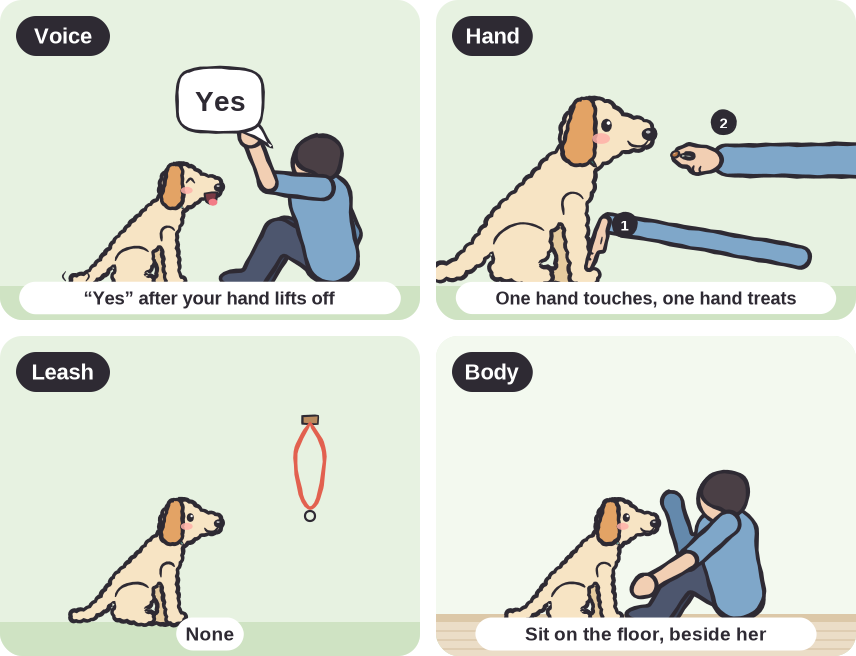
- Voice
Just before you touch, say a short word for the spot (“shoulder,” “paw,” “mouth” — always the same word for the same spot). Knowing what’s coming helps her relax. After you take your hand away, say “Yes.”
- Hand
Touch with one hand; after that hand comes away, the treat comes from the other. Don’t touch while you’re showing or feeding a treat.
- Leash
None. Make sure she can walk away if she wants to.
- Body
Sit on the floor beside her. Don’t lean over her. No holding, no hugging her still.
Today’s session
With the trainer, you work on step 1.
Step 1Start where she’s comfortable(At home (quiet room))
The trainer shows you once — a one-second touch on a spot she’s comfortable with, like her chest or shoulder → hand away → treat — then hands over to you. Ten repetitions. Together you check how to read her signals and stop short of the spots she finds hard. It takes about five minutes.
Homework until the next visit
- How often
- 1–3 times a day
- How long
- 2–3 minutes each
- How much
- No more than 10 touches per session
A good sign she’s readyA one-second touch on a sensitive spot with her body staying relaxed, 8 out of 10 times
What the trainer checks next visit
In front of the trainer, touch a sensitive spot (paw, mouth…) for one second, 10 times.
If she canRelaxed 8 out of 10 times → step 3 (longer touches, holding) becomes the next homework.
If not yetGo back one place and do another week. If she growls or tries to bite, don’t push on: have your vet check for pain, and rework the plan with a professional.
Next stages: steps
- 1
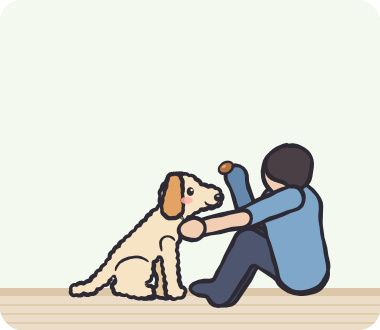
At home (quiet room)
Start where she’s comfortable
A one-second touch on a comfortable spot — chest, behind the ears, shoulder → hand away → treat.
A good sign to move onWhen touched, she looks at you expecting the treat
- 2
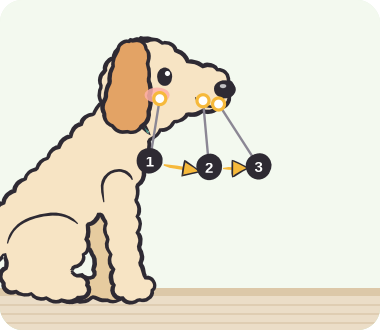
At home (quiet room)
Work toward a sensitive spot
One place at a time — for a paw: shoulder → elbow → wrist → paw; for the mouth: cheek → side of the mouth → lips. If she signals, go back one place.
A good sign to move onA one-second touch on a sensitive spot with her body relaxed, 8 out of 10 times
- 3
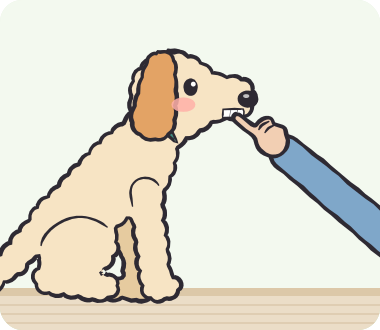
At home (quiet room)
Longer touches, holding
Very slowly make the touch longer (3 seconds → 5 → about 10). For a paw, hold it and spread the toes; for the mouth, lift the lip.
A good sign to move onHeld for about 10 seconds with her body relaxed (the number of seconds is a guide)
- 4
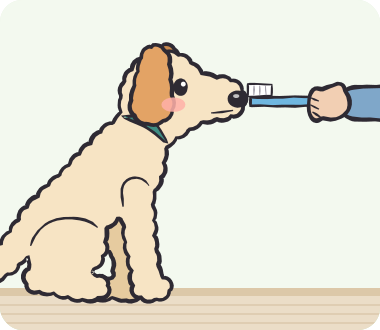
At home (quiet room)
Show the tool, touch with it
Show the tool → put it away → treat. Touch her body with the tool → take it away → treat. With nail clippers, just the “click” sound without cutting → treat.
A good sign to move onShe comes over when she sees the tool
- 5
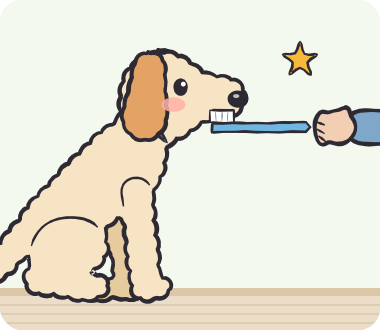
At home (quiet room)
One real go
Trim one nail or brush one tooth → a really good treat → done for today.
A good sign to move onSeveral days in a row of doing one without her objecting
- 6
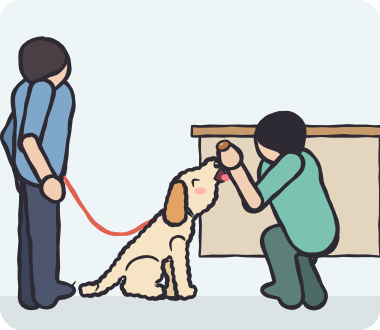
At the vet’s (no appointment)
At the vet’s
On a day with no appointment, drop into the waiting room and do touch → treat. Bring treats and ask the reception staff or the vet to hand them over.
A good sign to move onEven at the vet’s, she eats the treats and her body stays relaxed
Timing
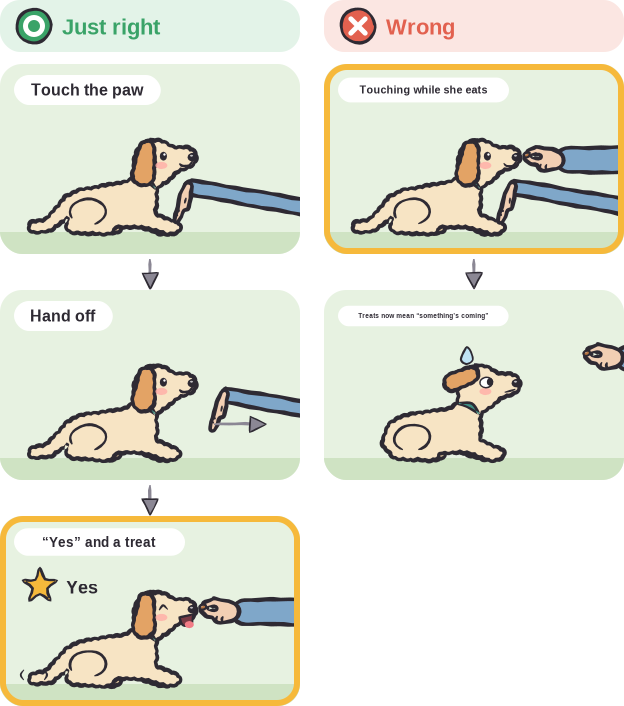
Just right
Say “paw” → touch → take your hand away → straight away, “Yes” and a treat. Always in the same order.
Too late
In this practice, touching while she’s eating a treat. The touch and the treat arrive together, and the “touch, then treat” order falls apart.
Order is what matters in this practice. The thing she dislikes (being touched) comes first, the good thing (a treat) comes after. That way, being touched becomes a signal that a treat is on its way. We keep to this order because, in our view, showing a treat first or touching while she eats can, over time, turn the treat itself into a sign that “something is about to be done to me.” The American Animal Hospital Association (AAHA) guidelines also list changing how a dog feels about something by pairing it with something good (counterconditioning) and using food to distract her as two separate techniques. Distracting a dog with food to get a quick procedure done — at the vet’s, for example — is sometimes used, but as a different method from this practice.
How much and how often
2–3 minutes per session, no more than 10 touches. About 1–3 sessions a day — a little every day.
If it isn’t working
She turns her head away, licks her nose or goes stiff
That’s “please stop.” Take your hand away at once and go back to the previous place, or a shorter touch. Once she learns that you’ll stop, she settles and finds it easier to accept being touched.
She stops taking treats
That spot or that length of touch is too hard for your dog right now. Go back to a comfortable spot. Switching to a treat she likes even more can help too.
She growls, shows her teeth or tries to bite
Please don’t scold her. A growl is an important warning: “that’s enough.” That spot is still too soon. Have your vet check for pain and talk to a qualified behavior professional who doesn’t use punishment.
She backs off as soon as she sees a treat, before you’ve even touched her
The treat may have become a sign that “something is about to be done to me” (our reading). For a while, keep treats out of sight and only bring one out after the touch.
Her nails or teeth need doing right now
Until the training catches up, ask your vet or groomer to do it. Holding her down at home to force it sets the training back.
Avoid
- Holding her down to get it over with in one go
- Scolding her for growling
- Carrying on when she is signaling “I don’t like this”
- Sneaking in a touch while she’s eating a treat
A good sign to move on
- Steps 1–2: a one-second touch on a sensitive spot with her body relaxed, 8 out of 10 times → move on (our rule of thumb)
- Steps 3–5: several days in a row of doing that step with no “I don’t like this” signals → move on
- If she struggles, go back one step (our rule of thumb: two signals in a row)
- Once step 2 is going well, you can start the Chin Rest alongside this practice
Sources
- Dogs Trust — How to have a happy vet visit with your dog
- Hawaiian Humane Society — Handling and Touch Sensitivity (PDF)
- MSD Veterinary Manual — General Guidelines for Effective Controlled Exposure Behavior Modification in Dogs (table)
- MSD Veterinary Manual — Treatment of Behavior Problems in Animals
- AAHA (2015) Canine and Feline Behavior Management Guidelines
- Klebba, K. (AVSAB handout) — Cooperative Care: When to touch and poke?
- RSPCA — Understanding your dog’s body language
- Dogs Trust — Dog aggression: causes, warning signs and how to help
- RSPCA NSW — Prevent-a-Bite Program 2024: Growling (PDF)
- VCA Animal Hospitals — Introduction to Desensitization and Counterconditioning