 BAUDOG The dictionary of dog–human communication
Contents
What this skill is
This is your dog’s ability to stay loose and relaxed while her paws, mouth, ears and body are touched. Nail trims, toothbrushing, grooming, eye drops and vet exams all rest on it. Holding a dog down may get the job done today, but she usually resists more next time. There are two ways to build it. One is Touch Then Treat: making the touch itself a sign that something good is coming. The other is the Chin Rest: giving her a way to say “go ahead” and “wait a moment” herself. The idea is to let her take part in her own care.
How your dog feels
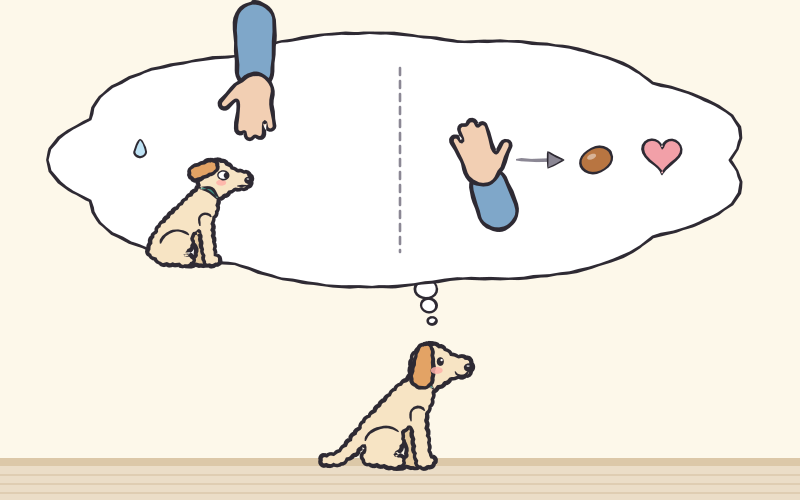
Paws, mouth, ears and tail are places many dogs don’t like being touched. A hand reaches in suddenly and she’s held still. On top of not knowing what’s about to happen, she can’t get away.
Dogs can’t tell us “I don’t like this” in words, so they say it with their bodies: turning the head away, a quick lick of the nose, a yawn, going stiff, showing the whites of the eyes, ears pinned back. If those signals are missed and the handling carries on, many dogs learn to say it louder — with a growl or a snap.
On the other hand, once she learns that you’ll stop if she’s uncomfortable, she settles and finds it easier to accept being touched. The American Animal Hospital Association (AAHA) guidelines note that dogs who had some control over their exam were less stressed. Knowing she can stop it is what makes accepting it possible. In a small study of 28 dogs (four vet visits over eight weeks), dogs who had exams designed to minimize restraint and fear — and whose owners practiced at home three times a week for about 5 minutes — became less stressed over time than dogs who had standard exams.
If she has suddenly started disliking being touched, think about pain. Sore teeth and sore joints are hard to see from the outside.
Assessment: where is your dog now?
A visiting trainer might start by checking, at home, how far your dog is comfortable right now. Try these four. Wherever she struggles is the stage to start at.
Lightly touch her shoulder, back, chest, paws, mouth, ears and tail in turn. Where does she stay relaxed? Where does she start to object?
→Start where she’s comfortable and work toward the more sensitive places. If any spot bothers her, begin at the first stage: at home, touching with your hand.
Does she run off or freeze just at the sight of the nail clippers, toothbrush or grooming brush?
→Then put the tools away for a while. Do the hand-touch stage first, and rebuild the tools from “just showing them” in the second stage.
Does she growl, show her teeth or try to bite when touched — or has she recently started objecting out of the blue?
→See your vet to rule out pain or illness before you train. Then make a plan with a qualified behavior professional who doesn’t use punishment.
At the vet’s or the groomer’s, does she struggle, tremble or refuse treats?
→Once the home stages are going well, move on to dropping in at the vet’s on days she has no appointment.
Problems when this skill is weak
Signs this skill is weak
- She fights nail trims, toothbrushing or grooming
- She growls or tries to bite when touched
- She pulls her paw away when you touch it, or runs at the sight of the tools
- She struggles or trembles at the vet’s or the groomer’s
- Problems Dog Biting: Keep Everyone Safe First, Then Find Out Why and Fix It With a Professional Read →
- Problems Dog Growling: What It Means, Why You Shouldn’t Punish It, and What to Do Read →
- Problems Dog Hates Teeth Brushing? How to Rule Out Pain and Train It Step by Step Read →
- Problems Dog Hates Nail Trimming? How to Fix It, One Nail at a Time Read →
- Problems Dog Hates Being Brushed? Why It Happens and How to Make Brushing Easy Read →
Prescription: a suggested order
Our suggested order. Start with Touch Then Treat. Once she’s fine with being touched in her comfortable spots, you can start the Chin Rest alongside it. With a puppy, build a little daily handling into Puppy Socialization.
- ExerciseTouch Then Treat: Help a Dog Who Hates Being Handled Learn to Enjoy ItDoable at home (Steps 1–5 at home)Turns being touched into a sign that something good is coming. This is the very first practice.Read →
- ExerciseChin Rest Training: Teach Your Dog a “Start Button” for Grooming and Vet CareDoable at home (Steps 1–5 at home)Gives her a way to say “go ahead” and “wait a moment” herself. This is what you use for the real nail trim or brushing.Read →
- ExercisePuppy Socialization: How to Make New Things Good ExperiencesStart at home, finish outside (Steps 1–2 at home)While she’s young, makes having her mouth, paws and ears touched a series of good experiences.Read →
- ExerciseThe Trade Game: Teach Your Dog to Drop It by Swapping, Not GrabbingDoable at home (Steps 1–4 at home)Teaches her to give up what’s in her mouth in exchange, rather than having it taken. She also gets used to hands near her mouth.Read →
- ExerciseRelaxing on a Mat: How to Teach Your Dog to SettleDoable at home (Steps 1–4 at home)Teaches her to settle and relax in the place where you do her care.Read →
How it grows
-
Level 1At home (hand only)
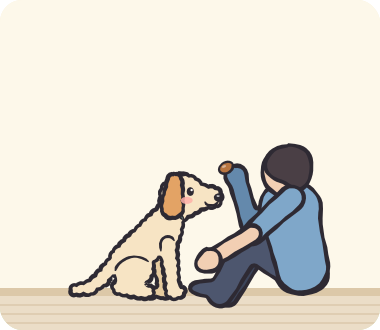
In a quiet room, one spot at a time with your hand — from where she’s comfortable toward where she’s sensitive. Touch → take your hand away → treat. The practice is Touch Then Treat. The first homework starts here.
A good sign to move on A one-second touch on a sensitive spot with her body staying relaxed, 8 out of 10 times
-
Level 2At home (with tools)
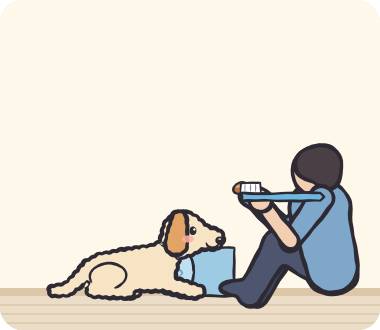
Start with looking at the tool → treat, then touching her with it → treat, and work up to one nail or one tooth. If she knows the Chin Rest, use the tool only while her chin is resting.
A good sign to move on Day after day of using the tool with no “I don’t like this” signals. With a chin rest: one nail or one tooth while her chin stays down
-
Level 3At the vet’s (drop-in, no appointment)
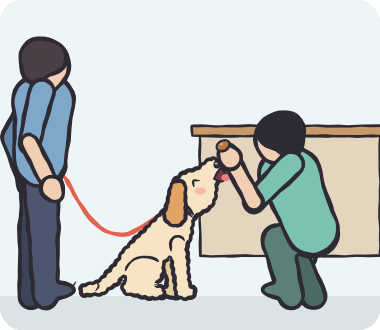
On a day with no appointment, pop into the waiting room, get a treat and go home. Stack up “just fun” visits with no injections or procedures. In a study that observed 135 dogs at a vet clinic, about 8 in 10 (78.5%) showed fear, mostly on the exam table — and dogs who had only had good experiences at the vet were less fearful than dogs who’d had a bad one.
A good sign to move on She can eat treats and stay settled in the waiting room
-
Level 4On the exam table and at the groomer’s
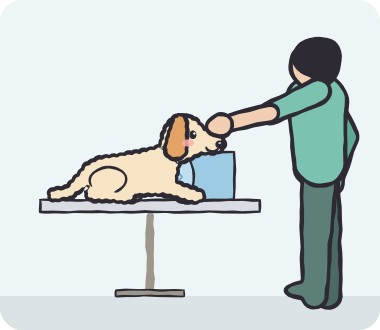
Being touched by people outside the family — the vet, the groomer. Bring her usual towel and treats, and use the Chin Rest. Practice with familiar people first, then people she knows less well, then someone new.
A good sign to move on Even when someone outside the family touches her, she can eat and her body stays relaxed
Principles
- Touch first, treat after. This isn’t about sneaking in a touch while a treat distracts her.
- Let go the moment she signals (turns away, licks her nose, goes stiff). Learning that you’ll stop is what makes her able to accept it.
- Don’t hold her down. Care that can’t wait — a nail trim, say — can go to your vet or groomer until the training catches up.
- One nail or one tooth a day still counts as success. Don’t try to get it all done at once.
- Never scold a growl. A growl is an important warning: “that’s enough.” Punish it and she may learn to bite without warning.
- Work from her least sensitive spots to her most sensitive ones, and if she gets uneasy, go back to where she was comfortable.
- If she suddenly starts objecting to being touched, have your vet check for pain first.
- Keep sessions short — a few minutes — and stop while she’s still comfortable.
When to see a professional
- She has suddenly started disliking being touched, or objects strongly to one particular spot. Pain or illness is possible — see your vet first.
- She growls, snaps or tries to bite when touched. Have your vet check for pain, then talk to a behavior professional who doesn’t use punishment (for example, a veterinarian who sees behavior cases).
- She struggles hard, panics or can’t eat anything every time you try to care for her. Don’t push on with home practice alone — make a plan with a professional. Vets sometimes use medication to ease the anxiety.
Sources
- MSD Veterinary Manual — Behavior Problems of Dogs
- AAHA (2015) Canine and Feline Behavior Management Guidelines
- Purdue University Canine Welfare Science (Croney Research Group) — Quick Tips for Success: Adult Dog Body Handling
- Dogs Trust — How to have a happy vet visit with your dog
- Dogs Trust — Dog aggression: causes, warning signs and how to help
- RSPCA — Understanding your dog’s body language
- Squair et al. (2024). Effects of changing veterinary handling techniques on canine behaviour and physiology Part 2. Animal Welfare 33:e43
- Döring et al. (2009). Fear-related behaviour of dogs in veterinary practice. The Veterinary Journal 182:38–43
- MSD Veterinary Manual — Treatment of Behavior Problems in Animals