 BAUDOG The dictionary of dog–human communication
Contents
- In short
- When it happens
- How your dog feels
- Why is my dog humping? Look at when, who and what happens
- When it’s fine to let it go
- If a trainer came to your home: the first session and the first homework
- How to stop dog humping: switch her before it starts
- When she humps your leg or arm
- When she humps other dogs
- When she humps pillows or toys
- Why does my female dog hump?
- Will neutering or spaying stop humping?
- Helping her come back down from excitement
- The missing core skill
- Exercises
- In the moment: do / don’t
- When to see a professional
- Sources
In short
Humping — clasping with the front legs and thrusting — is something male and female dogs both do, neutered and spayed dogs included. Dogs hump for many reasons: play, excitement, stress, sex or wanting your attention. You’ll often read that it’s about dominance, but views differ. The ASPCA does list social status as one reason, but only as one among many, and the American Veterinary Society of Animal Behavior (AVSAB) says most unruly behavior in dogs happens because it has been rewarded, not because a dog wants higher rank. If it happens now and then and bothers no one, you don’t need to stop it. If it does bother someone, skip the scolding: at the first warning signs (panting, sidling up), switch your dog to a toy or a cue she knows, and practice calming back down after excitement. If she licks her genitals a lot or pees more often than usual, see your vet first.
When it happens
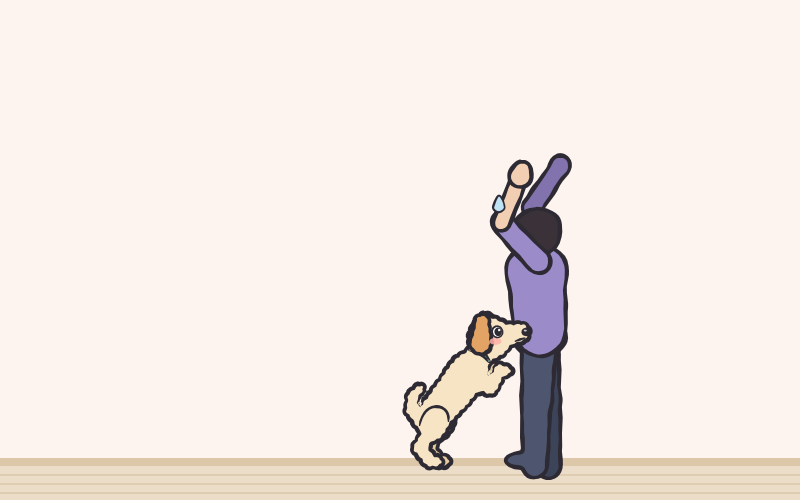
- Your dog wraps her front legs around a guest’s leg and starts humping
- At the dog park, she climbs onto another dog’s back
- She humps a cushion or a stuffed toy
- When play gets wild, she mounts your arm or leg
- You walk in the door and, before you’ve put your bag down, she’s humping your leg
How your dog feels
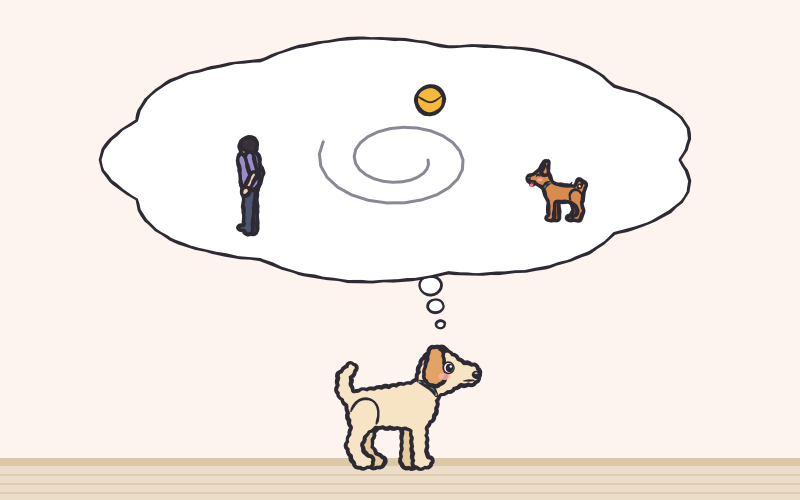
Puppies hump their littermates, playmates, people and toys, and mounting is a normal part of play. Plenty of dogs keep it up as adults, too — male and female, and after being neutered or spayed. For dogs who keep humping after being neutered or spayed, the ASPCA’s explanation is that they’ve learned it feels good.
Excitement and stress can set it off as well. The ASPCA describes how, after meeting a new dog or person, an aroused, excited dog may mount another dog, his owner or a nearby object like a dog bed or a toy.
Then there’s what happens next. She humps, and everyone laughs, shouts or pushes her away. To a dog, all of that is attention — and attention is a good reason to do it again.
The “it’s about dominance” explanation is everywhere. The ASPCA does include displaying social status among its reasons, but alongside play, excitement, stress and sex. The UK veterinary charity PDSA, listing the most common triggers, names sex, play, excitement, stress and medical problems — status isn’t on the list. And AVSAB says, about dog behavior in general rather than humping specifically, that most unruly behaviors happen not out of a desire to gain higher rank but because they’ve been rewarded. A board-certified veterinary behaviorist writing for PetMD goes further and calls the dominance idea a myth.
Why is my dog humping? Look at when, who and what happens
The reason changes what you do about it. For about a week, jot down each time it happens: where, who or what she humped, and what was going on just before. We also suggest a short phone video of an episode — a handout written by UC Davis veterinary students notes that a journal or a video can help your vet work out the reason. The same handout offers a rough guide, not a rule: when a dog mounts a person, it’s typically stress, anxiety or attention-seeking; when she mounts another animal, it’s typically arousal, anxiety or play.
- When play gets exciting, after visitors arrive or when you come home? It’s an outlet for excitement. Start with “Switch her before it starts” below, and practice calming down.
- When people are busy with something else — and someone always reacts when she does it? Wanting attention is keeping it going. Agree as a family on how everyone responds.
- Around a female in heat, or she’s an intact male? Sex may be a big part of it. See “Will neutering or spaying stop humping?” below.
- She licks, chews or rubs her genitals a lot, or pees more often than usual? A medical problem may be involved. See your vet first.
- Many times a day, she won’t stop when you try to interrupt, and it gets in the way of everything else? It may be serious stress, or a compulsive habit. Talk to your vet or a qualified behavior professional.
When it’s fine to let it go
The ASPCA says that if a dog mounts infrequently — once or twice a day at most — and it doesn’t bother you, other people or other dogs, there’s no need to stop it.
Other dogs are the exception. Many dogs don’t like being humped, and it can start a fight. If the other dog moves away, growls or freezes, step in right away.
If a trainer came to your home: the first session and the first homework
Here is how we’d expect a first in-home session to go — one example, not a fixed script. A trainer might, for example, start by going over the situations where your dog humps and the signs just before (panting, sidling up, putting a paw on someone), and ask whether there are any medical warning signs and whether she’s been checked by a vet.
- Today: play with a toy for about 5 seconds, say “All done” and stop the toy. Once your dog settles, say “Let’s play” and start again (step 1 of Play and Pause). The trainer also shows you how to switch her when the signs appear — toss a toy, or ask for a cue she knows, like “Sit.”
- Homework: note each episode and the signs just before it. When the signs appear, switch her before she starts humping, and praise her. Play and Pause twice a day, 3–5 minutes each time. Before guests come, set her up on her mat or in another room with a long-lasting chew. Everyone in the family agrees not to laugh or shout when she humps.
- Next visit: the trainer checks whether your notes show fewer episodes, and whether you’re catching the signs in time. Our rule of thumb: once she settles on “All done” in the middle of play 8 out of 10 times, the next homework moves to practicing with visitors (Relaxing on a Mat, Four on the Floor Greetings). If the numbers haven’t dropped, you go through the situations together again and add ways to avoid them.
How to stop dog humping: switch her before it starts
There are often warning signs before mounting: sidling up, panting, licking, whining, pawing, rubbing against the person, dog or object. At that point, switch her to something else — toss a toy, hand her a chew, start a game, or ask for a cue she already knows and enjoys (sit, down, shake).
Decide on a behavior she can do instead, and practice it in advance — “Sit” works well. When the signs appear, say “Sit”; when she sits, praise her and give a treat. Ask for a few more sits or other tricks she knows, and once she’s calmed down a little, play with a favorite toy for a few minutes. Changing what she’s focused on lowers the urge to hump.
When she humps your leg or arm
- Stand up, turn away or sit down — any position she can’t mount. Don’t look at her or talk to her.
- If she keeps going, end the game and give her a short break to calm down (the ASPCA suggests 1–3 minutes in a quiet room). When it’s over, carry on as if nothing happened. There’s no need to be angry.
- If it happens during visits or other lively moments — people hugging, greeting or arguing — ask for a “Sit” or send her to her mat (see Relaxing on a Mat) before those moments start, and reward her often while she stays calm.
When she humps other dogs
- Watch play closely. When she looks ready to mount, call her name or say “Leave it,” and reward her when she comes away.
- If she can’t come away, end that play session. Keep practicing “Leave it” and her name without other dogs around before letting her play again.
- Playing more fetch and tug with you can also make other dogs a little less interesting to her.
When she humps pillows or toys
If it doesn’t bother anyone, you can leave it. If it does, invite her to play or toss a toy as soon as she starts, or move her somewhere else. Our suggestion: put away the cushion or stuffed toy she usually picks, at least for a while.
In male dogs, very frequent humping of objects can damage the sheath (the skin covering the penis). If the skin there looks red or sore, have your vet take a look.
Why does my female dog hump?
Female dogs hump too, and it isn’t always about sex. Play, excitement and stress can drive it in females too. The ASPCA also notes that, during courtship, females in heat often mount the males they’re interested in, and that females commonly mount other females when one or both are in heat.
If she’s intact and mostly humps around her heat — or around other females in heat — spaying might reduce it, the ASPCA says. The PDSA adds that neutering helps with hormone-related humping but usually makes more difference in males than in females. For everything else, the same steps apply: switch her early, and practice calming down.
Will neutering or spaying stop humping?
In intact males, it can reduce humping that’s sexually driven. One study interviewed, by phone, the owners of 57 male dogs neutered after age 2 about how things had changed. Each dog had at least one of nine problem behaviors, such as urine marking, mounting, roaming, fearfulness or aggression, so only some of them mounted. By the owners’ estimates, for mounting, urine marking in the house and roaming, at least 60% of dogs improved by half or more, and 25–40% improved by 90% or more (the three behaviors were reported together).
But humping that comes from play, excitement or stress can carry on regardless of hormones, so neutering or spaying won’t necessarily stop it — which is one reason many neutered and spayed dogs still hump. The ASPCA puts it this way: neutering doesn’t always stop mounting, but it does reduce sexual motivation. Decide on neutering or spaying with your vet, including how it may affect her health.
Helping her come back down from excitement
For a dog whose excitement is looking for an outlet, learning to calm back down gets at the root of it. Practice pausing mid-play and settling (Play and Pause), and relaxing on a mat (Relaxing on a Mat). Reward her for staying relaxed in the moments when she’d usually start humping. Make sure she gets enough exercise to burn off spare energy — and after a high-energy walk or game, give her time to wind down with licking or sniffing activities (a puzzle feeder, a sniffing game).
The missing core skill
Exercises
The order we recommend. All three start at home, and you can work on them side by side.
- ExercisePlay and Pause: Teach Your Dog an “Off Switch” With TugDoable at home (Steps 1–3 at home)Pausing and settling in the middle of play, so she learns to switch her own excitement off.Read →
- ExerciseRelaxing on a Mat: How to Teach Your Dog to SettleDoable at home (Steps 1–4 at home)Relaxing on a mat while guests visit or things get lively.Read →
- ExerciseFour on the Floor: Teaching Your Dog to Greet People PolitelyDoable at home (Steps 1–2 at home)Greeting people with all four paws on the floor. For dogs who grab visitors’ legs.Read →
In the moment: do / don’t
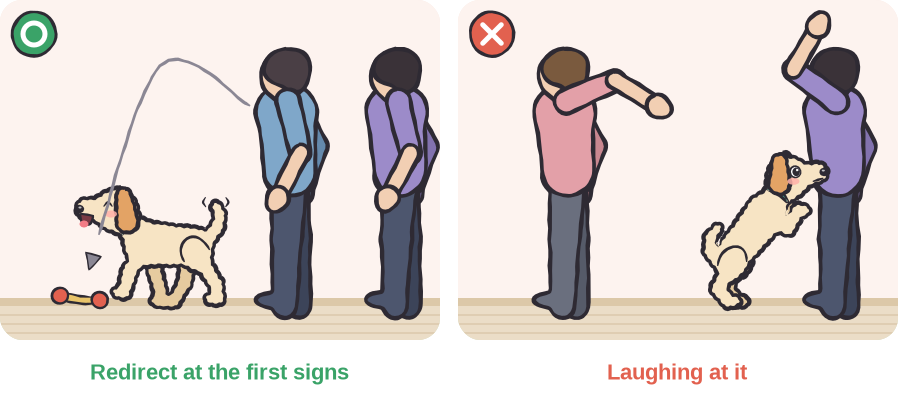
Do
- Switch her to a toy or a cue at the first signs (sidling up, panting)
- When she switches, praise her and play
- Separate them right away if the other dog doesn’t like it
- Before guests arrive, set up her mat or another room with a chew
Don’t
- Yell, hit or pin her down
- Knee her, kick her or shove her off — it can make things worse
- Laugh or make a big fuss when she humps
- Pull apart a dog who growls when you try to stop her
- Rely on training alone when there are medical warning signs
When to see a professional
- She licks or chews her genitals a lot, pees more often or leaks urine, or rubs her body against things — urinary tract infections, incontinence, itchy skin or persistent erections (priapism) can all be involved. See your vet
- In a male, the sheath (the skin covering the penis) is red or has sores
- She growls or looks ready to bite when you try to stop her. Don’t try to stop her yourself — talk to a board-certified veterinary behaviorist or another qualified behavior professional
- She does it all day and can’t be stopped, and it crowds out everything else. It may have become a compulsive behavior. Talk to your vet or a qualified behavior professional
Go to the root
Don’t stop at the quick fix. Growing the skill underneath makes other problems lighter too.
 Core skill Settling Down
- ExercisePlay and Pause: Teach Your Dog an “Off Switch” With TugDoable at home (Steps 1–3 at home)Read →
- ExerciseRelaxing on a Mat: How to Teach Your Dog to SettleDoable at home (Steps 1–4 at home)Read →
- ExerciseFour on the Floor: Teaching Your Dog to Greet People PolitelyDoable at home (Steps 1–2 at home)Read →
Sources
- ASPCA — Mounting and Masturbation
- PDSA — Humping Behaviour in Dogs
- PetMD — Why Do Dogs Hump? (Wailani Sung, MS, PhD, DVM, DACVB)
- Neilson, Eckstein & Hart (1997). Effects of castration on problem behaviors in male dogs with reference to age and duration of behavior. JAVMA 211(2):180–182
- AVSAB — Position Statement on the Use of Dominance Theory in Behavior Modification of Animals
- AVSAB — Position Statement on Humane Dog Training (2021)
- MSD Veterinary Manual (pet owner version) — Behavior Problems in Dogs
- UC Davis (Clinical Animal Behavior Service) — Inappropriate Mounting, a handout created by veterinary students as a class exercise
- Toronto Humane Society — Mounting: What Is It and Why Our Dogs Do It
- Dogs Trust — How to stop your dog jumping up at people
- Dogs Trust — How to prepare your dog for visitors