 BAUDOG The dictionary of dog–human communication
Contents
- In short
- Common at this age
- Your dog at this age
- Assessment: where is your dog now?
- When is the puppy socialization period?
- What to get her used to
- How to socialize a puppy: good experiences over numbers
- Can you socialize a puppy before she’s fully vaccinated?
- Missed the socialization window? (4 months, 5 months, 7 months, adult dogs)
- When a trainer comes to your home: the first session and the first homework
- A good sign to move on
- Skills to build now
- Exercises
- At this age: do / don’t
- When to see a professional
- Sources
In short
Socialization is your puppy learning that the world is safe. The most important stretch — the socialization period — runs from about 3 weeks to about 12 weeks of age, and certainly no later than 14 weeks. Many puppies go home at around 8 weeks: in England, licensed breeders may not sell a puppy under 8 weeks old. In the US, a federal rule bars shipping puppies in commerce before they’re 8 weeks old and weaned, and about 27 states and D.C. have their own minimum age for selling, transferring or bringing in puppies — usually 8 weeks, though many of these laws cover only pet stores, dealers or certain breeders. So even if she comes home at 8 weeks, only about 4–6 weeks of the window are left. That’s why you start in safe ways — carrying her out to watch the world, inviting people over — without waiting for every vaccination. Quality matters more than numbers: if she’s scared, add distance and never push her closer. And when the window closes, she doesn’t stop learning; it just gets slower. At 4 months, 7 months or as an adult, keep going.
Common at this age
- Our vet said to keep her inside until her shots are done — but everyone talks about the socialization window
- What does “carrying her out to see the world” actually involve?
- The socialization checklist is so long we don’t know where to start
- She’s 5 months — or 7 months. Did we miss the window?
Your dog at this age
The American Veterinary Society of Animal Behavior (AVSAB) explains that in the first three months, a puppy’s sociability outweighs her fear, which makes this the main window for getting used to new people, animals and experiences. The UK charity Blue Cross says that by about 12 weeks of age, anything she hasn’t met yet is approached with caution.
A review of the research found that dogs who were appropriately socialized as puppies are less likely to have behavior problems as adults, including aggression and fearfulness. The same review notes that studies of puppy classes themselves have had mixed results. What she experiences in everyday life matters more than whether she goes to a class.
The flip side: repeated frightening experiences can make her more afraid of that thing. Dogs Trust advises stopping the interaction straight away if your puppy shows signs she’s worried or frightened. Socialization isn’t about showing her as much as possible — it’s about stacking up good experiences.
Assessment: where is your dog now?
Where to start with your puppy right now.
How many weeks old is she?
→Up to 12 weeks (3 months), she’s right in the middle of the window. Even past 14 weeks, keep going, using the approach under “Missed the socialization window?” below.
How far along are her vaccinations?
→Until her last shot, socialize from your arms or a carrier, at home, and in indoor classes with floors that can be disinfected. Decide with your vet when she can walk on the ground outside.
How does she react to new things and sounds?
→Going up to sniff, tail wagging loosely — that’s going well. Hiding, freezing, licking her lips, yawning or refusing treats — add distance and start somewhere easier.
Is she okay with being touched (ears, mouth, paws)?
→If there’s a spot she dislikes, do a little Touch Then Treat practice every day.
When is the puppy socialization period?
A review of the research (Howell and colleagues, 2015) puts the socialization period at about 3 to 12 weeks of age, and certainly no later than 14 weeks. Veterinary behaviorists writing for VCA Animal Hospitals also name 3 to 12 weeks as one of the most sensitive periods for behavioral development.
So why do some sources say 12 weeks, and others 14, 16 or even 20? Because the window doesn’t slam shut on a particular day. VCA’s puppy socialization guide calls 3 to 16 weeks the sensitive period, and Best Friends Animal Society says 3 to 20 weeks. The MSD Veterinary Manual (owners’ edition) says dogs are most receptive to learning how to deal with new situations until about 16 to 20 weeks of age — and that after that they don’t stop learning from exposure; they just learn more slowly. AVSAB strongly encourages owners of puppies past three months to keep socializing them to as many people, pets and places as is practical. The earlier the better, but there’s no cliff edge.
Many puppies go home at around 8 weeks: in England, licensed breeders may not sell a puppy under 8 weeks old. In the US, a federal rule bars shipping puppies in commerce before they’re 8 weeks old and weaned, and about 27 states and D.C. have their own minimum age for selling, transferring or bringing in puppies — usually 8 weeks, though many of these laws cover only pet stores, dealers or certain breeders. If she comes home at 8 weeks, that leaves 4 weeks until 12 weeks, and 6 until 14 — short enough that it’s worth starting the day she arrives.
What to get her used to
You don’t need to tick off everything. Put first the things she’ll meet in the life she’s going to live with you. A checklist helps you remember, but research hasn’t established how much socialization a puppy needs, so treat any list — including this one — as a reminder, not a quota.
- People: children, older people, men and women. Hats, umbrellas, beards, high-vis vests, walking canes. Don’t bring them up to her — let her watch from a distance, and wait for her to approach on her own.
- Dogs: calm adult dogs who are healthy and fully vaccinated.
- Sounds: the vacuum, hair dryer, doorbell, traffic, building work, thunder and fireworks (use recordings, starting quiet — see Getting Used to Sounds Step by Step).
- Places and vehicles: the car, a carrier, different floors (tile, grass, mats), and the vet clinic (drop in on a day she doesn’t have an appointment).
- Being handled: ears, eyes, mouth, paws, tail, brushing. The RSPCA also recommends gradually getting puppies used to being handled and having their ears, eyes and other body parts checked.
- Time alone: short spells to begin with. The RSPCA recommends starting to leave puppies alone for short periods now (see Building Alone Time Step by Step).
How to socialize a puppy: good experiences over numbers
- Short and calm: a few minutes at a time (up to about 5), a few times a day (BAUDOG’s practice guideline).
- New things, a little at a time: there’s no set number. In BAUDOG’s practice, small things at home (the vacuum switched off, a new floor surface) are capped at 2–3 a day. That’s a ceiling, not a daily target. Battersea Dogs & Cats Home suggests something slower: adding one or two new things each week, anything from a new toy to a short walk somewhere different.
- Which pace to follow: BAUDOG’s advice is to let your puppy decide. If she goes up to sniff new things and can still eat treats, work within the practice’s cap (no more than 2–3 a day). If she gets tired or scared, or stops taking treats, drop to Battersea’s one or two a week and repeat things she already knows. Space out the big experiences, like car rides or new places.
- Let her choose: she approaches at her own pace and can always move away. Don’t hand her to people or carry her up to things.
- Seeing it means something good: the moment she sees or hears something new, “Yes” → treat. Praise her curiosity.
- If she’s scared, stop at once: hiding, backing away, freezing, barking or whining on and on, lip-licking, yawning, looking away, pacing. Battersea advises that if you see these signs, you go back to a distance where she feels safe and build up again gradually.
- A wobble around 8–11 weeks is normal: Battersea says puppies can go through normal fear periods, often around 8 to 11 weeks. Keep socializing, but watch her mood and go at her pace.
- Small breeds especially: small puppies tend to get picked up and handed around. Keep her on the floor whenever you can, so you can read her body language and she can choose how close to get (Battersea).
Can you socialize a puppy before she’s fully vaccinated?
Yes. AVSAB says it should be the standard of care for puppies to be socialized before they are fully vaccinated. The World Small Animal Veterinary Association (WSAVA) vaccination guidelines put the last puppy shot at 16 weeks of age or older, and say careful socialization can begin before the series is finished. VCA’s veterinary behaviorists put it plainly: by the time a puppy has finished her vaccination series, her sensitive period for socialization will be over. If you wait, you miss it.
There’s research on puppy classes and parvovirus, too. A study of puppies 16 weeks old or younger in four US cities found that, of 279 puppies who had at least one vaccination and attended socialization classes, none were suspected of or diagnosed with parvovirus. Vaccinated puppies who went to classes were at no greater risk than vaccinated puppies who didn’t.
Safe ways to start: carry her, or use a carrier or stroller, to watch sounds and people outside, and have healthy, fully vaccinated dogs and people visit your home. Avoid dog parks and places lots of unknown dogs pass through. Dogs Trust says puppies shouldn’t go out walking in public before they’re fully vaccinated, so start at home — but that they can be carried outside, in a carrier or sling, to start meeting the world. Decide with your vet when she can walk outside on her own four feet.
Puppy classes: AVSAB says puppies can generally start socialization classes as early as 7–8 weeks of age, with at least one set of vaccines 7 days before the first class and a first deworming. Pick a class that asks for proof of vaccination and is held indoors, somewhere that can be cleaned and disinfected. Advice on class timing differs, though: in the UK, the Royal Kennel Club says you can start classes as soon as her vaccinations are complete, but that how early you can go may vary from class to class — and it also says keeping a puppy confined to the house and garden may be counterproductive. Ask your vet and the class.
Missed the socialization window? (4 months, 5 months, 7 months, adult dogs)
Don’t give up. Her ability to learn carries on, just more slowly. Best Friends Animal Society says it’s never too late to socialize a dog — though with an adult dog it can take much longer than with a puppy. VCA’s veterinary behaviorists add that even past 16 weeks, regular social experiences still matter, and that through adolescence (about 6 to 18 months) it’s important to keep them positive and calm. Battersea notes that adolescence, from about 6 months, can bring another normal fear period. Keep going through it, watching how she’s doing.
If she’s already afraid of something, the approach is systematic desensitization combined with counterconditioning. Show her the scary thing so faintly (far away, quietly) that she barely reacts, and pair each time with a favorite treat. Over many sessions, gradually make it stronger (closer, louder). The MSD Veterinary Manual’s guidelines say to go on only while the dog stays calm, and to stop immediately if she reacts.
When a trainer comes to your home: the first session and the first homework
One example, put together by BAUDOG, of how a visit from an in-home dog trainer might go. On the first day, you and the trainer watch together how your puppy reacts to things around the house.
- Today: put the vacuum or hair dryer, switched off, at the edge of the room. When she looks at it, “Yes” → treat. The trainer checks on the spot whether she can watch it without stiffening. A few rounds of touching a paw or an ear for one second → treat, too.
- Homework until next time: a few times a day, up to about 5 minutes each. No more than 2–3 things from around the house a day (steps 1–2 of Puppy Socialization, Done Gently — a cap, not a daily target). Tick off the things she’s met on a chart, and mark any that scared her.
- What the trainer checks next visit: can she watch things at home without stiffening, and does she look at you expecting a treat when she’s touched? If so, the next step is watching the outside world from the doorstep or a balcony (carried, if her vaccinations aren’t finished).
A good sign to move on
- She can watch things at home (switched off) without stiffening → move on to things that make noise, and to being handled
- She’s settled with things at home → move on to watching the outside world from the doorstep or a balcony
- She can eat treats while watching outside → a quiet street (carried, before her vaccinations are finished)
- If she can’t eat in front of that person, dog or thing, add distance (the guide in Puppy Socialization, Done Gently)
Skills to build now
Exercises
BAUDOG’s suggested order. The steps and homework are on each practice page.
- ExercisePuppy Socialization: How to Make New Things Good ExperiencesStart at home, finish outside (Steps 1–2 at home)Stack up good experiences with new people, things and sounds. The core practice for this page.Read →
- ExerciseTouch Then Treat: Help a Dog Who Hates Being Handled Learn to Enjoy ItDoable at home (Steps 1–5 at home)Being touched on the ears, mouth and paws means good things happen. Groundwork for grooming and vet visits.Read →
- ExerciseGetting Used to Sounds Step by Step: Sound Desensitization for DogsDoable at home (Steps 1–3 at home)Get her used to the vacuum, the doorbell, thunder and other sounds, starting quiet.Read →
At this age: do / don’t
Do
- Before vaccinations are finished, start from your arms, at home and in indoor classes that can be disinfected
- “Yes” → treat the moment she sees or hears something new
- Wait for her to approach on her own, and always leave her a way out
- If she’s scared, go back to a distance where she feels safe
Don’t
- Introducing lots of people or dogs all at once
- Carrying a scared puppy up to the thing that scares her
- Before vaccinations are finished, taking her to dog parks or other places lots of unknown dogs visit
- Carrying on “until she gets used to it” while she’s scared
When to see a professional
- Around new things she keeps cowering and trembling, peeing, or refusing treats. Don’t push her to get used to them; talk to your vet
- Past 4 months, she growls at, barks at or runs from people or dogs, and it’s strong. Talk to your vet, a veterinary behaviorist, or a behavior professional who uses reward-based methods
- Decide her vaccinations, deworming and when she can go outside with your vet
Grow the skill underneath
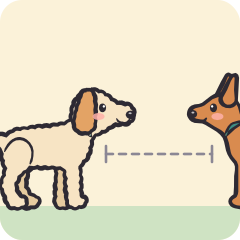 Core skill Confidence
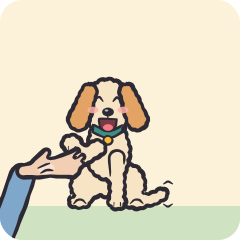 Core skill Comfort with Handling
- ExercisePuppy Socialization: How to Make New Things Good ExperiencesStart at home, finish outside (Steps 1–2 at home)Read →
- ExerciseTouch Then Treat: Help a Dog Who Hates Being Handled Learn to Enjoy ItDoable at home (Steps 1–5 at home)Read →
- ExerciseGetting Used to Sounds Step by Step: Sound Desensitization for DogsDoable at home (Steps 1–3 at home)Read →
Sources
- AVSAB — Position Statement on Puppy Socialization
- Howell, King & Bennett (2015). Puppy parties and beyond: the role of early age socialization practices on adult dog behavior. Veterinary Medicine: Research and Reports 6:143–153
- MSD Veterinary Manual (owners) — Normal Social Behavior in Dogs
- VCA Animal Hospitals (Horwitz & Landsberg) — Behavior Counseling: Diagnosing a Behavior Problem – Is It Medical or Behavioral?
- VCA Animal Hospitals (Lindell, Feyrecilde, Horwitz, Landsberg) — Puppy Behavior and Training: Socialization and Fear Prevention
- Best Friends Animal Society — How to Socialize a Dog
- The Animal Welfare (Licensing of Activities Involving Animals) (England) Regulations 2018, Schedules 3 and 6 (legislation.gov.uk)
- eCFR — 9 CFR § 2.130 Minimum age requirements (USDA, Animal Welfare Act regulations)
- Michigan State University Animal Legal & Historical Center — Table of State Laws Concerning Minimum Age for Sale of Puppies (Wisch, 2025)
- WSAVA — 2024 Guidelines for the Vaccination of Dogs and Cats
- Stepita, Bain & Kass (2013). Frequency of CPV infection in vaccinated puppies that attended puppy socialization classes. JAAHA 49(2):95–100 (PubMed abstract)
- Herron & Stull — Balancing Puppy Socialization with Infectious Disease Prevention (The Ohio State University College of Veterinary Medicine)
- VCA Animal Hospitals — When to Start Puppy Training Classes
- The Royal Kennel Club (UK) — Vaccinations for dogs and puppies
- Battersea Dogs & Cats Home — How to socialise your puppy
- Dogs Trust — Introducing your puppy to the world around them
- Blue Cross — Socialising (leaflet DOG 17)
- RSPCA — Caring for your puppy
- VCA Animal Hospitals — Puppy Behavior and Training: Training Basics
- VCA Animal Hospitals — Introduction to Desensitization and Counterconditioning
- MSD Veterinary Manual — General Guidelines for Effective Controlled Exposure Behavior Modification in Dogs (table)