 BAUDOG The dictionary of dog–human communication
Contents
- In short
- Common at this age
- Your dog at this age
- Assessment: where is your dog now?
- Is it too late at 2, 3, 5 — or 10? And how long will it take?
- How it differs from training a puppy — and what to do about it
- Bringing home a rescue or adult dog: the first weeks
- Starting with a senior dog — or keeping training going as she ages
- What to teach first
- When a trainer visits: the first session and the first homework
- A good sign to move on
- Skills to build now
- Exercises
- At this age: do / don’t
- When to see a professional
- Sources
In short
It’s never too late to start training. The UK vet charity PDSA puts it plainly: old dogs can learn new tricks, too. What’s different from a puppy comes down to three things. First, your dog already has habits — so you set up the house so the old habit is hard to repeat, and reward something else instead. Second, an old cue or even her name may have been used for scolding, so it can carry bad memories — swap it for a fresh word. Third, pain, fading hearing or eyesight, and an aging brain can change behavior — so check with your vet first. The order of training is the same as for a puppy: start with the marker word “Yes” and her name. If she has only just come home, spend the first days to weeks helping her settle in.
Common at this age
- You’ve adopted an adult dog from a shelter or rescue
- She’s 3 or 5 years old and still pulls, jumps up or barks
- You don’t know her old name or which cues she already knows
- Now that she’s a senior, she’s slower to answer cues she has known for years
Your dog at this age
An adult dog has learned things from the life she has lived so far. Two board-certified veterinary behaviorists, writing for VCA Animal Hospitals, note that learning plays a role in virtually every behavior problem: if a behavior is followed by something pleasant, such as food or attention, it’s likely to be repeated. Jumping up got her noticed; barking made dinner appear. From her side, the “problem” is simply a strategy that worked. So rather than trying to scold the old habit away, teach her a different strategy that works. PDSA notes that punishment such as shouting or smacking causes anxiety and fear — and anxiety and fear make animals learn more slowly.
Older dogs do take longer to learn. In one study, 95 pet Border Collies aged 5 months to 13 years were taught to tell pictures apart on a touchscreen. The older the dog, the more sessions she needed — but 93 of the 95 learned the task. Think of a senior dog not as one who can’t learn, but as one who learns at her own pace.
Dogs who don’t see or hear as well may start responding differently to cues, the same veterinary behaviorists note. And a dog who stops responding to cues she has known for years, or struggles to learn new ones, may be showing signs of cognitive decline (Cornell University College of Veterinary Medicine).
Assessment: where is your dog now?
Before you start, check these five things.
Is anything hurting? How are her hearing and eyesight?
→If she flinches when touched, walks oddly or doesn’t notice when you call, see your vet first. Pain can make a dog more irritable, more afraid of being handled and, in the end, more likely to bite.
Has she been home only a few days or weeks?
→Settling in comes first. Hold off on visitors and give her a quiet place to rest. For now, teach little more than “Yes” and her name.
Are there cues — or a name — that have been used for scolding?
→Replace those words with new ones and teach them from scratch. (If you change her name, the practice steps are the same.)
What does she love most?
→Rank her top three: food, toys, petting, a walk.
Does she growl, snap or bite, or is she very fearful of people or dogs?
→Work alongside a reward-based behavior professional or a veterinary behaviorist.
Is it too late at 2, 3, 5 — or 10? And how long will it take?
No. Whether your dog is 2, 3, 5 or 10, it isn’t too late. PDSA says it’s best to start young but never too late to start, and the Border Collie study above found that dogs as old as 13 could learn — older dogs just needed more sessions.
There’s no set age when a dog becomes a senior. The American Animal Hospital Association’s senior care guidelines define senior as the last 25% of a dog’s estimated lifespan, and lifespan varies with breed. For example, for a dog expected to live about 12 years, that would be from around age 9.
How long does it take? We haven’t found a study or guideline that gives a number of weeks — it depends on the dog, how long the old habit has been paying off, and how often you practice. Our suggestion: don’t judge by the calendar. Judge by the pass marks at the bottom of this page, and move on when she meets them.
How it differs from training a puppy — and what to do about it
- She already has habits: first make the problem behavior hard to repeat (a baby gate, a leash, putting things away), then teach and reward a different behavior. The Merck Veterinary Manual gives an example: teaching a dog to sit and stay before you let her outside may deter bolting through the door.
- Old cues may carry bad memories: a cue that was used for scolding is often easier to replace with a new word than to repair. If you rename a rescue dog, the name practice works the same way with the new name.
- She’s full-grown: she’s strong, and pulling or jumping up can be dangerous. Outside, keep the leash in your hand — many places require it anyway; New York City, for example, requires a leash no longer than 6 feet in public. Practice indoors first, then take it outside.
- Focus varies from dog to dog: keep each session short — a few minutes — and stop while she still wants more.
Bringing home a rescue or adult dog: the first weeks
Battersea Dogs & Cats Home advises taking things slowly in the first few days and weeks with a new dog. The first days are when you start building her trust in you and help her get used to her new routine and surroundings.
- No pressure: don’t expect a lot straight away, and avoid having visitors for at least the first few days (Battersea).
- A safe space: a bed in a quiet spot, or a crate with the door open and a blanket over it — somewhere she can take herself off to rest. It’s her safe retreat, never a “naughty corner” (Battersea).
- House rules from day one: if she won’t be allowed on the sofa, start that on the first day (Battersea).
- Assume she needs a potty refresher: the Richmond SPCA says almost all newly adopted adult dogs need to learn or relearn when and where to go, and suggests treating her as not yet housetrained at first — even if you think she was — to prevent mistakes.
- Every dog settles at her own pace: some relax within days, others take much longer. You’ll often see the “3-3-3 rule” (3 days, 3 weeks, 3 months), but in our search we didn’t find any study behind those exact numbers. Follow your dog, not the calendar.
Starting with a senior dog — or keeping training going as she ages
- See your vet first: the American Kennel Club advises getting your vet’s all-clear before starting any new training program. A dog who stops answering cues she knows, wanders at night, gets lost in familiar places or has more potty accidents may be showing signs of cognitive decline or illness (Cornell).
- Short sessions, small steps: AKC’s trainer advice is to teach everything in very short steps and to stop for the day, or for a few hours, as soon as she looks physically or mentally tired.
- Easy on the joints: if her joints are stiff, sitting and lying down over and over can hurt. AKC says begging or jumping the high bar may not be the best choice for a dog with arthritis, and VCA suggests tricks that don’t stress old limbs, such as touch. Our picks: hand touch, the name game and sniffing games — all done standing or lying still. We also suggest practicing on a rug or mat rather than a hard, slippery floor.
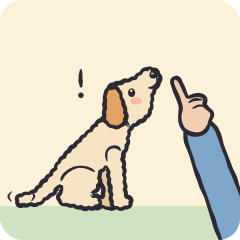
- Help her hear and see you: speak up (without yelling) and make hand signals bigger and clearer (AKC, VCA). For a dog with hearing loss, Dogs Trust suggests an obvious hand signal, such as a thumbs-up, as the marker instead of “Yes.”
- Give her a moment: older dogs may respond more slowly to cues (AKC). VCA suggests giving the cue and then waiting a little — she may be working up to the right answer.
- Treats: small and soft if her teeth or mouth are sore (our suggestion, following VCA). Count them as part of her food — the World Small Animal Veterinary Association (WSAVA) says treats should make up less than 10% of a dog’s daily calories.
- Keep her brain busy: Cornell says play, varied or interactive toys and regular exercise can help stimulate a dog’s brain, as part of managing cognitive decline.
What to teach first
The order is the same as for a puppy. Start with the marker word “Yes” and her name. After that, you can start early — in parallel — on the practice that’s closest to your biggest problem.
- 1. The marker word “Yes”: in a quiet room at home, 2–3 times a day, 2–3 minutes each.
- 2. Turning when she hears her name: if you’re giving her a new name, this is where it starts.
- 3. Say please by sitting: meals, walks and doors open when she sits. It replaces jumping up and demand barking.
- 4. The practice for your problem: “loose-leash walking” if she pulls, “relaxing on a mat” if she barks, and so on — see the problem pages.
When a trainer visits: the first session and the first homework
Here is one example, put together by BAUDOG, of how a visit from an in-home dog trainer might go. With an adult dog, the trainer starts by finding out what she already knows and what she finds hard.
- Today’s session: try the cues she might know (sit, down, come) once each to see which ones work. Ask which words have been used for scolding. Then “Yes” → treat, 10 times.
- Homework until next time: “Yes” practice 2–3 times a day, 2–3 minutes each. Make the problem behavior harder to repeat (baby gate, leash, putting things away). Put her food bowl down when she sits.
- What the trainer checks next visit: when she’s looking away, does she turn at “Yes” 5 times in a row (our rule of thumb)? Is the problem behavior happening less often? If so, add the name practice and the practice for your main problem to the homework.
A good sign to move on
- “Yes”: when she turns to it 5 times in a row while looking away, move on to her name (our rule of thumb)
- Name: when she turns within 2 seconds of hearing her name once, 9 times out of 10, in a quiet room at home, move to slightly more distracting spots indoors
- Say please: when she sits on her own, without being asked, in 3 or more everyday situations, move on to the practice for your main problem
Skills to build now

Exercises
This is the order BAUDOG suggests. From the third practice on, you can work on your problem practice in parallel.
- ExerciseCharging Your Marker Word: How to Teach Your Dog That “Yes” Means a RewardDoable at home (Steps 1–4 at home)A brand-new word that means “that’s right.” It doesn’t depend on any memories of old cues.Read →
- ExerciseThe Name GameDoable at home (Steps 1–2 at home)Turns her name into a signal that looking at you pays off. The steps are the same if you give her a new name.Read →
- ExerciseSay Please by SittingDoable at home (Steps 1–3 at home)Sitting before she gets what she wants. It replaces old habits like jumping up and demand barking.Read →
At this age: do / don’t
Do
- Have your vet check her first (especially a senior, or any sudden change)
- If she’s just arrived, put settling in first for the first days
- Make the problem behavior hard to repeat, and reward a different one
- Replace any word that has been used for scolding with a new one
Don’t
- Giving up because “she’s an adult now”
- Packing visitors and outings into her first days home
- Trying to scold old habits away
- Asking for sit and down over and over when she seems to be in pain
When to see a professional
- She flinches when touched, walks oddly or has suddenly become grumpy — pain may be behind it. See your vet first
- She has stopped answering cues she knows, gets lost in familiar places, wanders at night or has more potty accidents — these can be signs of cognitive decline or illness
- She growls, snaps or bites at people or dogs, or is very fearful — talk to a veterinary behaviorist or a reward-based behavior professional
Grow the skill underneath
Sources
- PDSA — Reward-based training
- Wallis, Virányi, Müller, Serisier, Huber & Range (2016). Aging effects on discrimination learning, logical reasoning and memory in pet dogs. Age 38:6
- VCA Animal Hospitals (Horwitz & Landsberg) — Behavior Counseling: Diagnosing a Behavior Problem – Is It Medical or Behavioral?
- Cornell Riney Canine Health Center — Cognitive dysfunction syndrome
- AAHA — 2023 AAHA Senior Care Guidelines for Dogs and Cats (Dhaliwal et al., JAAHA 59:1–21)
- American Kennel Club — The Importance of Training Your Senior Dog
- VCA Animal Hospitals — Practical tips for training your senior dog
- PetMD — Can You Teach an Old Dog New Tricks?
- WSAVA — Guide to Treats for Dogs (2025)
- Battersea Dogs & Cats Home — How to settle in your new puppy or dog
- Richmond SPCA — Housetraining Your New Adult Dog
- Merck Veterinary Manual (Dog Owners) — Behavior Modification in Dogs
- AVSAB — Position Statement on Humane Dog Training (2021)
- Dogs Trust — Introducing a marker
- Dogs Trust — Top ten dog training tips
- Dogs Trust — Recall training
- American Kennel Club — How to Teach Your Dog Their Name
- American Kennel Club — How to Train a Reliable Recall for Your Dog (Sassafras Patterdale, CPDT-KA)
- Whole Dog Journal — Beware of the Poisoned Dog Cue (Pat Miller)
- New York City Health Code Article 161, §161.05