 BAUDOG The dictionary of dog–human communication
Contents
When to use this exercise
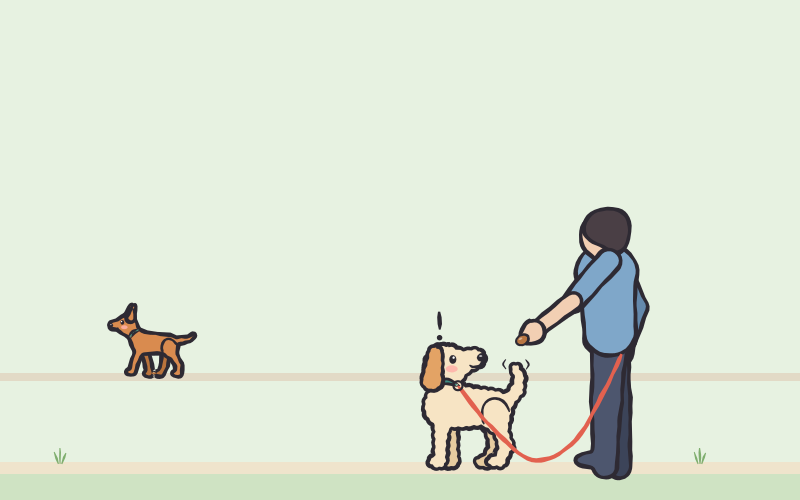
For dogs who bark at or freeze over other dogs, people, bikes or anything else that worries them. Use it when that “trigger” appears in the distance. You mark the moment she looks at it and give her a treat, again and again, until the sight of it comes to mean “something good is coming.” The game comes from the US trainer Leslie McDevitt’s book Control Unleashed. It builds confidence and attention. Start by setting up the “look, then turn back to me” rhythm at home, then practice outside at a distance where she doesn’t bark.
GoalShe can look at the thing that worries her without barking, and turn back to you on her own.
Assessment: what a trainer might check on the first visit
Before starting, a visiting trainer would look at things like these.
How far away does her trigger (a dog, a person, a bike) have to be before she barks or freezes?
→You find out on a short walk together. Sometimes you can tell from the window or the front of the house.
Just outside that distance, can she eat treats? Does she turn when you call her?
→The distance where she can eat and turn back to you is where outdoor practice starts. There’s no set number. If she can’t eat anywhere outside, stick to the indoor step and to avoiding triggers for now.
Is she already barking at noises in the house or at things outside the window?
→If so, cut down that barking first — block the view from the window, for example.
What you need
- Really good treats (chicken, cheese — cut small, and plenty of them)
- A marker word she knows — “Yes” means a treat is coming (see Teach a Marker Word)
- A well-fitting harness and leash
- A place where her trigger is visible at a distance she can still eat at (across the street, the far edge of a big park)
- For the early steps, a helper from the family or a friend (ideally with a calm dog)
How to signal
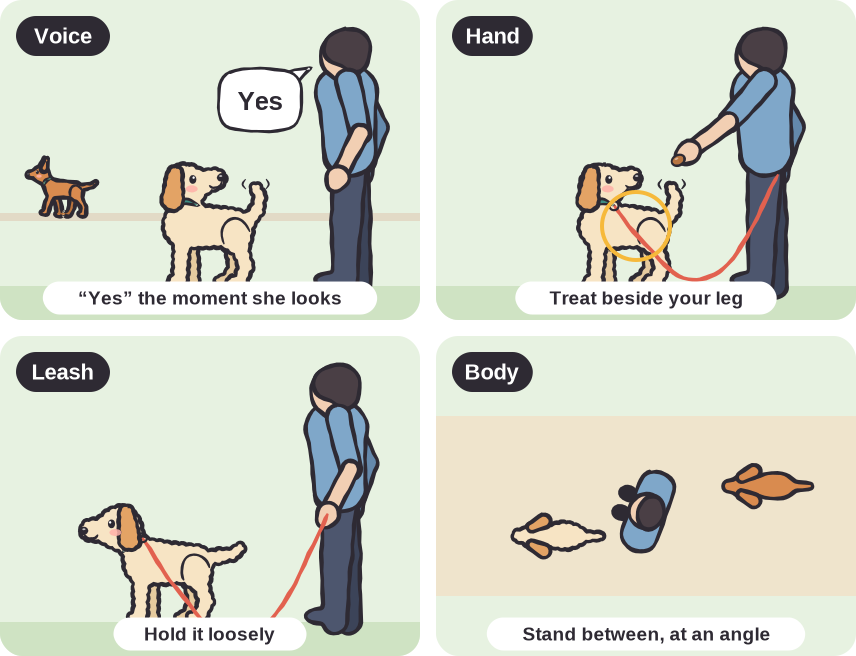
- Voice
Say “Yes” the instant she looks at the trigger. Bright and short. Once she starts glancing at triggers on her own, you can add a cue before she looks — “Look!”
- Hand
Give the treat where it turns her head away from the trigger (beside your leg, for example), so she’s ready to look again when she’s finished.
- Leash
Hold it loose. No tightening or jerking.
- Body
Don’t walk straight at the trigger. Stand between it and your dog, or at an angle to it (our suggestion).
Today’s session
With the trainer, you work on step 1.
Step 1Build the rhythm at home(At home, quiet)
You take a short walk with the trainer to find the distance at which she starts to react (the point where she stops taking treats). Back home, a family member lifts a cushion at the far end of the room, and the instant your dog looks at it — “Yes” → treat. Ten repetitions. The trainer watches for two slips and fixes them on the spot: marking too late, and showing the treat before she looks.
Homework until the next visit
- How often
- Twice a day
- How long
- About 5 minutes (a 1–2 minute break after every 5–10 treats)
- How much
- Up to about 10 per session
A good sign she’s readyAt home, “look → turn straight back” 8 times out of 10 — and you know roughly how far away a trigger has to be for her to keep eating on walks
What the trainer checks next visit
With the trainer, go somewhere her trigger is visible at a distance she can eat at, and do 10 reps of “look → Yes → treat.”
If she canIf she looks and turns back without barking 8 times out of 10 → next stage: step 3 (the real thing, far away) becomes the homework. If you have a helper, start with step 2 (a helper walking at a distance while you’re in the yard or outside your home).
If not yetIf she won’t eat or she barks, you look together for places and times where you can get farther away — and rethink the treats.
Next stages: steps
- 1
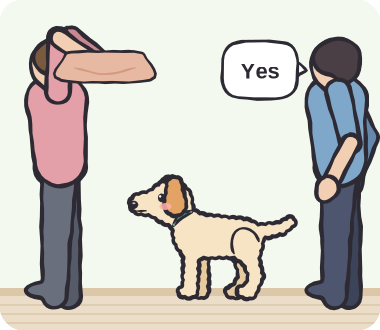
At home, with something that doesn’t worry her At home, quiet
Build the rhythm at home
A family member lifts something that doesn’t worry her (a soft toy, a cushion) at the far end of the room. The instant your dog looks at it — “Yes” → treat. You’re building the pattern “I look at something, a treat appears.”
A good sign to move onShe looks, then turns straight back to you for the treat, 8 times out of 10
- 2
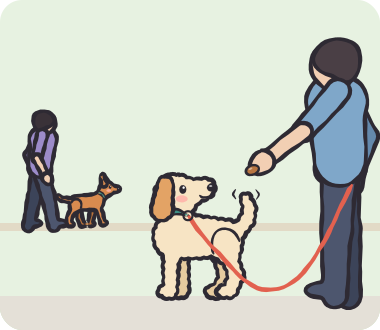
Ask a helper to walk at a distance Yard, doorstep, outside the house
In the yard or outside your home, with a helper
Go out into the yard or in front of the house, on leash. A family member or friend walks back and forth at a distance where she doesn’t bark (ideally with a calm dog). The instant she looks — “Yes” → treat.
A good sign to move onShe looks and turns back without barking, 8 times out of 10
- 3
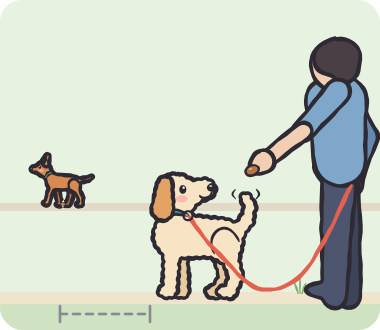
Start farther away than you think Quiet street
The real thing, far away
Somewhere her trigger is visible far away — at a distance she can eat at — like across the street or the far edge of a big park. The instant she looks — “Yes” → treat.
A good sign to move onShe looks, then turns straight back to you for the treat, 8 times out of 10
- 4
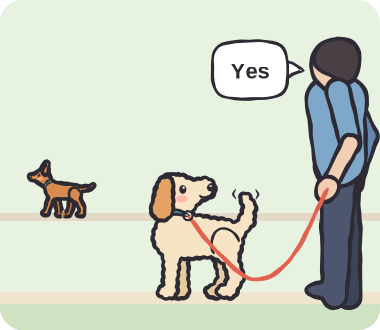
She looks, then checks in by herself Quiet street
Wait for her to turn back on her own
At the same distance, hold off on the “Yes” for a moment (2–3 seconds, for example). If she looks at the trigger and then turns to you on her own — “Yes” → treat. If she keeps staring instead, don’t wait: go back to the previous step.
A good sign to move onShe looks, then turns back on her own straight away, 8 times out of 10
- 5
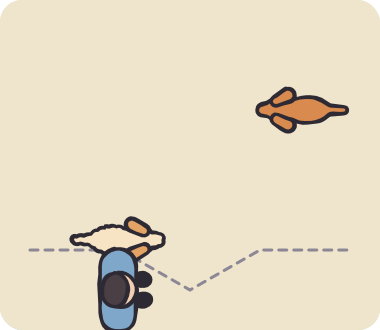
Pass in a wide curve Around distractions
A little closer → passing by
Once she reliably looks and turns back without barking, close the distance a little at a time (about 1–3 feet, 30 cm–1 m, for example). If she stops eating, back off straight away. When she’s ready, pass the trigger in a wide curve rather than head-on (our suggestion — friendly, off-leash dogs usually approach each other in an arc, not straight on; ASPCA).
A good sign to move onShe passes without barking, 8 times out of 10
Timing
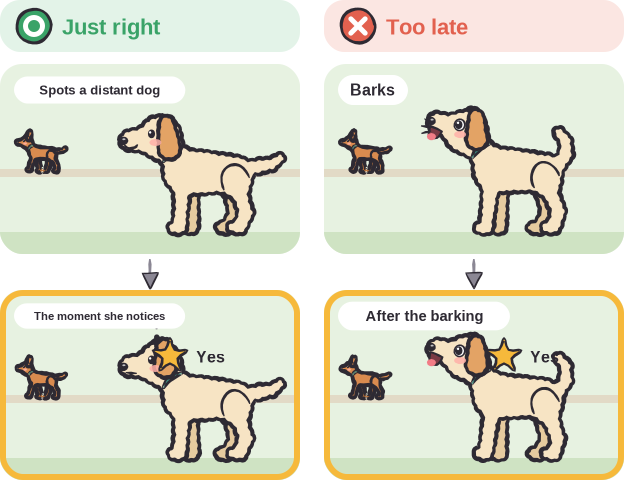
Just right
Say “Yes” the instant she sees the trigger — before she barks. Then the treat. The order is “trigger appears → treat.”
Too late
Saying “Yes” after she has barked — or showing her the treat first to keep her from noticing the trigger.
The order is what matters. The trigger appears, and treats start; it goes away, and the treats stop. The ASPCA’s plan says the same: as soon as your dog notices the other dog, before she can bark, feed treat after treat, so that good things only happen when other dogs are around. If you show the treat first to distract her, the trigger and the good stuff never get linked.
How much and how often
About 5 minutes per session, with a 1–2 minute break after every 5–10 treats. About twice a day. Watching a trigger is tiring work, so keep it short and finish on a success.
If it isn’t working
She won’t take the treats
You’re too close, or the treat can’t compete with the situation. Add distance and use something better. East Bay SPCA notes that if your dog doesn’t turn back quickly, you’re probably too close or the reward isn’t valuable enough.
She can’t take her eyes off the trigger
That’s a sign you’re too close. A fixed stare and refusing favorite food are threshold signs, just like barking (East Bay SPCA). Add distance and end the session on a success.
She barked
Don’t scold. Say “This way!” brightly, U-turn and move away. Best Friends Animal Society also advises turning and moving away from the trigger until she’s no longer upset. Don’t wait for her to calm down mid-bark and then treat; move away and start again farther off.
If I give treats around barking, won’t I reward the barking?
The treat comes the moment she looks — before she barks. If she does bark, the first thing you do is move away, not hand out treats. So the barking doesn’t earn treats.
There’s nowhere she doesn’t bark
Stick to step 1 at home and to avoiding triggers for now. East Bay SPCA and Best Friends both say that if no outdoor distance is far enough, start indoors. A friend walking a calm dog in the distance can make it easier to start outside. Consider getting help from a professional, too.
When I wait for her to turn back, she freezes
It’s too soon. Stop waiting and go back to marking the moment she looks. Some trainers prefer to keep feeding for every look rather than wait for a turn at all (Pat Miller in Whole Dog Journal).
Does it work for people, bikes or cars?
Yes. It’s the same process for anything that worries her. Each trigger will have its own comfortable distance.
How long will it take?
There’s no set time; fear changes gradually. Our rule of thumb is to judge progress by whether the distance at which she can look and turn back without barking is slowly shrinking.
Avoid
- Yanking the leash or scolding when she barks
- Dragging or carrying her closer to the trigger
- Making her greet other dogs to “get her used to them”
- Showing her the treat first to distract her from the trigger
A good sign to move on
- Step 1 (at home): she turns straight back after looking, 8 times out of 10 (our rule of thumb)
- Steps 2–4 (yard or outside your home → the real thing far away → turning back on her own): at that distance, she looks and turns back without barking, 8 times out of 10 (our rule of thumb)
- Step 5: close the distance a little at a time. If she stops eating, back off straight away
- Make only one thing harder at a time — the distance, the place, or the kind of trigger (a person instead of a dog, for example)
- If she struggles, go back a step — our rule of thumb is two misses in a row
Sources
- East Bay SPCA — LAT (“Look at That”): A Training Exercise for Reactive Behavior (PDF, 2024)
- Best Friends Animal Society — “Look at That” (LAT) Training for Reactive Dogs
- East Bay SPCA — Dog Reactivity Training: Emergency U-Turns (PDF)
- ASPCA — Dogs Who Are Reactive On-Leash (PDF)
- MSD Veterinary Manual — General Guidelines for Effective Controlled Exposure Behavior Modification in Dogs
- Whole Dog Journal (Pat Miller) — Reactive dog behavior
- Whole Dog Journal — 5 Things to Know About a Dog’s Threshold
- Dogs Trust — Signs your dog is reactive and how to help
- AVSAB — Position Statement on Humane Dog Training (2021)