 BAUDOG The dictionary of dog–human communication
Contents
- The finished behavior
- Assessment: where is your dog now?
- The cue
- How to signal
- Teaching steps
- When to reward
- On her side or on her back: which should you teach?
- Is my own way right? Common questions
- Looking after her body
- If she collapses and lies still without a cue
- A good sign to move on
- If it isn’t working
- Prescription: a suggested order
- In the moment: do / don’t
- When to see a professional
- Sources
The finished behavior
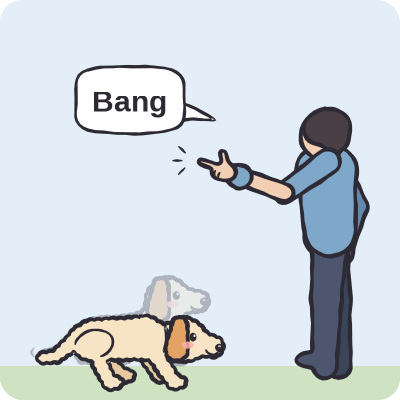
On “Bang,” your dog drops onto her side and stays still until you say “Free.”
Assessment: where is your dog now?
A visiting trainer might check something like this before starting.
Can she lie down on the word “Down” alone?
→Play dead starts from a down. If she still needs a treat to lie down, start with the “Down” page.
Does she know “Stay” and a release word?
→Holding still on her side works the same way as a stay. If she already understands “Free” as “you can get up now,” this is much easier to teach.
Is she comfortable lying on her side? Is the floor non-slip?
→If she resists, start with the side-lying step of Roll Over. BAUDOG suggests practicing on a non-slip mat.
On her side, or belly-up?
→Pick one as a family. If she also knows Roll Over, keep the words and the finish positions different.
The cue
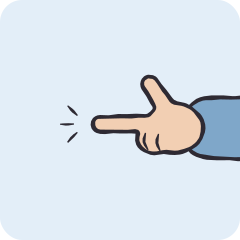
The word is “Bang.” For the hand signal, a finger gun is one common choice — there is no standard form, and any clear gesture works if you’d rather not use a gun. Add both only once she can reliably flop onto her side. Her release word — the word that tells her she can get up — is “Free.”
How to signal
- Voice
Say “Bang” once, brightly — and only once she reliably flops onto her side. When she may get up, say “Free.”
- Hand
At first, the hand signal is the lure itself: a treat at her nose, moved toward her shoulder. Switch to an empty hand, shrink the motion, then transfer it to a finger gun (finger gun → short pause → the usual hand motion).
- Leash
Practice indoors, off leash.
- Body
At first, kneel in front of or beside her. Once you start building the hold, BAUDOG suggests keeping your own body still — if you move, she is likely to get up too.
Teaching steps
- 1
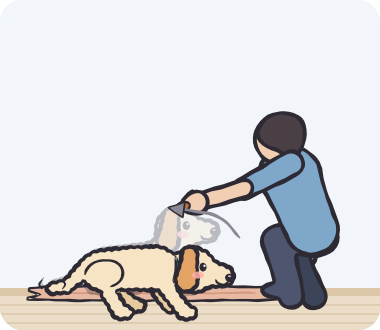
Nose → shoulder. Reward the moment she tips over From a down, onto her side
With your dog in a down, hold a treat at her nose and move it slowly toward her shoulder, then toward her back. The moment she tips onto her side, say “Yes” → treat. At first, reward even a small lean.
A good sign to move onBAUDOG’s rule of thumb: she follows the lure onto her side 8 times out of 10
- 2
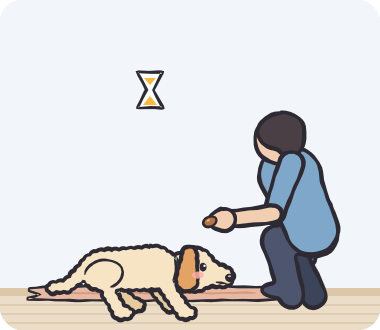
Stretch the stillness a little at a time Stay on her side for a moment
Once she’s on her side, wait 1 second before the treat. If she stays still, “Yes” → treat → “Free” to get up. Build the time slowly: 1 second, 2 seconds, 3 seconds…
A good sign to move onBAUDOG’s rule of thumb: she stays still for that many seconds 8 times out of 10
- 3
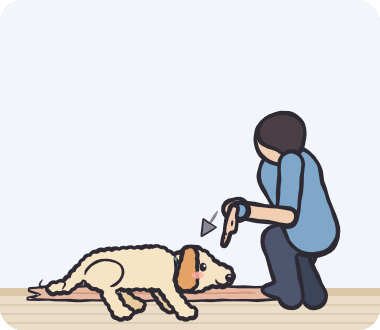
Lure with an empty hand With an empty hand
Make the same hand motion without a treat in it. When she’s on her side, reward from your other hand. Make the motion a little smaller each time.
A good sign to move onBAUDOG’s rule of thumb: she drops onto her side for an empty hand 8 times out of 10
- 4
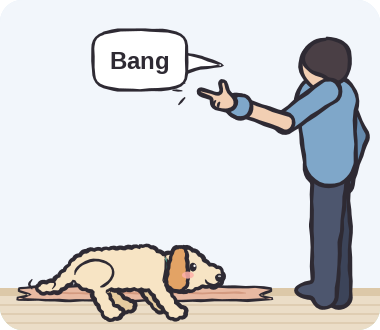
Cue → short pause → the usual hand Add the cue (word and finger gun)
“Bang” (with the finger gun) → short pause → small hand motion → “Yes” when she’s down on her side. With repetition, she starts to drop on the cue alone.
A good sign to move onBAUDOG’s rule of thumb: on the cue alone, she drops and holds for your chosen seconds 8 times out of 10
- 5
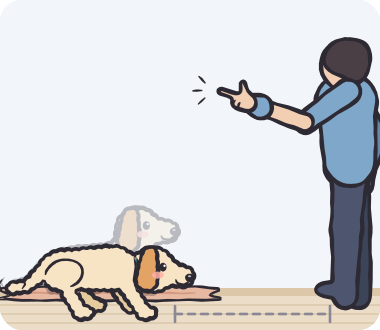
Add distance little by little From a sit or stand, and from farther away (finishing)
Teach her to go down first and then onto her side, even from a sit or a stand. Then give the cue from a little farther away. Make only one thing harder at a time.
A good sign to move onBAUDOG’s rule of thumb: 8 out of 10 under that condition
When to reward
Just right
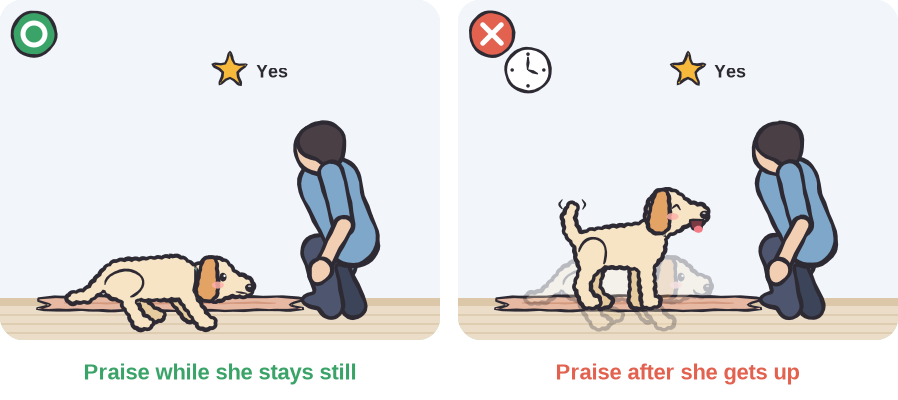
At first, say “Yes” the moment she tips onto her side. Once you’re building the hold, say “Yes” when she has stayed still for your chosen number of seconds. BAUDOG suggests delivering the treat to her mouth while she’s still lying down, and only then saying “Free.” Another common way — the American Kennel Club’s — is to say the release word first and then give the treat.
Too late
Saying “Yes” after she has already got up — or, before “Free,” holding the treat out at a distance instead of at her mouth, so she gets up to reach it.
On her side or on her back: which should you teach?
There are two ways to “play dead”: flopping onto the side, or ending belly-up. The American Kennel Club teaches the side version and says you can choose to have your dog roll all the way onto her back instead.
BAUDOG recommends the side version. It involves less twisting, and it’s easier to keep separate from Roll Over. Whichever you choose, agree on one finish position as a family and use a different word from Roll Over.
In the AKC Trick Dog program, play dead is an Advanced-level trick. AKC expects your dog to know “Down” before you start. In BAUDOG’s view, a dog who already knows Roll Over learns this faster, because she already knows how to tip onto her side — and play dead needs both a dropping movement on cue and the ability to stay still.
Is my own way right? Common questions
Answers to the questions owners most often have about methods they worked out themselves.
“I’ve been saying ‘Bang’ with the finger gun from the very start, while luring. Is that OK?” — She will still learn it, but a cue links more cleanly to a movement that’s already reliable. If you’re already using it, carry on. If you want her to drop for the finger gun alone, put it first: finger gun → short pause → the usual hand lure.
“She knows Roll Over. Can I stop her partway and make that play dead?” — Yes; it’s the same basic movement, so BAUDOG suggests it as a shortcut. Keep the finish position (on her side) and the word (“Bang”) different from Roll Over, though. Because you’re stopping partway through a movement she knows, she may roll all the way over at first. When she does, don’t reward it — just start again from the lure.
“She often lies on her side by herself. Can I use that?” — Yes. The American Kennel Club describes another way to teach it: reward the position when your dog is resting on her side by herself, naming it as she does it, until she lies on her side when you say the word. In BAUDOG’s view, it can suit dogs who are wary of being lured over.
“I want sit → bang → ‘Free’ → she jumps up wagging, all as one routine.” — That’s a chained trick. BAUDOG suggests making sure sit, bang and “Free” each work reliably on their own first, then linking them by giving the cues one at a time. Once the flow is steady, give the whole routine a new single cue (for example, “Gotcha!”). To add it: new cue → short pause → the usual first cue.
“I want to ‘shoot’ her from across the room.” — Build distance a little at a time. Raise only one difficulty at a time, so BAUDOG suggests shortening the hold on days you add distance.
“The dramatic flop from standing is so cute — can I teach that?” — BAUDOG suggests that even from a stand, she goes down first and then onto her side. We advise against teaching a flop that slams her body onto the floor. We found no veterinary source on the impact of a dramatic fall, so this is a cautious call on our part, made with long-backed breeds prone to disc disease and older dogs in mind.
Looking after her body
Play dead is a drop onto the side and a hold, so there’s no landing impact like a jump. What matters is how she goes down and what she lands on. BAUDOG suggests practicing on a non-slip mat, going down first and then onto her side, so she doesn’t crash down on a slippery or hard floor.
Breeds prone to intervertebral disc disease (IVDD) — the “chondrodystrophic” breeds such as Dachshunds, Pekingese and Beagles — as well as dogs with a history of back trouble and older dogs: BAUDOG suggests checking with your vet before you start. Puppies can learn it too once they know “Down” — VCA Animal Hospitals lists play dead among the tricks puppies learn.
If she collapses and lies still without a cue
Separate from the trick: if your dog suddenly falls over by herself and goes limp or stops responding, that isn’t playing dead — it may be fainting (syncope). A typical episode starts suddenly, without warning, often during exercise or excitement; the dog goes limp, and recovers within seconds to minutes (VCA). The most common cause is a heart problem, so contact your vet right away.
A good sign to move on
- Onto her side → hold → empty hand → cue, in that order. BAUDOG’s rule of thumb: move on when the current step works 8 times out of 10
- Build the hold a little at a time (for example 1 second → 2 → 3…). If she gets up, go back to a shorter hold
- Add the word and the finger gun only once she drops onto her side reliably
- If she’s struggling, go back one step — our rule of thumb is two misses in a row
- Keep sessions to a few minutes, and stop while she still wants more
If it isn’t working
She gets straight back up
Usually the hold is too long for now. Go back to a length she can manage and reward there. Showing the treat at a distance can also pull her up. BAUDOG suggests marking, then delivering the treat to her mouth while she’s still lying down, and letting her get up only after “Free.”
She stays in a down and won’t tip over
Usually the treat has drifted away from her nose, or your hand is moving too fast. Keep it touching her nose and move slowly toward her shoulder. Reward even a slight lean. Starting on the side she prefers (left or right) can help.
She rolls all the way over
Common in dogs who already know Roll Over. Stop your hand at her shoulder and reward the moment she tips onto her side. If she rolls right over, don’t reward — start again from the lure.
She won’t do it on the cue alone
Usually the switch from lure to cue was too sudden. Go back to cue → short pause → small hand motion, and shrink the hand bit by bit.
She won’t do it in other rooms or outside
A new place looks like a different task to a dog. Bring her usual mat, for example, and restart briefly from the “onto her side” step.
How long does it take to teach?
There’s no set time — it depends on whether she already knows Down and Roll Over, and how comfortable she is lying on her side. What speeds it up is small steps: short sessions, moving on only when the current step works 8 times out of 10 (our rule of thumb).
Prescription: a suggested order
Play dead rests on two skills: linking a cue to a movement, and the self-control to stay still.
- ExerciseCharging Your Marker Word: How to Teach Your Dog That “Yes” Means a RewardDoable at home (Steps 1–4 at home)A word that marks the exact moment she drops, or the moment she has stayed still. Without “Yes,” she can’t tell what earned the treat during the hold.Read →
- ExerciseBuilding a Stay: Duration, Distance, Distraction — One at a Time, Up to the Front Door and GuestsDoable at home (Steps 1–3 at home)Holding still on her side works just like building a stay: time, distance and distractions, one at a time, a little at a time.Read →
In the moment: do / don’t
Do
- Start from a down, and reward the moment she tips onto her side
- Build the hold a little at a time; she gets up only after “Free”
- Add the cue once she can drop onto her side reliably
- Practice on a non-slip mat, going down first and then onto her side
Don’t
- Push her over with your hands
- Praise after she has already got up
- Use the same word or finish position as Roll Over
- Teach a flop that slams her body onto the floor
When to see a professional
- She suddenly collapses without a cue and goes limp or stops responding — even if she recovers within seconds or minutes. It may be fainting; see your vet right away
- She avoids turning her head to one side, or walks to her bowl and just looks at it. These can be signs of a spinal disc problem (Cornell University College of Veterinary Medicine)
- She struggles to sit or get up from lying down, or suddenly stops doing “Bang.” These can be signs of pain
The skills behind this command
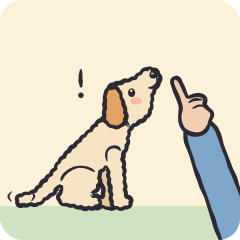 Core skill Understanding Cues Telling “Bang” from “Roll over,” and the finger gun from the hand lure, as different cues.
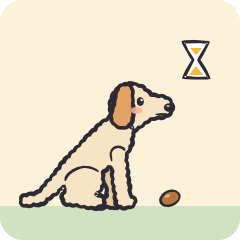 Core skill Impulse Control Staying down until “Free,” even with a treat in view.
- ExerciseCharging Your Marker Word: How to Teach Your Dog That “Yes” Means a RewardDoable at home (Steps 1–4 at home)Read →
- ExerciseBuilding a Stay: Duration, Distance, Distraction — One at a Time, Up to the Front Door and GuestsDoable at home (Steps 1–3 at home)Read →
Sources
- American Kennel Club — Teach Your Dog to Play Dead
- American Kennel Club — Lure-and-Reward Training
- AKC Trick Dog Participant and Evaluator Guide (PDF)
- American Kennel Club — Dog Training Duration, Distance, Distraction
- Whole Dog Journal — Clean Up Your Cues
- Battersea Dogs & Cats Home — How to teach your dog to lie down
- Karen Pryor Clicker Training — The Ten Laws of Shaping
- AVSAB — Position Statement on Humane Dog Training (2021)
- AVSAB — Position Statement on the Use of Dominance Theory in Behavior Modification of Animals
- VCA Animal Hospitals — Syncope (Fainting) in Dogs
- VCA Animal Hospitals — Tricks To Teach Your Puppy
- American College of Veterinary Surgeons — Intervertebral Disc Disease
- Cornell University Riney Canine Health Center — Intervertebral disc disease
- Cornell University Riney Canine Health Center — Recognizing pain in dogs
- Dogs Trust — Top ten dog training tips