 BAUDOG The dictionary of dog–human communication
Contents
- The finished behavior
- Assessment: where is your dog now?
- The cue
- How to signal
- Teaching steps
- When to reward
- How far does she need to back up?
- Is my own way right? Common questions
- Looking after her body: hind legs and hips
- A good sign to move on
- If it isn’t working
- Prescription: a suggested order
- In the moment: do / don’t
- When to see a professional
- Sources
The finished behavior
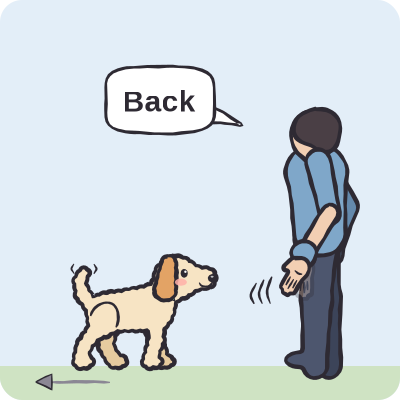
On “Back,” your dog keeps facing you and walks a few steps straight backwards.
Assessment: where is your dog now?
A visiting trainer might check something like this before starting.
Do you have a hallway, or a gap between furniture and a wall, too narrow for her to turn around in?
→If so, teaching her to back up straight is much easier. If not, make a narrow chute with a wall and a few chairs.
What does she do when you take one step toward her?
→If she naturally steps back, start by rewarding that moment. If she sidesteps or sits, start with the treat lure.
Do her hind legs move smoothly?
→If she favors a back leg, skips now and then, or is reluctant to get up, see your vet first (see the vet signs below).
The cue
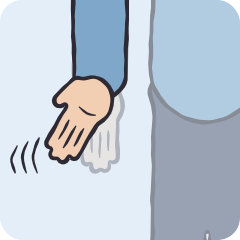
The word is “Back.” Add it once she can move backwards. If you add a hand signal, make it one she can tell apart from “Stay” (palm held up toward her).
How to signal
- Voice
Say “Back” once — and only once she can move backwards. At first: “Back” → short pause → the usual prompt.
- Hand
BAUDOG suggests, for example, holding your hand at hip height with the back of your hand toward her and flicking your fingertips toward her two or three times (a small “shoo”). Make it differ from the “Stay” hand (palm toward her at chest height, held still) in three ways — height (hip vs. chest), which side of the hand faces her (back vs. palm), and movement (flick vs. still) — so she can tell them apart even from a distance. Don’t turn your palm down: that looks like the “Down” hand (palm down, moving from top to bottom). Add the hand signal only once she understands the word.
- Leash
Practice indoors, off leash.
- Body
At first, stand facing her and take one step toward her. As she gets the idea, make your step smaller, until in the end you stand still and just give the cue.
Teaching steps
- 1
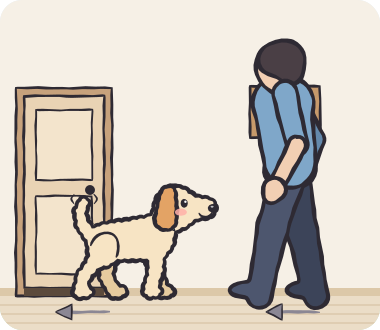
In a hallway, straight back is the only way In a hallway, reward one step back
Face your dog in a hallway, or a gap between furniture and a wall, where she can’t turn around. Take one step toward her, and the moment she takes even one step back, “Yes” → treat. If you’re luring, move a treat from her nose low and straight toward her chest, as if pushing it gently back.
A good sign to move onBAUDOG’s rule of thumb: one step back, 8 times out of 10
- 2
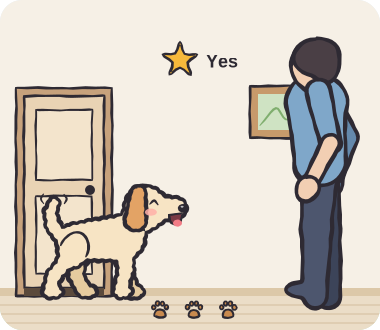
One step at a time Two steps, then three
Once one step is reliable, increase the number of steps before you mark — 2, then 3, and so on.
A good sign to move onBAUDOG’s rule of thumb: 8 out of 10 at that number of steps
- 3
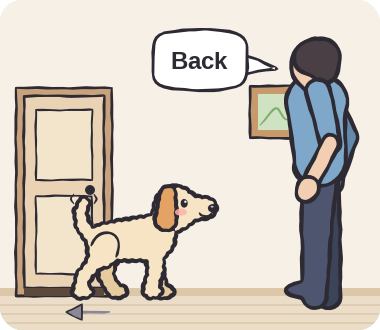
Word → short pause → the usual prompt Add the word
“Back” once → short pause → the usual prompt (your step forward, your hand) → “Yes” when she steps back. With repetition, she starts to move back on the word alone.
A good sign to move onBAUDOG’s rule of thumb: 2–3 steps on the word alone, 8 times out of 10
- 4
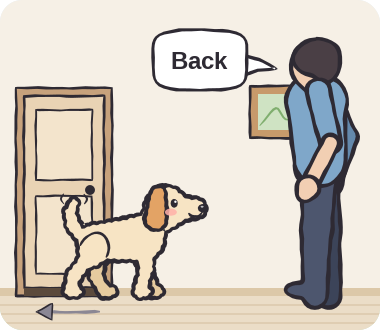
She backs up without being pushed by your body Without you moving
Make your step toward her smaller and smaller, until she backs up on “Back” while you stand still.
A good sign to move onBAUDOG’s rule of thumb: 8 out of 10 with you standing still
- 5
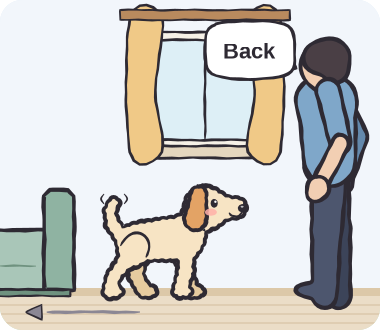
Gradually, without walls Widen the space, change the place
Move from the hallway to a bigger room. If she starts to drift, practice along a wall (a wall on one side of her) before moving to open space. Change rooms too — the front hall, the living room.
A good sign to move onBAUDOG’s rule of thumb: a few straight steps in open space, 8 times out of 10
When to reward
Just right
“Yes” the moment a hind foot moves back. Once you’re adding steps, the moment she completes your chosen number.
Too late
“Yes” after she has finished and come forward again — the reward goes to coming forward.
Give the treat where she has backed up to, or toss it slightly behind her. Handing it over only after she has come back to you can teach her to creep forward (BAUDOG’s suggestion).
How far does she need to back up?
There’s no set distance, but there is a useful yardstick. In the AKC Trick Dog program, Back up is one of the Novice-level options — 3 body lengths, and the handler may use a lure and walk toward the dog. At the Advanced level, the dog backs up at least 5 body lengths with the handler facing her, and the handler should not be walking into the dog to get her to back up.
At home, it’s most useful when you need her to “give me a little room” at the front door or in a narrow hallway. A few straight steps back is plenty.
Is my own way right? Common questions
Answers to the questions owners most often have about methods they worked out themselves.
“I say ‘Back’ and walk into her with my body to make her back up. Is that OK?” — For the first step, yes: the AKC method and Best Friends Animal Society both start with you stepping toward her and rewarding a step back. But if you keep pushing with your body, you’ll have a dog who only backs up when you move. Once she understands the word, make your step smaller and smaller. If she backs away because she’s scared (ears back, body low), stop advancing on her and use the treat lure instead.
“She only does it in the hallway.” — Learning in a chute is the right order. Next, try a spot with a wall on just one side, then open space. Raise only one difficulty at a time.
“At the front door I want ‘Back,’ then ‘Stay,’ then I open the door.” — BAUDOG suggests linking them only once “Back” and “Stay” each work reliably on the word alone. Give “Back” → “Stay” one at a time at first; once the flow is steady, you can add a new single phrase for the whole thing (“Make room,” for example). To add it: new phrase → short pause → the usual first cue (“Back”). If she might bolt out the door, practice on leash first.
“My cue is a ‘shoo’ wave of the hand.” — Using a movement as the cue is fine if it doesn’t worry her. But a big wave in front of her face bothers some dogs. Keep it small and always the same, and make it different from the “Stay” hand. BAUDOG suggests the back of your hand toward her at hip height, flicking your fingertips two or three times. It differs from “Stay” (palm toward her at chest height, held still) in height, which side of the hand faces her, and movement — so the two won’t blur when you chain “Back” → “Stay.”
Looking after her body: hind legs and hips
Backing up means moving the hind legs back one step at a time — no impact like a jump. But it’s an awkward movement for a dog with sore hind legs or hips. Dogs with hip dysplasia may look wobbly, be reluctant to get up from sitting or lying down, or be reluctant to climb stairs. Small dogs with kneecaps that slip out of place (patellar luxation) may suddenly carry a back leg up for a few steps — a “skip.” If you see signs like these, see your vet before you practice.
In a UK study of 210,824 dogs seen at 119 primary-care veterinary practices in England (the VetCompass programme), 1.3% had been diagnosed with patellar luxation. Eleven breeds had higher odds than crossbreeds, including Pomeranians (about 6.5 times), Chihuahuas (5.9), Yorkshire Terriers (5.5) and French Bulldogs (5.4).
On a slippery floor her hind feet slide, which makes backing up harder. BAUDOG suggests practicing on a non-slip mat or carpet.
A good sign to move on
- One step → two, three → word → you stand still → open space, in that order. BAUDOG’s rule of thumb: move on when the current step works 8 times out of 10
- Add the word once she can move backwards; add a hand signal once she understands the word
- If she’s struggling, go back one step — our rule of thumb is two misses in a row
- Keep sessions to a few minutes, and stop while she still wants more
If it isn’t working
She drifts off at an angle
Usually the space is too wide. Go back to the hallway or the gap beside furniture, or practice with a wall on one side of her.
She sits instead of backing up
If the treat is held high, her head comes up and she tends to sit. Keep the treat at nose height and move it low and straight toward her chest, for example. If she sits, say nothing, get her standing and try again — or set up a narrow chute so the only way to move is back.
She only takes one step
Have you added steps too quickly? Make one step reliable, then add steps one at a time.
She comes straight forward again after backing up
Handing over treats at your hand can build a habit of coming forward. BAUDOG suggests giving the treat where she has backed up to, or tossing it slightly behind her.
She has suddenly stopped backing up, or favors a back leg
It may be pain in her hind legs or back. Stop practicing and see your vet.
Prescription: a suggested order
Back up rests on two skills: linking a cue to a movement, and staying focused on you while moving.
In the moment: do / don’t
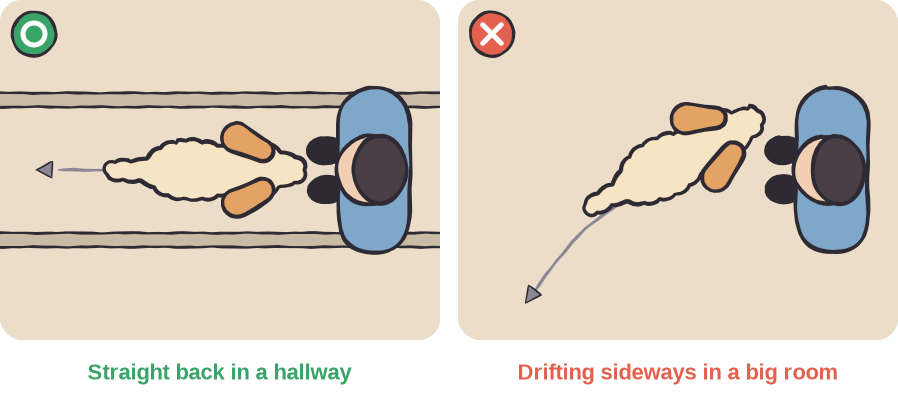
Do
- Start somewhere she can’t turn around, like a hallway
- Mark the moment a hind foot moves back
- Add steps one at a time
- Give the treat where she has backed up to, or toss it slightly behind her
Don’t
- Keep advancing on her when she’s scared
- Praise after she has come forward again
- Use the same hand shape as “Stay”
- Keep going when she’s favoring a back leg
When to see a professional
- She favors a back leg, looks wobbly, is reluctant to get up from sitting or lying down, or avoids stairs. It may be a hip or knee problem
- She suddenly carries a back leg up for a few steps (“skips”), or runs on three legs and then is fine again. It may be a sign that her kneecap is slipping out of place
- She hesitates to play actively, or suddenly stops backing up. These can be signs of pain
The skills behind this command
Sources
- Best Friends Animal Society — How to Teach a Dog to “Back Up”
- American Kennel Club — Teach Your Dog to Back-Up (AKC Canine Partners, Sheila Dempsey)
- AKC Trick Dog Participant and Evaluator Guide (PDF)
- American Kennel Club — Dog Training Duration, Distance, Distraction
- Whole Dog Journal — Clean Up Your Cues
- Karen Pryor Clicker Training — The Ten Laws of Shaping
- VCA Animal Hospitals — Hip Dysplasia in Dogs
- American College of Veterinary Surgeons — Patellar Luxations
- VCA Animal Hospitals — Luxating Patella in Dogs
- O’Neill DG, Meeson RL, Sheridan A, Church DB, Brodbelt DC (2016). The epidemiology of patellar luxation in dogs attending primary-care veterinary practices in England. Canine Genetics and Epidemiology 3:4
- Cornell University Riney Canine Health Center — Recognizing pain in dogs
- Dogs Trust — Top ten dog training tips