 BAUDOG The dictionary of dog–human communication
Contents
When to use this exercise
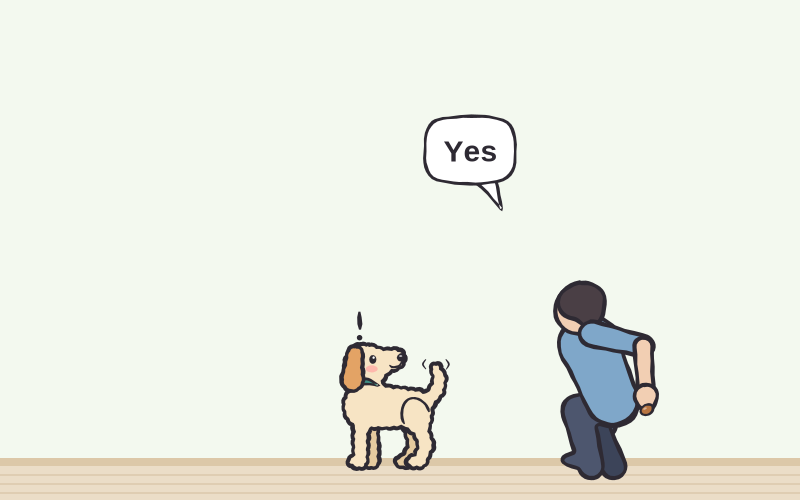
“Yes” is a short signal that tells your dog “that — right there — was correct.” The moment she finishes peeing in the right spot, the moment she turns at her name, the moment she sits on her own. Getting a treat to her always takes a second or two, and in that time she has already moved on to something else. A marker word lets you tag the exact moment, and hand over the treat a moment later. This comes before every other practice, and it builds the skill of Understanding Cues. You need a quiet room and less than five minutes.
GoalThe instant your dog hears “Yes,” she snaps her attention to you — she knows a reward is on its way.
Assessment: what a trainer might check on the first visit
Before starting, a visiting trainer might check these three things.
Can she take a treat from your hand calmly, without grabbing your fingers?
→If she’s very excited, start by placing the treat on the floor or switching to her regular kibble, so she can eat calmly.
How often does your family say “yes” or “good” in ordinary conversation?
→If it comes up all the time, choose a different word or use a clicker.
Which treats does she eat straight away and then wait for more?
→Pick about three, in order of how much she loves them. Use everyday food indoors and something better outside.
What you need
- About 20 tiny treats (fingernail-sized; her regular kibble is fine) that she can swallow in a second
- A quiet room at home
- Choose one marker: a short word you don’t use much in everyday talk. We use “Yes” in our examples; if your household says “yes” all day, pick something rarer, such as “Yip!” or “Bingo.” A clicker (a small device that makes a click sound) works too
How to signal
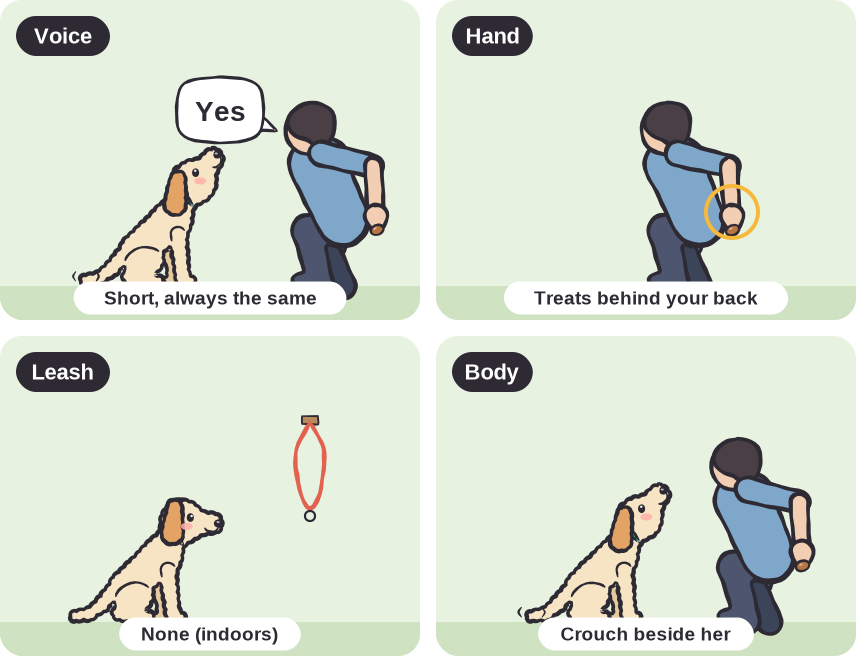
- Voice
Say “Yes” short and calm. Same word, same pitch, same volume every time. Keep it separate from everyday praise like “Good girl!”
- Hand
Keep treats behind your back or in a pouch. Don’t move your hand before you speak. Say the word, then move your hand.
- Leash
None (indoors).
- Body
Crouch or sit facing your dog, or beside her.
Today’s session
With the trainer, you work on step 1.
Step 1Say it, then give it(At home, quiet)
The trainer shows “Yes” → treat a few times, then you take over for 10 repetitions. The trainer watches whether your hand moves only after you finish the word, and whether it’s creeping toward the pouch before you speak — and fixes it on the spot. About three minutes.
Homework until the next visit
- How often
- 2–3 times a day
- How long
- 2–3 minutes each
- How much
- Up to 20 treats per session
A good sign she’s readyWhile she’s looking at a toy or out of the window, she turns at “Yes” five times in a row
What the trainer checks next visit
In front of the trainer, say “Yes” while your dog is looking elsewhere — five times.
If she canFive turns in a row → on to step 4 (using it at the right moment). Start using it as the marker in your other practices — The Name Game, potty training and so on.
If not yetIf she doesn’t turn, look together at whether word and hand are in the right order and whether the treats are ones she loves, then do another week of steps 1–2.
Next stages: steps
- 1
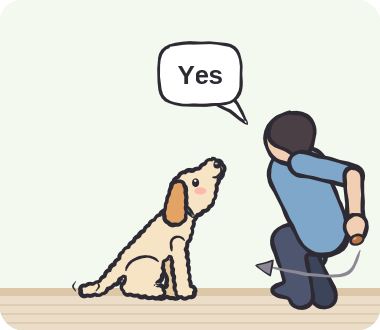
The word, then the treat At home, quiet
Say it, then give it
Whatever your dog is doing: “Yes” → treat. 10 times.
A good sign to move onShe eats every treat straight away
- 2
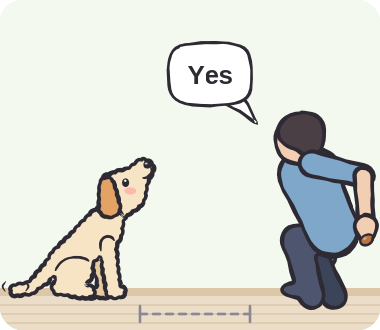
She can’t guess when — but the word tells her At home, quiet
Mix up the timing
After 3 seconds, then 10, then 5… another 10 times. That way she can’t predict it from the rhythm — only from the word.
A good sign to move onAt “Yes,” her ears or face turn toward you
- 3
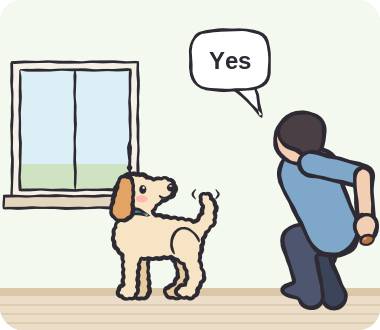
Even looking away, she turns At home, small distractions
When she’s looking away
While your dog sniffs a toy or gazes out of the window: “Yes” → treat.
A good sign to move onShe turns the instant she hears it, five times in a row
- 4
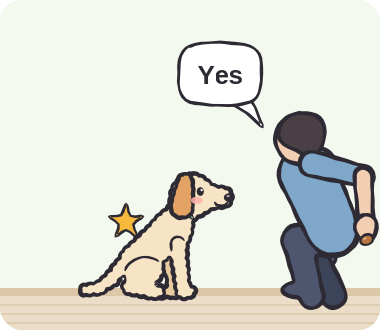
Mark the moment she gets it right At home, small distractions
Use it at the right moment
The moment your dog sits on her own: “Yes” → treat. This is how you’ll use it in every practice from now on. In potty training, it’s the moment she finishes in the right spot.
A good sign to move onShe starts sitting more often all by herself
Timing
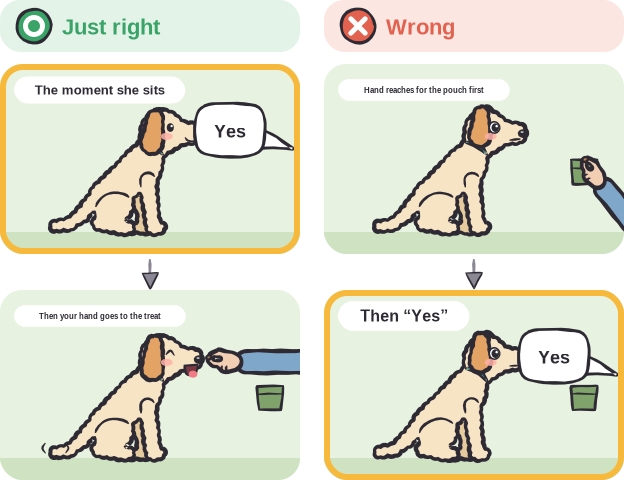
Just right
“Yes” at the exact moment she does the right thing. Finish the word, then bring out the treat — straight away, within 2–3 seconds at most.
Too late
Reaching for the treat first and speaking second. Your dog may learn your hand movement as the signal instead of the word.
What matters is the order — word, then treat — and the moment you say it. Battersea says to give the treat within 3 seconds of the click; FOUR PAWS says within about 2 seconds. Studies comparing how fast dogs learn with a clicker, a word, or just a treat with no marker don’t agree. In one study, 51 dogs with no previous training were split into three groups and taught to open a breadbox; all three groups learned equally well. A study of shelter puppies (8–22 weeks old), also split into three groups and tested on three tasks, found no method clearly better than the others — except that on a sit-stay task, the treat-only group held the sit longer than the word-marker group. On the other hand, in a study of 28 Labrador detection-dog candidates, the clicker group finished the final stage of training in fewer trials. We still teach a marker because it lets you tag the right moment when you can’t deliver the treat instantly. Behaviorist Dr. Maxwell on the AVSAB blog and RSPCA Australia both describe the same pattern for recall: say “Yes” the moment your dog starts moving toward you, and give the treat when she reaches you.
How much and how often
2–3 minutes and up to 20 treats per session, 2–3 times a day. It’s easiest when she’s a little hungry — before a meal, for example.
If it isn’t working
Clicker or word — which is better?
Either. As the studies above show, it isn’t clear that one is learned faster. A word works when your hands are full and you always have it with you. A clicker sounds exactly the same whoever presses it. Pick the one your family finds easier, and stick with one.
She just stares at my hands
Keep treats behind you or in a pouch. Keep your hands still, say “Yes,” and only after the word, move your hand. Word first, hands second — that’s our advice.
We say “yes” all the time in conversation
Switch to a sound you don’t normally use — “Yip,” “Bingo,” a tongue click — or use a clicker.
I said it, but I had no treat
Go and get one, but always follow through. If the word keeps arriving with nothing after it, it loses its meaning. The UK assistance-dog charity Dogs for Good recommends giving a treat after every click, even when you click by mistake.
How long do I have to keep giving treats?
Every “Yes” is followed by a treat (or another reward she loves), every time. As she gets the hang of a behavior, you reward the behavior itself less often — so you say “Yes” less often. What you don’t do is say “Yes” and then give nothing.
She doesn’t respond outside
Outside is full of smells and sounds, and the treats that work indoors may not compete. Once she turns at “Yes” five times in a row indoors, try the same steps in front of your home, with better treats.
Avoid
- Saying “Yes” and not following it with a reward
- Moving your hand or showing a treat before you speak
- Saying it in the same sharp voice you use for a telling-off
- Mixing it into everyday praise, so its meaning blurs
A good sign to move on
- Steps 1–2: once her ears or face turn toward you at “Yes,” go on to step 3
- Step 3: she turns at “Yes” while looking away, five times in a row (our rule of thumb). Then start using it in other practices
- The next practice is The Name Game. If you’re potty training, use “Yes” the moment she finishes in the right spot, too
- If a step isn’t working, go back one step
Sources
- Dogs Trust — Introducing a marker
- Battersea — The basics of clicker training
- PDSA — Clicker training
- FOUR PAWS — Clicker & marker signals in animal training: tips & best practices
- American Kennel Club — Clicker Training Your Dog: Mark and Reward
- Dogs for Good — Advanced training: clicker training and shaping (PDF)
- Maxwell, M. E. (2017). Teaching Name Recognition (AVSAB blog)
- RSPCA Australia — How can I teach my dog recall (to come when called)?
- Chiandetti, Avella, Fongaro & Cerri (2016). Can clicker training facilitate conditioning in dogs? Applied Animal Behaviour Science 184:109–116
- Gilchrist et al. (2021). The click is not the trick: the efficacy of clickers and other reinforcement methods in training naïve dogs to perform new tasks. PeerJ 9:e10881
- Lazarowski et al. (2025). Effectiveness of marker training for detection dogs. Frontiers in Veterinary Science 12:1538452
- Dorey & Cox (2018). Function matters: a review of terminological differences in applied and basic clicker training research. PeerJ
- AVSAB — Position Statement on Humane Dog Training (2021)