 BAUDOG The dictionary of dog–human communication
Contents
- The finished behavior
- Assessment: where is your dog now?
- The cue
- How to signal
- Teaching steps
- When to reward
- Roll over, belly up or lying on her side: which one are you teaching?
- Is my own way right?
- Body safety: disc-prone breeds, puppies and seniors
- A good sign to move on
- If it isn’t working
- Prescription: a suggested order
- In the moment: do / don’t
- When to see a professional
- Sources
The finished behavior
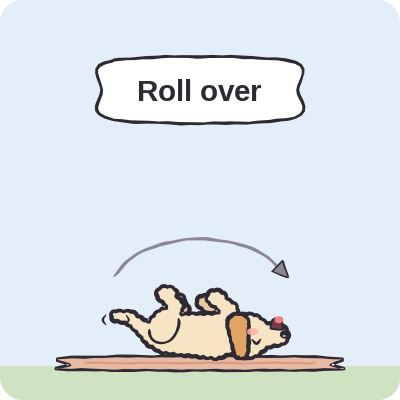
On the cue “Roll over”, your dog goes from a down onto her side, onto her back, and over to the other side in one full roll.
Assessment: where is your dog now?
A visiting trainer might check something like this before starting.
Does she lie down on the spoken cue “Down” alone?
→Roll over starts from a down. If she still needs a treat to lure her into the down, work on “Down” first.
Is the floor slippery?
→On hardwood or tile, our rule of thumb is to put down a non-slip mat or rug big enough for her whole body. She’ll be rolling on her back, and some dogs dislike hard floors.
Lying on her side, is she relaxed when you touch her belly and back?
→If she stiffens or pops straight up, don’t push the roll. Our suggestion is to first make being touched a good thing with “touch → treat”.
Her age, breed and back history?
→For breeds prone to disc disease, such as dachshunds and French bulldogs, dogs who have hurt their back before, and senior dogs, talk to your vet first. Our rule of thumb for these dogs is to stop at lying on the side.
The cue
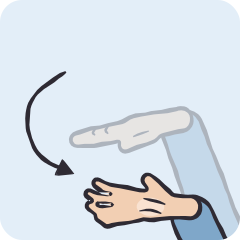
People use “roll over” for different things: a full roll, flipping onto the back for a belly rub, or just flopping onto one side. On this page, “Roll over” means the full roll. If you also want her to stop on her back (“belly up”), give that its own word (see “Is my own way right?” below). Add the spoken cue only once she can follow your hand all the way around.
How to signal
- Voice
Say “Roll over” once. Add it only after she can roll all the way over following your hand. At first, say “Roll over” → pause → give the hand signal.
- Hand
Your first hand signal is the lure itself: the treat moving from her nose to her shoulder, over her back and down the other side in a big arc. Switch to an empty hand, then make the movement a little smaller each time until it is a small circle with one finger or a flick of the wrist. There is no standard shape, so the whole family should agree on one.
- Leash
Practice indoors with the leash off.
- Body
Start by kneeling beside her, so your hand can move close to the floor. Once the signal is small, you might stand up a little at a time, until she can see the signal while you are standing.
Teaching steps
- 1
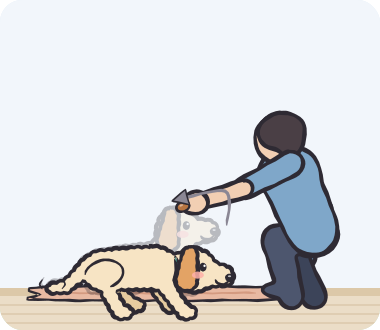
Nose to shoulder. Praise when she tips over Down to lying on her side
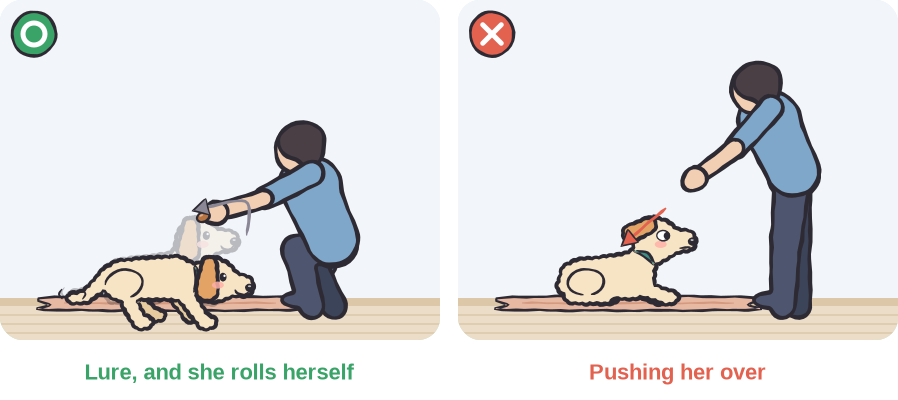
With her in a down, hold a treat at her nose and move it slowly from her nose toward her shoulder. The moment she tips onto her side with her head on the floor, say “Yes” → treat.
A good sign to move onOur rule of thumb: she tips onto her side following the lure 8 times out of 10
- 2
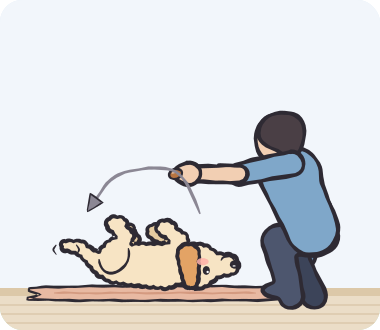
Shoulder to back Onto her back
From lying on her side, keep the treat moving from her shoulder toward her backbone. The moment her back touches the floor and she is belly up, say “Yes”.
A good sign to move onOur rule of thumb: onto her back 8 times out of 10
- 3
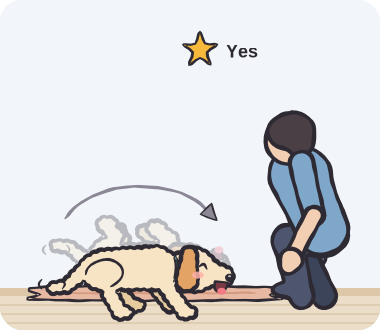
“Yes” the moment she finishes the roll All the way over
Keep your hand moving down toward the floor on the other side. When she rolls onto her other side, say “Yes” → treat. Join steps 1 and 2 into one smooth movement.
A good sign to move onOur rule of thumb: a full roll following the lure, 8 times out of 10
- 4
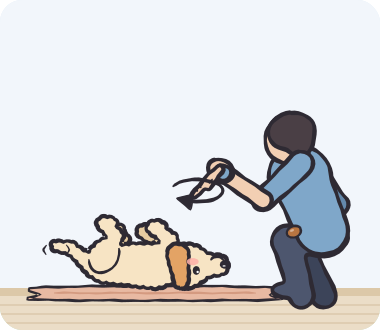
Lure with an empty hand, reward from the other Empty hand
Make the same movement with a hand that holds no treat. When she rolls, give the treat from your other hand. Then make the movement a little smaller.
A good sign to move onOur rule of thumb: a full roll to an empty hand, 8 times out of 10
- 5
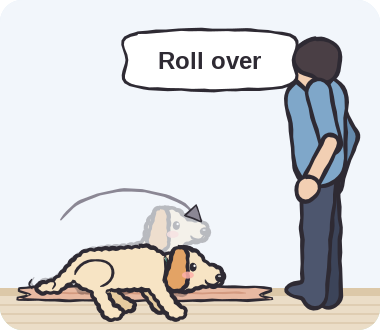
Words → pause → hand Add the spoken cue
Say “Roll over” once → pause → small hand signal → “Yes” when she rolls. After enough repetitions, she starts rolling on the words alone.
A good sign to move onOur rule of thumb: on the words alone, 8 times out of 10
- 6
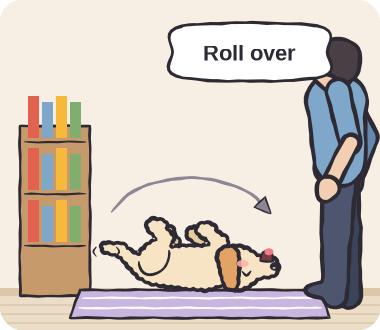
Does it still work in a new place? New rooms, other direction
Try it in another room, or in front of the sofa: does it still work somewhere new? If you want her to roll the other way too, our suggestion is to polish the direction she finds easier first, then teach the other direction from step 1.
A good sign to move onOur rule of thumb: in any room, on the words alone, 8 times out of 10
When to reward
Just right
At first, the moment she tips onto her side and her head touches the floor. Once you are working on the full roll, the moment she finishes rolling onto the other side. Say “Yes”, then treat.
Too late
Saying “Yes” after she has got up, or after she has eaten the treat and stood up. What you have rewarded is getting up.
Roll over, belly up or lying on her side: which one are you teaching?
Ask three owners what “roll over” means and you may get three different moves. That is why instructions for this trick can seem to contradict each other: they are not always teaching the same thing.
The AKC Trick Dog program treats the full roll and belly up as separate tricks. “Rollover” is an Intermediate-level trick, and the handler may say “down” as the first step. At Intermediate level the handler may not lure with food, though food can still be the reward afterward. That is roughly where step 5 above gets you. “Rollover – belly up” is listed separately among the AKC’s ideas for extra Intermediate tricks, and the Performer level has a trick where the dog gets into her bed, turns belly up on a cue such as “turn over”, and stays on her back for at least 5 seconds.
- Roll over (full roll): from a down, onto her side, onto her back and over to the other side. This page
- Belly up (stopping on her back): she stops halfway through the roll, on her back. Give it a different word (next section)
- Lying on her side: she tips onto one side and stays there. Handy for grooming and vet checks
- Bang (play dead): she drops on the cue and stays still. See the “Bang” page
- For why dogs show their belly on their own, see the page on showing the belly
Is my own way right?
Answers to the questions owners most often ask about ways they have worked out themselves.
“She did down → onto her back (and stayed there) a few times, so I added the cue ‘Belly’. Is that OK?” The order is right. Adding the spoken cue once the movement is reliable is the standard way. As for how reliable: for example, once she stops on her back about 8 times out of 10 following your hand alone (our rule of thumb; Whole Dog Journal says 80 to 90 percent before adding a cue). If you are still at “a few times”, keep going with just the lure for a while. The thing to check is when you say the word. If you say “Belly” at the same time as the lure, or after she is already on her back, switch the order: say the new word “Belly” once → pause → your usual hand lure → “Yes” the moment she stops on her back. Repeat, and she will start going belly up on the word alone. Stop her in the same position every time (on her back), and if you are also teaching the full “Roll over”, keep the two words separate.
“I want to chain them, like roll over and then bang.” Before you join them, check that she does each one reliably on its own word (our suggestion). At first say “Roll over”, then “Bang”, one at a time. Once the sequence runs smoothly, give the whole thing one new word, added the same way as “Belly”: new word → pause → the cues she already knows.
“Would pushing her over by hand teach it faster?” Don’t push. A dog who is pushed tends to stiffen and can come to dislike lying on her back at all. The American Veterinary Society of Animal Behavior (AVSAB) warns that confrontational methods such as pinning a dog on her back (the “alpha roll”) frequently drew an aggressive response from dogs, and recommends reward-based methods for all dog training. Lure with a treat and reward her when she rolls by herself.
“Is any hand signal fine: a twirl of the finger, a finger gun?” We could not find a standard shape. A signal that is a smaller version of the lure tends to connect most easily with the movement she has learned. What matters is that everyone in the family uses the same signal and the same word.
Body safety: disc-prone breeds, puppies and seniors
Roll over means rolling on the back and using the back and hips to get up again. Chondrodystrophic breeds, whose cartilage makes the spinal discs wear early (dachshunds, Pekingese, beagles, Lhasa apsos and others), account for the vast majority of disc ruptures, according to the American College of Veterinary Surgeons. In a US Dog Aging Project study of about 43,500 dogs, owners reported that 1.2% of all the dogs had ever had intervertebral disc disease (IVDD), compared with 15.3% of dachshunds; among purebreds, French bulldogs had the highest odds. These are owner reports from a single survey, so they show which dogs are affected more often, not what causes it. The same study found that dogs with more daily activity, and dogs who regularly used stairs, had lower odds: an association, not proof that activity protects the back.
We found no veterinary source saying that rolling over is bad for these breeds, for dogs with a past back injury, or for seniors. Still, for any dog whose spine you want to protect, our suggestion is to talk to your vet before you start and to stop at lying on the side.
Puppies can learn it too: VCA Animal Hospitals lists roll over among the basic tricks a puppy may already know. Teach it after “Down”, and keep sessions short.
A good sign to move on
- Side → back → full roll, in that order. Our rule of thumb: move on when she gets the current step 8 times out of 10
- Add the spoken cue once she rolls all the way over reliably to your empty-hand signal
- When it isn’t working, go back one step (our rule of thumb: after two misses in a row)
- Keep each session to a few minutes and stop while she still wants more
If it isn’t working
She stays in the down and won’t move
Usually the down isn’t solid yet, or the treat has drifted away from her nose. Keep the treat right at her nose and move it slowly toward her shoulder. If she can’t do a down without a treat, go back to practicing “Down”.
She stands up to follow the treat
Often your hand is moving too fast or too high. Move it slowly, close to the floor. If she stands, say nothing and start again from the down.
She stops on her side
Reward lying on her side plenty, then in the next step move the treat from her shoulder over toward her backbone. Don’t try for the full roll in one go: make “onto her back” a step of its own. Once she understands where your hand is going, moving the lure a little faster can help, because most dogs roll more easily with a bit of momentum (trainer Pat Miller in Whole Dog Journal), but only as fast as she can follow it.
She only rolls one way
That is common: most dogs find one direction easier, notes a Fear Free Happy Homes article reviewed by a veterinary behaviorist, and Whole Dog Journal suggests starting in the direction of the hip she is already resting on. Our suggestion is to polish the easy direction first, then teach the other direction from step 1. Rolling only one way is perfectly fine if that is all you want.
She keeps rolling over and over
For example, say “Yes” the moment she finishes one roll, and have the next treat at her nose before she starts a second. If you do want several rolls in a row, our rule of thumb is to build one clean roll first and then ask for more.
She doesn’t like going onto her back
Don’t force it. Common reasons are a hard or slippery floor, or not liking being touched. Put down a non-slip mat, and get her used to being touched with “touch → treat” first. If she has suddenly started refusing, it could be back pain, so check the vet signs below.
She used to do it, but has stopped
If you haven’t practiced for a while, go back to the lying-on-her-side step and rebuild. If she still does other tricks but not roll over, or is also reluctant to lie down or get up, it could be back or hip pain. Stop practicing and see your vet.
How long does it take to teach a dog to roll over?
We couldn’t find a reliable figure, and dogs vary a lot. Rather than counting days, use the checks in each step (our rule of thumb: 8 out of 10) and move on when she passes. Keep each session to a few minutes.
Prescription: a suggested order
Roll over rests on two skills: connecting a cue with a movement, and being relaxed when her body is touched. Build them in this order.
- ExerciseCharging Your Marker Word: How to Teach Your Dog That “Yes” Means a RewardDoable at home (Steps 1–4 at home)A word that marks the exact moment she finishes the roll. The roll is fast, so without a marker your timing will slip.Read →
- ExerciseTouch Then Treat: Help a Dog Who Hates Being Handled Learn to Enjoy ItDoable at home (Steps 1–5 at home)Once she is relaxed being touched on her side and back, she won’t mind rolling over or going belly up, and you can use these positions for brushing and vet checks too.Read →
In the moment: do / don’t
Do
- Start from a down, on a non-slip mat
- Break it into side → back → full roll and reward each step
- Switch early to an empty hand and make the signal smaller
- Say “Roll over” once, and only after she can do the movement
Don’t
- Push her over by hand or pin her on her back
- Reward after she has got up
- Use the same word for the full roll and for belly up
- Keep going when she seems sore or has suddenly started refusing
When to see a professional
- She avoids turning her head to one side, or walks to her food or water bowl and just looks at it. These can be signs of a spinal disc problem (Cornell University College of Veterinary Medicine)
- She has trouble sitting or getting up from lying down, hesitates to join in physical play, or has suddenly stopped rolling over. These can be signs of pain
- She is wobbly or her hind legs are weak. See your vet right away
The skills behind this command
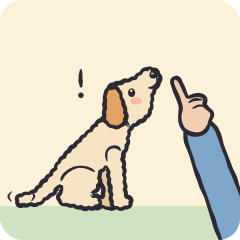 Core skill Understanding Cues Telling “Roll over”, “Belly” and “Bang” apart as different movements.
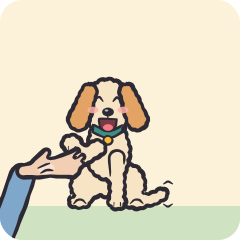 Core skill Comfort with Handling Lying on her back with her belly showing, and staying loose while she is touched.
- ExerciseCharging Your Marker Word: How to Teach Your Dog That “Yes” Means a RewardDoable at home (Steps 1–4 at home)Read →
- ExerciseTouch Then Treat: Help a Dog Who Hates Being Handled Learn to Enjoy ItDoable at home (Steps 1–5 at home)Read →
Sources
- American Kennel Club — How to Teach a Dog to Roll Over
- American Kennel Club — Lure-and-Reward Training
- AKC Trick Dog Participant and Evaluator Guide (PDF)
- Whole Dog Journal — How to Teach Your Dog to Roll Over (Pat Miller, CBCC-KA, CPDT-KA)
- Whole Dog Journal — Clean Up Your Cues (Lisa Lyle Waggoner)
- Fear Free Happy Homes — Roll Over, Rover! How To Teach Your Dog This Fun Trick (Kate Eldredge Basedow, LVT; reviewed by a board-certified veterinary behaviorist)
- Susan Garrett — When Do I Add a Cue? (archived copy)
- Battersea — How to teach your dog to lie down
- AVSAB — Position Statement on the Use of Dominance Theory in Behavior Modification of Animals (PDF)
- AVSAB — Position Statement on Humane Dog Training (2021, PDF)
- ACVS (American College of Veterinary Surgeons) — Intervertebral Disc Disease
- Wee C, Nin DZ (2025). Demographic and lifestyle characteristics impact lifetime prevalence of owner-reported intervertebral disc disease: 43,517 companion dogs in the United States. J Am Vet Med Assoc 263(5):1–9
- Cornell University Riney Canine Health Center — Intervertebral disc disease
- Cornell University Riney Canine Health Center — Recognizing pain in dogs
- American Kennel Club — Why Dog Core Strength Matters
- VCA Animal Hospitals — Tricks To Teach Your Puppy
- Dogs Trust — Top ten dog training tips
- East Bay SPCA — Nose Targeting (PDF)
- American Kennel Club — How to Train Your Dog to Come When Called
- Toronto Humane Society — How to Teach Recall (PDF)
- Maxwell, M. E. (2017). Teaching Name Recognition (AVSAB blog)