 BAUDOG The dictionary of dog–human communication
Contents
- In short
- When it happens
- How your dog feels
- Why does she hate it? Five reasons and how to tell
- If a trainer came to your home: the first session and the first homework
- Step by step: teaching her to like the brush
- Let her choose to stop
- The right brush for her coat — and how to use it
- Don’t force mats out — and don’t cut them with scissors
- How often to brush
- Brushing is also a health check
- What the research says: the hard part is keeping it up
- The missing core skill
- Exercises
- In the moment: do / don’t
- When to see a professional
- Sources
In short
Sometimes a dog hates brushing because she remembers it hurting or scaring her — the American Kennel Club lists this as one possible reason. Mats got pulled, someone brushed too hard, she was held down. Dogs are said to remember frightening or painful experiences well. The fix isn’t to hold her still and finish the job. Go back to before the brush: your hand, then a treat. Then brush a few strokes on a spot she likes and stop. Don’t try to pull out big mats or cut them out with scissors — leave those to a groomer or your vet. And if she objects strongly to one particular area, it may hurt there (skin, joints, ears), so have your vet take a look.
When it happens
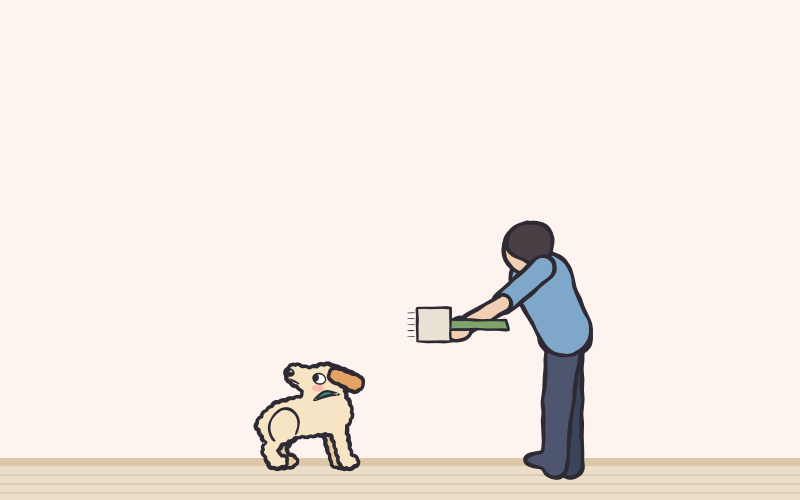
- Your dog runs and hides as soon as she sees the brush
- Once you start, she twists, sits down or rolls over
- She gets cross when you reach one area — her hips, legs, tail or around her ears
- She puts her teeth on the brush or your hand, or growls
- It’s shedding season and you can’t get the loose coat out
How your dog feels
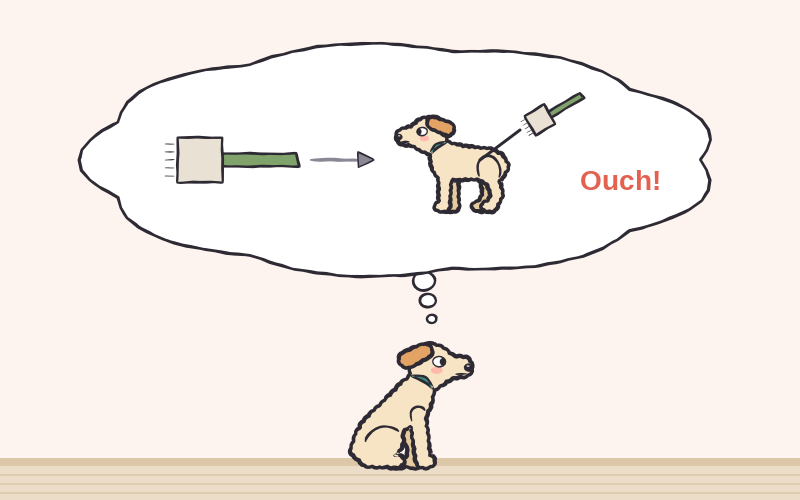
Dogs are said to remember frightening and painful experiences well. A mat that got yanked, a brush dragged too hard — even one painful session can be enough to make a dog run at the sight of a brush. Experiences in puppyhood are thought to stick especially well.
Holding her down and brushing to the end adds one more “something hurt me and I couldn’t get away” to the list. Next time she’s likely to run sooner or fight harder.
Some dogs simply find it hard to keep still. Try to brush a dog who is full of energy and the brush ends up competing with her urge to play.
Why does she hate it? Five reasons and how to tell
First, work out which of these fits. What you do first depends on the reason. (These five groups are one example of how BAUDOG sorts it.)
- It hurt or scared her before: she runs as soon as she sees the brush. → Start by turning the brush back into a sign that something good is coming (step 2 below).
- She dislikes being handled at all: her body goes stiff even when you stroke her with your hand. → Put the brush away and start with your hand (step 1, and Touch Then Treat).
- The brush or the pressure is wrong: she only objects to one particular brush. → Switch to a brush that suits her coat and don’t press into her skin (see “The right brush for her coat”).
- Mats, sore skin, joints or ears: she gets cross only at certain spots — hips, legs, around her ears. → See your vet before you start training.
- She can’t keep still: she wriggles before a walk or when she’s full of energy. → Try brushing after a walk or play, when she’s calmer (the AKC suggests this too).
If a trainer came to your home: the first session and the first homework
Here is how we’d expect a first in-home session with a visiting trainer to go — one example from BAUDOG, not a fixed script. On day one, the brush doesn’t actually touch her coat.
- What the trainer looks at first: where she’s happy to be touched by hand and where her body starts to stiffen (light touches from shoulder and back toward her paws, tail and ears). Her “I don’t like this” signals — freezing, a quick lick of the lips, yawning, turning her head away. How she reacts when she sees the brush. Whether she has any mats.
- Today: touch a spot she’s happy with (shoulder or back) for one second → take your hand away → treat, 10 times. The trainer shows you how to read her stress signals and stops just before the spots she dislikes (step 1 of Touch Then Treat).
- Homework (BAUDOG’s rule of thumb): a few times a day, 2–3 minutes each. Up to 10 rounds of touch-then-treat on a spot she’s happy with. Once that’s easy, put the brush on the floor and treat her when she sniffs it. Keep the order — touch first, then treat. Leave any mats alone for now (ask about them at the next visit, or at the groomer).
- At the next visit, the trainer checks: when the brush comes out, does she come over instead of running? Our rule of thumb: if she stays relaxed 8 times out of 10 when you rest the back of the brush on a spot she likes, the next step is one or two gentle strokes there.
Step by step: teaching her to like the brush
Break brushing into small steps and get her used to each one gradually (desensitization), pairing every step with something delicious (counterconditioning). VCA handouts written by veterinary behavior specialists say each step should be easy for your dog to accept; if she looks worried, stop and go back to an easier step. Keep sessions short — at first a few seconds, then a minute, then a few minutes.
- 1. Your hand: touch a spot she’s happy with → take your hand away → treat. Stop just before the places where she stiffens (Touch Then Treat).
- 2. Show her the brush: brush comes out → treat. She sniffs it → treat. Brush goes away → treats stop too.
- 3. Touch with the brush: rest the back of the brush (the side without bristles) gently on a spot she likes → treat. For a dog who hates brushes, a grooming glove — which feels more like being petted — is another place to start.
- 4. Brush a little: brush gently in the direction of the coat, about 1–2 strokes on a spot she likes (BAUDOG’s rule of thumb — the AKC says to stop “after a few strokes”) → treat → done for today. Stop while she’s still comfortable.
- 5. Build up slowly: add either more strokes or one more area — just one at a time. Leave the tricky spots until last (BAUDOG’s rule of thumb; the AKC also suggests starting where she’s comfortable and moving to more sensitive areas as she gets used to it).
- 6. Give her a “start button”: brush only while her chin rests on your hand or a towel, and stop when she lifts it (Chin Rest: Your Dog’s Start Button). Once she can say “hang on,” she has much less reason to fight.
Let her choose to stop
The American Kennel Club describes brushing while your dog licks a plate or lick mat spread with something tasty: if she wanders off, don’t chase her; when she comes back, start again. When dogs learn they can stop any time, they start choosing to take part.
BAUDOG recommends sitting on the floor and brushing with her facing a way she can walk off, rather than holding her in a spot where she can’t leave. The AKC’s version of this choice-based grooming (husbandry training) works the same way: the tools go on the floor, and it’s fine if your dog walks away.
The right brush for her coat — and how to use it
The wrong tool for the coat, or too much pressure, can be the whole problem. VCA recommends choosing a brush by coat type:
- Curly, non-shedding coats (poodles, for example): a slicker brush.
- Medium-length coats that shed (retrievers, for example): a comb or a stiff bristle brush.
- Smooth, short coats (boxers, for example): a soft grooming glove or a brush with short bristles.
- Long coats (collies, for example): a long-toothed comb — also good for lifting out clumps of loose undercoat in shedding season.
- Whatever brush you use, don’t press it into her skin and don’t pull hard on tangles. If you’re not sure which brush suits her, ask your vet or groomer.
Don’t force mats out — and don’t cut them with scissors
Small tangles can be gently brushed out. But brushing through a large mat pulls on the skin, which hurts a lot — and that can be how brushing fear starts. VCA advises that if mats need cutting out, you use clippers, never scissors, and take great care not to cut the skin, and that severe matting is best left to a groomer or your vet. If a mat has irritated her skin, see your vet.
Brush out tangles before a bath. Once wet, mats can become impossible to remove.
How often to brush
VCA says dogs with long, silky or curly coats need daily brushing to stop tangles and mats, especially around the ears, in the armpits and along the back of the legs. Dogs with short coats may need brushing less often.
For a dog who hates brushing, a little every day before mats form is far kinder than a long session to get mats out. While you’re building up, care more about finishing without a fuss than about how much coat you got through.
Brushing is also a health check
VCA notes that regularly checking her coat and skin gives you a better chance of spotting unusual lumps or bumps, fleas and ticks, or sore areas early. If she starts objecting in a new spot, there may be something there.
What the research says: the hard part is keeping it up
One small study took 37 dogs that were afraid of the vet: 15 had four weeks of exam-style handling practice at home (desensitization and counterconditioning) plus weekly visits to the clinic, and 22 had no training. The trained dogs crouched in fear less often during exams, and 86.7% of their owners said the fear had gone down — but heart rate and other measures didn’t change, and the authors called the effect “mild.” And even among motivated owners who signed up, 44% didn’t keep up with the training.
This wasn’t a study of brushing. But it shows that getting a dog comfortable with handling doesn’t change overnight, and that sticking with the practice is the hard part. That’s why BAUDOG keeps homework to sessions of 2–3 minutes.
The missing core skill
Exercises
- ExerciseTouch Then Treat: Help a Dog Who Hates Being Handled Learn to Enjoy ItDoable at home (Steps 1–5 at home)Even when a sensitive spot is touched, her body stays relaxed and she looks to you for the next treat.Read →
- ExerciseChin Rest Training: Teach Your Dog a “Start Button” for Grooming and Vet CareDoable at home (Steps 1–5 at home)She offers her chin to your palm or a towel on her own, and keeps it there for a few seconds up to about 10. While her chin is down, she’s comfortable being touched.Read →
In the moment: do / don’t
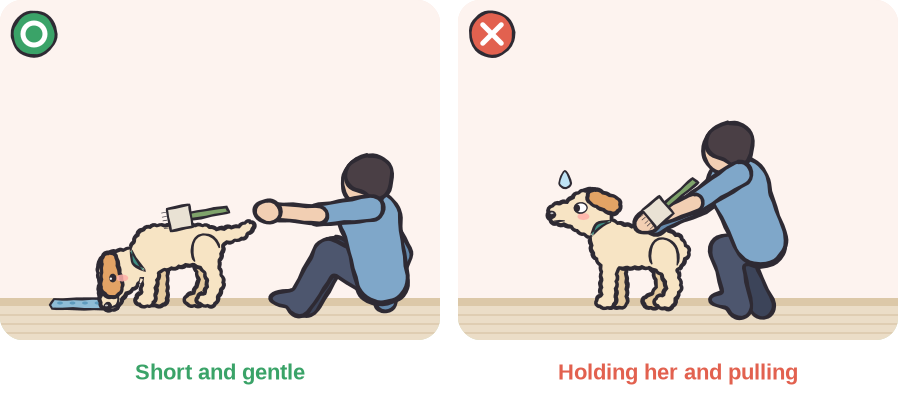
Do
- Start with your hand and a treat, before the brush
- Brush a few strokes on a spot she likes, and stop while she’s still happy
- Use a brush that suits her coat, without pressing into her skin
- Choose a calm moment, such as after a walk or play (one option)
- Brush a little every day, before mats form
Don’t
- Hold her down and brush until you’re finished
- Pull big mats out with the brush
- Cut mats out with scissors (it’s easy to cut the skin)
- Punish her for growling
- Chase her down and bring her back to finish
When to see a professional
- She objects strongly to one area only — hips, legs, ears or tail. It may be a skin problem or joint or ear pain. Have your vet take a look
- The skin under a mat is red, raw or smelly
- She bites or growls at the brush or your hand. Get help from a qualified trainer or behavior professional (see also our page on biting)
- She used to be fine with brushing but suddenly isn’t
- She has severe mats. Leave them to a groomer or your vet
Go to the root
Don’t stop at the quick fix. Growing the skill underneath makes other problems lighter too.
Sources
- VCA Animal Hospitals — Grooming and Coat Care for Your Dog
- VCA Animal Hospitals — Handling Exercises for Trimming Nails and Brushing Teeth (Lindell, Feyrecilde, Horwitz, Landsberg)
- American Kennel Club — Why Does My Dog Dislike Being Brushed?
- American Kennel Club — Dog Hates Being Groomed: How Husbandry Training Can Help
- MSD Veterinary Manual (veterinary edition) — Behavioral Problems of Dogs (cooperative care)
- Stellato et al. (2019). Effect of a Standardized Four-Week Desensitization and Counter-Conditioning Training Program on Pre-Existing Veterinary Fear in Companion Dogs. Animals 9(10):767
- Riemer et al. (2021). A Review on Mitigating Fear and Aggression in Dogs and Cats in a Veterinary Setting. Animals 11(1):158
- ASPCA — Aggression in Dogs
- Cornell Riney Canine Health Center — Dog Bite Prevention (April 2025)
- AVSAB — Position Statement on Humane Dog Training (2021)