 BAUDOG The dictionary of dog–human communication
Contents
- The finished behavior
- Assessment: where is your dog now?
- The cue
- How to signal
- Teaching steps
- When to reward
- The chin rest trick vs. the “start button” for care
- If a trainer came to your home: today’s session and the homework
- Am I doing it right? (Combos and changing the cue)
- Why does my dog rest her chin on me?
- A good sign to move on
- If it isn’t working
- Prescription: a suggested order
- In the moment: do / don’t
- When to see a professional
- Sources
The finished behavior
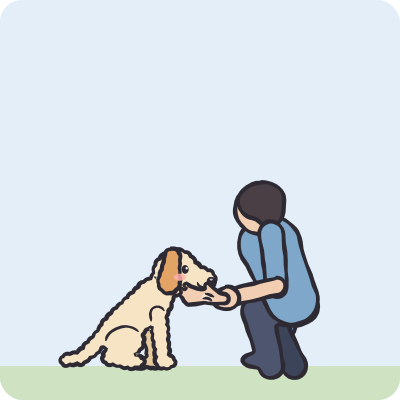
A chin rest is your dog placing her chin in your palm on her own and keeping still for a little while. It makes a sweet trick, and it can also be her way of saying “go ahead” for eye drops, ear cleaning or nail trims. To teach it, hold your palm a little lower than her chin, lure her with a treat, and say “Yes” the instant her chin lands. When she lifts her chin, that means “hang on” — and during care, that’s where you stop.
Assessment: where is your dog now?
A visiting trainer might check something like these three things before starting a chin rest.
Is she comfortable with a palm near her face? Can she calmly take treats from your hand?
→If she turns her face away or nibbles your hand, first get her used to hands around her face (“Touch Then Treat”).
What do you want it for? (A trick, or eye drops and nail trims?)
→For a trick, you’ll add the word “Chin” at the end. For care, you won’t add a word; instead you wait for her to offer it (the practice “Chin Rest: Your Dog’s Start Button”).
Does she already rest her chin on your lap or arm on her own?
→If so, start by rewarding the moment she does it — she’ll learn faster.
The cue
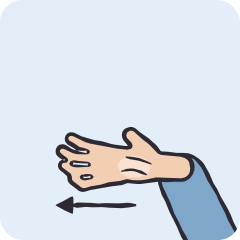
The voice cue is “Chin.” The hand signal is your palm facing up, held a little lower than your dog’s chin. It looks a lot like the shake signal (palm up, in front of her chest), so BAUDOG separates them by height — chin rest right under her face, shake lower. When you use the chin rest as a start button for grooming or care, give no voice cue: wait for her to offer it.
How to signal
- Voice
For the trick, once she lands her chin every time on the hand alone, say “Chin” once, just before you offer your hand. For the start button, don’t say anything — wait for her to offer it.
- Hand
Palm up, a little lower than her chin (so she doesn’t have to stretch her neck or look up). Hold a treat in your other hand and lure her from just beyond your palm to where her chin lands on your hand. Once she has it, make the treat hand empty.
- Leash
No leash indoors. When you use it somewhere like the vet’s, keep the leash in your hand.
- Body
Sit on the floor or crouch beside her. Don’t loom over her face from the front.
Teaching steps
- 1
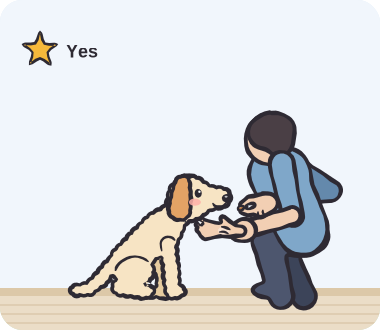
At home, quiet
Lure her chin over your palm
Palm up; use the treat in your other hand to bring her chin to just above your palm. When her chin is over your palm: “Yes” → treat (she doesn’t need to touch yet).
A good sign to move onHer chin comes over your palm, 8 out of 10 times
- 2
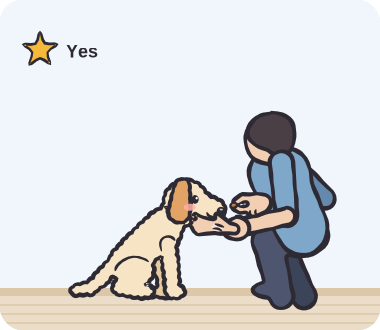
At home, quiet
Chin touches your hand
Lower the treat a little so her chin rests on your palm. The instant it touches: “Yes” → bring the treat to her mouth while her chin is still there.
A good sign to move onHer chin rests on your palm, 8 out of 10 times
- 3
At home, quiet
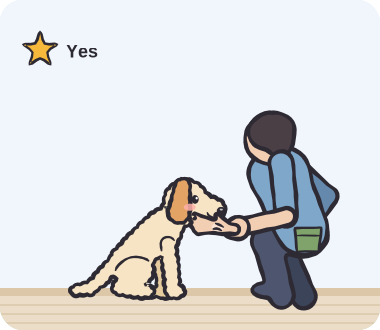
Empty the treat hand
Make the same movement with an empty hand. Chin lands: “Yes” → treat from your pouch. If she won’t do it for an empty hand, rub some treat scent on your fingers.
A good sign to move onHer chin lands for an empty hand, 8 out of 10 times
- 4
At home, quiet
From 1 second to several
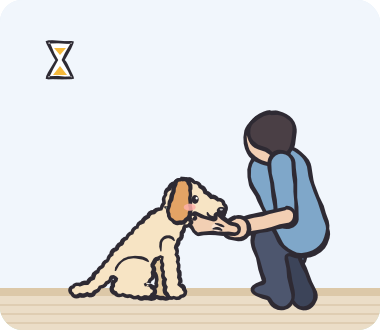
Once her chin is down, wait 1 second, then “Yes.” Then 2 seconds, 3… a little at a time, mixing in short reps now and then. If she lifts her chin, make it a bit shorter and try again.
A good sign to move onShe keeps her chin down for 5 seconds, 8 out of 10 times
- 5
At home, small distractions
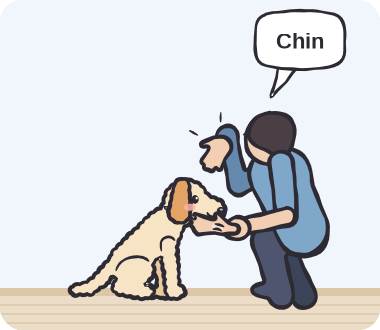
Add “Chin”; stay put while your other hand moves
For the trick, say “Chin” once, just before you offer your hand (if you’re using it as a care start button, don’t add a word — go to the practice “Chin Rest: Your Dog’s Start Button”). While her chin is down, move your other hand a little near her head. If she keeps her chin down: “Yes.”
A good sign to move onHer chin stays down while your other hand moves, 8 out of 10 times
When to reward
Just right
“Yes” the instant her chin lands on your palm. Bring the treat to her mouth while her chin is still there.
Too late
Praising after she has lifted her chin — you end up rewarding the lift.
When you use it as a care start button, lifting her chin is an important answer, too. Veterinary Partner, a veterinarian-run site, says to acknowledge and reward the “hang on” of a lifted chin, and to carry on only when she offers her chin again.
The chin rest trick vs. the “start button” for care
As a trick, the chin rest comes on the cue “Chin.” As a care tool it works a little differently: you give no cue and wait for her to offer it. Chin down means “go ahead”; chin up means “hang on.” Veterinary Partner says this kind of chin rest is never cued — it’s something the dog offers. In the American Kennel Club’s Trick Dog program, a chin rest in the handler’s palm is one of the suggested handler’s-choice tricks at the Novice level — but that’s the trick version.
For eye drops, for example, put them in while her chin is down and stop as soon as she lifts it. That’s easier on both of you than holding her down. The AKC also notes that restraining a dog for eye drops tends to make the next time harder. The full steps are in the practice “Chin Rest: Your Dog’s Start Button.”
If a trainer came to your home: today’s session and the homework
Here is how a first in-home session might go — one example BAUDOG has put together, not a fixed script.
- Today: after checking that she can calmly take treats from your hand, lure her chin over and onto your palm (steps 1–2). The trainer adjusts the height of your hand (a little lower than her chin) on the spot.
- Homework: twice a day, about 3 minutes (up to 10 reps). Steps 2–3. Don’t lengthen the hold yet.
- Next visit: does her chin land on an empty hand? Our rule of thumb: at 8 out of 10, lengthening the hold (step 4) becomes the next homework.
Am I doing it right? (Combos and changing the cue)
We looked at ways owners have come up with on their own, through a trainer’s eyes.
- I want a long hold with “Chin” → “Stay” → That works — just don’t jump to long holds. Start at 1–2 seconds and build gradually, mixing short and long reps. End with a release word, such as “Free.”
- I want to move it from my palm to a towel, the arm of the sofa or my lap → That works. Lay a towel over your palm for her to rest on; once she’s used to it, put the towel alone on the floor or the sofa arm. Bring the same towel to the vet and lay it on the exam table, and it becomes the same signal there.
- I want a chin rest while holding a camera → If she can rest her chin on your knee or a towel instead of your palm, both your hands are free.
- I want to change the word “Chin” — to “Rest,” say → Say the new word, pause briefly, then offer your hand as usual, and reward when her chin lands. If you say both at the same moment, she won’t learn the new word.
- I use the trick chin rest for eye drops too → If you cue “Chin” and then put drops in, the cue can start to predict something unpleasant. For care, switch to waiting for her to offer her chin, and stopping when she lifts it.
Why does my dog rest her chin on me?
Owner guides reviewed by veterinarians in Japan explain that a dog resting her chin on your lap or arm is most often thought to show that she wants reassurance or to be close to you — and sometimes she’s simply relaxing in a comfortable position.
Other possibilities: she’s tired and comfy; she wants something, like play or a treat; or she learned that resting her chin earned her a stroke. Tell them apart by the situation (relaxing on the sofa, before meals, while you’re eating, and so on).
Watch out if she presses her chin on you insistently, rests her chin on you while not wanting to be touched, or seems unusually low. She may have discomfort somewhere, so if she isn’t her usual self, talk to your vet.
A dog who already rests her chin on you on her own tends to learn the chin rest trick easily. Say “Yes” the moment she does it, and you’ve taken the first step.
A good sign to move on
- Steps 1–3: when her chin lands on an empty hand 8 out of 10 times, lengthen the hold (our rule of thumb)
- Step 4: when she holds 5 seconds 8 out of 10 times, add movement near her head (our rule of thumb)
- If she struggles, shorten the hold and go back one step — our rule of thumb is two early chin-lifts in a row
If it isn’t working
She lifts her chin straight away
The hold is too long. Go back to 1 second and build up slowly, mixing in short reps. If you’re using it as a care start button, lifting her chin means “hang on,” so stop there.
She won’t do it unless I’m holding a treat
Rub a strong-smelling treat on your empty fingers. If she still won’t, go back to the treat-in-hand step for a few reps.
She stays glued to my palm, hunting for the treat
Toss a treat on the floor a little way off so she leaves your hand, then offer your hand again.
When I bring my hand close, she nibbles it or turns her face away
Some dogs find taking food from a hand hard. First get her used to hands around her face (“Touch Then Treat”).
Prescription: a suggested order
Practices for using the chin rest in care as well.
- ExerciseChin Rest Training: Teach Your Dog a “Start Button” for Grooming and Vet CareDoable at home (Steps 1–5 at home)The full steps for using the chin rest as a care start button — from eye drops and nail trims to the vet, in stages.Read →
- ExerciseTouch Then Treat: Help a Dog Who Hates Being Handled Learn to Enjoy ItDoable at home (Steps 1–5 at home)Getting her used to being touched around the face and on the paws. Working on it alongside the chin rest makes care easier.Read →
- ExerciseCharging Your Marker Word: How to Teach Your Dog That “Yes” Means a RewardDoable at home (Steps 1–4 at home)So “Yes” can mark the moment her chin lands.Read →
In the moment: do / don’t
Do
- Hold your hand a little lower than her chin
- “Yes” the instant her chin lands
- Start the hold at 1 second
- In care, stop when she lifts her chin
Don’t
- Hold her chin down with your hand
- Ask for long holds right away
- Carry on with care after she lifts her chin
- Cue “Chin” and then do something she dislikes
When to see a professional
- She presses her chin on you insistently, rests her chin on you while not wanting to be touched, or seems low. She may have discomfort somewhere. Talk to your vet
- She growls or keeps turning her face away when your hand comes near her face or head. This can be pain or fear of hands. Don’t push on; talk to your vet or a behavior professional
The skills behind this command
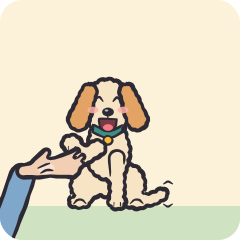 Core skill Comfort with Handling Being relaxed with hands around her face — the way into eye drops, ear cleaning and nail trims.
 Core skill Settling Down Resting her chin and staying calm and still.
- ExerciseChin Rest Training: Teach Your Dog a “Start Button” for Grooming and Vet CareDoable at home (Steps 1–5 at home)Read →
- ExerciseTouch Then Treat: Help a Dog Who Hates Being Handled Learn to Enjoy ItDoable at home (Steps 1–5 at home)Read →
- ExerciseCharging Your Marker Word: How to Teach Your Dog That “Yes” Means a RewardDoable at home (Steps 1–4 at home)Read →
Sources
- Veterinary Partner (VIN) — How to Teach a Chin Rest as a Start Button
- Veterinary Partner (VIN) — What Is Consent?
- American Kennel Club — Chin Rests: Practical Uses and Teaching Your Dog (Stephanie Gibeault, MSc, CPDT)
- American Kennel Club — AKC Trick Dog Participant and Evaluator Guide (PDF)
- Inu no Kimochi Web Magazine (veterinarian-supervised, Japanese) — Why do dogs rest their chin on you?
- petan (veterinarian-supervised, Japanese) — What it means when a dog rests its chin on you
- PETOKOTO (trainer article, Japanese) — Why does my dog rest its chin on me?
- Veterinary Partner (VIN) — Capturing Desirable Behaviors
- Dogmantics (Emily Larlham) — Adding a verbal cue or changing a cue
- Smart Dog University — How to Clean Up Cues and Transfer Cues
- Cornell Riney Canine Health Center — Recognizing pain in dogs
- Dogs for Good — Advanced training: Shake hands (PDF)