 BAUDOG The dictionary of dog–human communication
Contents
- In short
- When it happens
- How your dog feels
- Bored or anxious? Three things to look for on video
- If a trainer came to your home: the first session and the first homework
- How to build up time alone: next to you → behind a door → out the front door → real outings
- Before you leave, and where to leave her
- How long can a dog be left alone?
- Common questions
- The missing core skill
- Exercises
- In the moment: do / don’t
- When to see a professional
- Sources
In short
Staying home alone isn’t something dogs are born knowing — it’s a skill they learn. Don’t start with a long absence: begin with absences short enough that you’re back while she’s still relaxed, and build up a little at a time. The RSPCA and the Royal Kennel Club in the UK advise no more than four hours alone even for an adult dog who is used to it, and less for puppies. Before you go, walk her, let her toilet, and give her a special chew she only gets when you leave. If you come home to a mess, don’t scold her. And every so often, film her, to check she really is fine.
When it happens
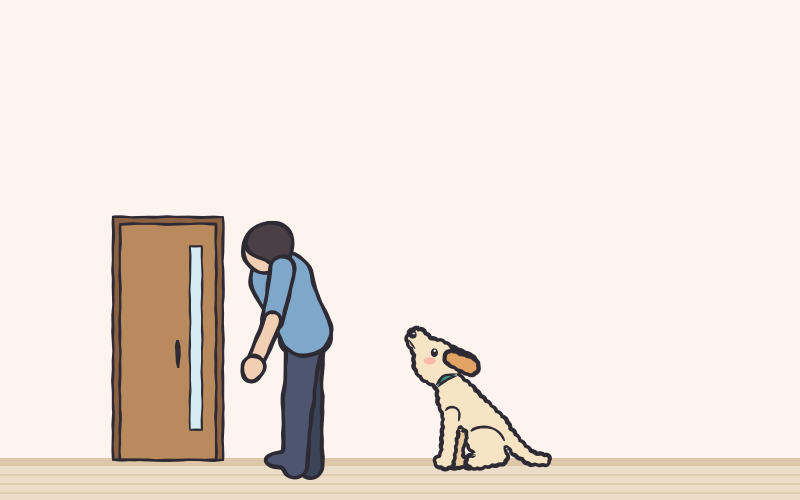
- You come home to chewed slippers and a shredded cushion
- A neighbor mentions that your dog barked the whole time you were out
- Your new puppy is just settling in, and you’re due back at work soon
- The moment you start getting ready to leave, she follows you from room to room
How your dog feels
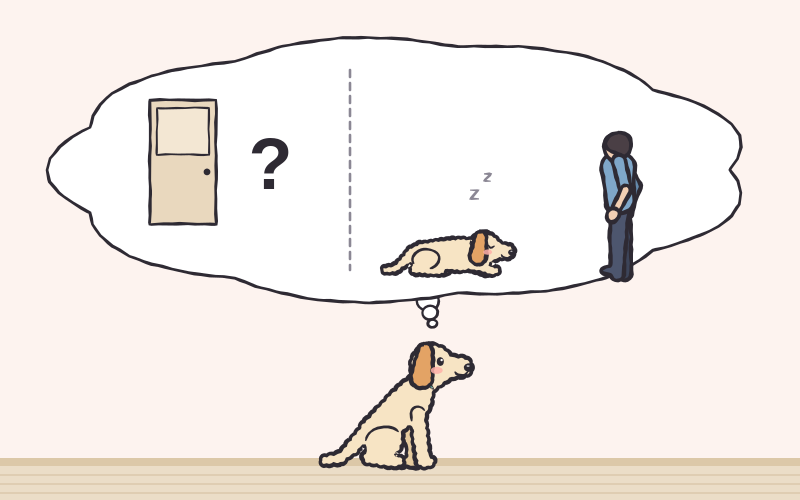
For a dog, being alone is out of the ordinary. If she meets it in short doses and builds up slowly, she learns that you always come back. If her first experience is a long absence, it can stay with her as a frightening one.
Chewing and barking while you’re out aren’t revenge for being left behind. Some dogs are bored and looking for something to do. Others are worried and can’t settle. Which one it is changes what you do next.
A quiet house when you get back doesn’t prove she was fine. The RSPCA points out that about half of the dogs who struggle when left alone show no obvious signs.
Bored or anxious? Three things to look for on video
Use a phone or a pet camera to film the first 30 minutes or so after you leave. Dogs who struggle on their own usually show it within a few minutes to half an hour. Look for three things:
- Did she eat the chew or food toy you left? If she normally loves it and leaves it untouched, she may be too worried to eat.
- Is she barking or howling non-stop, scratching at doors or windows, pacing, drooling or trembling? If it starts soon after you leave, it may be separation anxiety — read our separation anxiety page.
- Is she mostly asleep, barking only at noises outside and playing now and then? That usually points to boredom or outside sounds rather than anxiety. Start with a long-lasting chew and close the curtains so she can’t see out.
If a trainer came to your home: the first session and the first homework
Here is how we’d expect a first in-home session to go — one example, not a fixed script. A trainer would usually start by watching a recording with you to see how long she copes right now. Practice starts indoors: move away while she’s settled, then go behind a door, then out the front door — the same order the RSPCA uses.
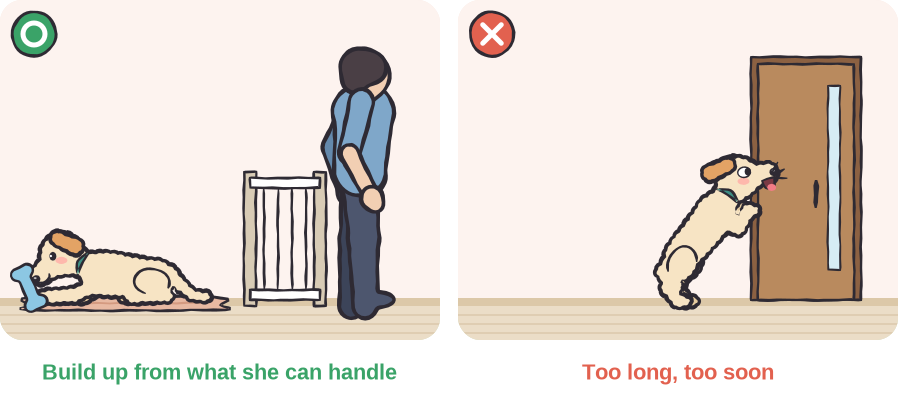
- Today: your dog gets a long-lasting chew behind a baby gate. You step one pace outside the gate and come straight back (step 1 of Building Alone Time Step by Step). The trainer watches with you to see whether she keeps chewing.
- Homework: a few short sessions a day. Increase only one thing at a time — the distance or the time — and only a little. Film some sessions to check she kept chewing. Before each real outing: a walk and a toilet break.
- Next visit: on the videos, is she relaxed and chewing while she can’t see you? If she got restless, the next homework steps back one stage.
How to build up time alone: next to you → behind a door → out the front door → real outings
This follows the RSPCA’s steps. There’s no set number of seconds per stage — how fast you move depends on how she copes. Our rule of thumb: move on once she has stayed relaxed on video several times in a row.
If she gets restless, don’t reward that repetition, and make the next one shorter. Never turn it into “wait until she cries” — practice with absences short enough that you’re back before she starts.
- She settles on her bed or mat with you right there. Praise her quietly while she relaxes.
- Take a few steps away and come straight back. Slowly increase how far you go and for how long.
- Go out through the door and come straight back → go out and close the door → stay out a little longer with the door closed. From here, mix long and short absences.
- If picking up your keys or putting on your coat makes her restless, do exactly that — then sit down instead of leaving, several times a day.
- Out the front door, then real outings: taking out the trash, a quick trip to the store. The RSPCA says that once a dog is happy to be left for up to an hour, longer absences usually aren’t a problem.
- Keep goodbyes and hellos low-key. No big reunion, no long farewell speech.
Before you leave, and where to leave her
- Walk her and get home about half an hour before you leave. Let her toilet, and give her a small meal. A dog who has had exercise and been fed relaxes more easily.
- Pick a special toy that only appears when you go out — a food-stuffed toy or something else she can chew for a long time. Put it away when you get back, until next time.
- Choose a quiet spot where she can’t watch you leave and can’t see out of the window much. Closing the curtains helps her ignore people and dogs passing by.
- Put away cables and anything small enough to swallow. If she isn’t used to a crate, don’t shut her in one — use a smallish room or a gated area where she can’t do much damage. Leave water.
- Keep her out of direct heat, cold and damp, as the Royal Kennel Club advises — and think about how warm that room gets on a summer afternoon, or how cold on a winter morning.
- TV or radio? There’s no clear answer. The Royal Kennel Club says there is evidence that calm music can encourage calm behavior. But in one small study that followed 34 puppies for six months, puppies left with a TV or radio on showed more passive signs of anxiety (such as lip-licking and yawning) and ate and played less. Film her both ways and see which one she settles with.
How long can a dog be left alone?
In the UK, the RSPCA advises no more than four hours even for an adult dog, and much less for puppies, so she has the chance to exercise, toilet and spend time with people. PDSA also says it’s best to avoid more than four hours at a time. The Royal Kennel Club calls it unfair to expect an adult dog to cope with more than four hours, and says a couple of hours is quite enough for a puppy, even once trained. In the US, the ASPCA writes that a dog who has been through separation anxiety training and can stay calm for 90 minutes can probably handle four to eight hours (and suggests starting with four, then working up to eight over a few days). So the guidance varies by country and organization.
You’ll often see “their age in months, plus one hour” for puppies. Humane World for Animals (formerly the Humane Society of the United States) gives that as the longest a puppy should stay in a crate, and the same guide also says puppies under 6 months shouldn’t be crated for more than three or four hours at a time. These are upper limits, not targets — and for young puppies they’re already longer than the Royal Kennel Club’s “couple of hours”.
So is a 9-to-5 workday OK? Not on her own every day. If you’re regularly out for more than four hours, arrange a dog walker, a pet sitter, a friend or doggy day care. The same goes for an overnight trip or a weekend away: that’s far beyond any of these limits, so she needs someone with her or a boarding place. If you have to be out for long stretches right after bringing a puppy home, ask friends or family to help for the first while.
From the day a puppy arrives, give her short, regular spells alone during the day in a place where she feels safe. That makes it less likely she’ll come to fear being alone.
Common questions
- Crate or free roam? For a dog who is already happy in a crate or pen, it can be a safe base. A dog who isn’t used to one can hurt herself trying to get out. If she isn’t used to a crate, use a smallish area where she can’t do much damage instead.
- What age should I start? The day she comes home — tiny absences, indoors. The RSPCA cites studies showing that dogs introduced to time alone gradually from the start are less likely to have problems later.
- I came home to chaos. Should I tell her off? No. She can’t connect your anger with something she did hours ago. She just learns that your homecoming is scary, and the next absence gets worse. Let her out into the yard or another room, then clean up quietly.
- Are rescue dogs worse at being left? Organizations disagree. The RSPCA says dogs rehomed from rescue centers are no more likely to have problems being left than dogs from other backgrounds. The ASPCA says separation anxiety is far more common in dogs adopted from shelters than in dogs kept by one family since puppyhood. Either way, the plan is the same: short absences from day one, built up slowly.
The missing core skill
Exercises
Our suggested order. The first one matters most; the others can run alongside it.
- ExerciseBuilding Alone Time Step by Step: Training Your Dog to Stay Home AloneDoable at home (Steps 1–3 at home)The home-alone training itself: behind a gate → behind a door → out the front door, a little at a time.Read →
- ExerciseMaking the Crate a Happy Place: Step-by-Step Crate Training Your Dog Will ChooseDoable at home (Steps 1–4 at home)If you want her to stay in a crate while you’re out, first make it a place she goes into and rests in by choice.Read →
- ExerciseRelaxing on a Mat: How to Teach Your Dog to SettleDoable at home (Steps 1–4 at home)A spot where she knows how to switch off — and one you can put where she’ll stay while you’re out.Read →
- ExerciseScent Games for Dogs: Easy Treat Hunts With a Towel and Paper CupsDoable at home (Steps 1–3 at home)A good sniff before you leave helps her settle and rest.Read →
In the moment: do / don’t
Do
- Walk her and let her toilet before you go; give a small meal
- Leave a special chew she only gets when you’re out
- Keep goodbyes and hellos low-key
- Film her now and then to check she’s really fine
Don’t
- Start with a long absence
- Scold her when you get home — she can’t link it to what happened hours ago
- Wait until she cries before coming back — keep absences short enough to beat it
- Shut her in a crate she isn’t used to and leave
When to see a professional
- She barks or howls the whole time you’re out, damages doors or windows, has accidents, drools or won’t eat anything. This may be separation anxiety — read our separation anxiety page and talk to your vet
- An older dog suddenly can’t cope with being left, or starts having more accidents in the house. An underlying illness or pain can be behind it, so see your vet first
Go to the root
Don’t stop at the quick fix. Growing the skill underneath makes other problems lighter too.
 Core skill Being Alone
- ExerciseBuilding Alone Time Step by Step: Training Your Dog to Stay Home AloneDoable at home (Steps 1–3 at home)Read →
- ExerciseMaking the Crate a Happy Place: Step-by-Step Crate Training Your Dog Will ChooseDoable at home (Steps 1–4 at home)Read →
- ExerciseRelaxing on a Mat: How to Teach Your Dog to SettleDoable at home (Steps 1–4 at home)Read →
Sources
- RSPCA (UK) — How to train your dog to stay home alone
- RSPCA (UK) — Recognising separation-related behaviour and anxiety in dogs
- The Royal Kennel Club — How do I help my dog adjust to spending time alone?
- PDSA — How to help your dog be comfortable with time alone
- MSD Veterinary Manual (veterinary edition) — Behavioral Problems of Dogs (Borns-Weil, 2025)
- ASPCA — Separation Anxiety
- Humane World for Animals (formerly the Humane Society of the United States) — How to crate train your dog or puppy
- Battersea — Bringing your puppy home
- Royal Veterinary College (2025) — Keep calm and carry on: new study offers clues for how to ease puppy separation stress
- Dale, Casey & Burn (2026). Efficacy of advice for preventing separation-related behaviors in puppies: a video trial and separation test. Journal of Veterinary Behavior 83:52–68