 BAUDOG The dictionary of dog–human communication
Contents
- The finished behavior
- Assessment: where is your dog now?
- The cue
- How to signal
- Teaching steps
- When to reward
- If a trainer came to your home: today’s session and the homework
- Which paw is the “other paw”?
- Am I doing it right? (Combos and changing the cue)
- A good sign to move on
- If it isn’t working
- Prescription: a suggested order
- In the moment: do / don’t
- When to see a professional
- Sources
The finished behavior
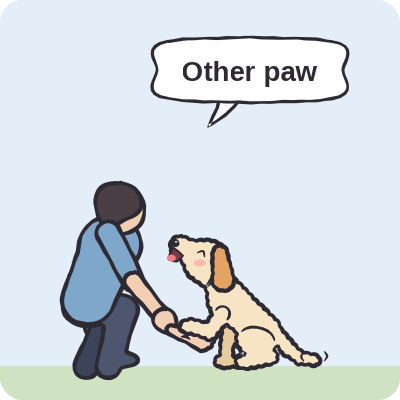
“Other paw” is your dog putting the opposite front paw — not her “Shake” paw — into your hand. Teach it only after shake is reliable. Start by holding out your other hand to draw out the other paw; once you’ve added the words “Other paw,” mix it with “Shake” so she learns to tell them apart by the word (our suggestion: mix them in no set order). If she gives the wrong paw, don’t scold — reward only the right one.
Assessment: where is your dog now?
A visiting trainer might check something like these three things before starting “Other paw.”
When you say “Shake” and hold out your hand, does her paw land at least 8 out of 10 times?
→If not, it’s too early for “Other paw.” Work through step 3 on the Shake page first.
Does the same paw come up for “Shake” every time?
→If it switches between left and right, our suggestion is to first settle on the paw she offers most easily as “Shake,” and keep it the same across the family.
Is she relaxed about having the other front paw touched?
→If she minds, get her used to it with “Touch Then Treat” on that paw first.
The cue
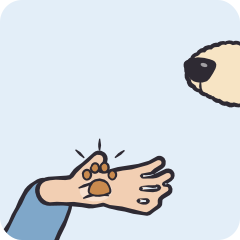
The voice cue is “Other paw.” The hand signal is the same as for shake — palm up, held out in front of her chest — but at first, use the hand opposite the one you use for “Shake”; that makes the other paw easier to lift. Later, if you like, you can hold out the same hand for both and let the word alone tell her which paw.
How to signal
- Voice
Once the other paw comes up every time, say “Other paw” once, just before you hold out your hand. Don’t say it straight after “Shake.”
- Hand
Hold out the hand opposite your “Shake” hand, in front of the other paw (in front of her chest). If the paw won’t come, move a treat from her nose a little to the side, toward her “Shake” paw; her weight shifts onto that leg and the other paw lifts more easily.
- Leash
No leash indoors. When you show it outside, keep the leash in your hand.
- Body
Crouch in front of your dog. She stays sitting, on a floor that isn’t slippery.
Teaching steps
- 1
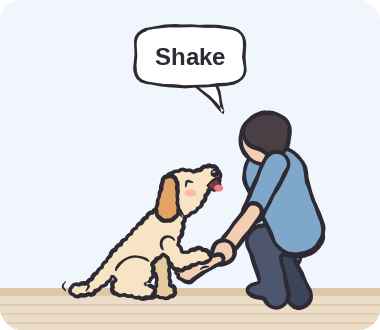
At home, quiet
Check that shake is solid
Ask for “Shake” 5 times. If her paw doesn’t land, go back to shake practice.
A good sign to move onHer paw lands on “Shake” 4 out of 5 times
- 2
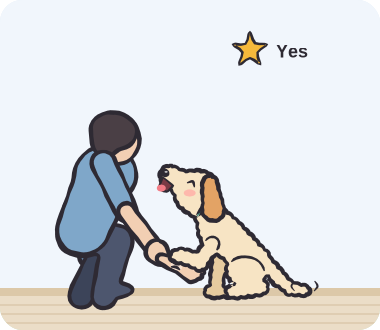
At home, quiet
Other hand, other paw
Hold out the hand opposite your “Shake” hand, in front of the other paw, and wait. The instant that paw touches your hand: “Yes” → treat. If it won’t come, use a treat to shift her weight sideways and praise even a small lift of the other paw.
A good sign to move onThe other paw lands when you offer your other hand, 8 out of 10 times
- 3
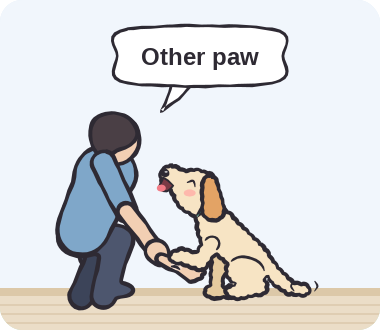
At home, quiet
Add “Other paw”
Say “Other paw” once, just before you hold out your hand. Paw lands: “Yes” → treat. Don’t mix in “Shake” at this step.
A good sign to move on“Other paw” gets the other paw, 8 out of 10 times
- 4
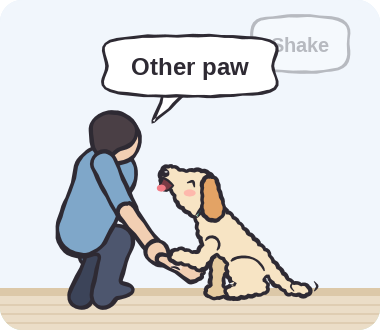
At home, quiet
Mix with “Shake” and tell them apart
Ask for “Shake” and “Other paw” mixed together. Our suggestion: no set order (Shake, Shake, Other paw, Shake, Other paw, Other paw…). Reward only the right paw. If the wrong paw comes up, say nothing, take your hand back, wait a moment, and ask again.
A good sign to move onMixed up, the right paw comes 8 out of 10 times
- 5
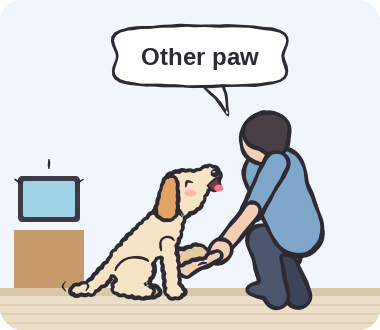
At home, small distractions
One hand, the word decides (optional)
Hold out the same hand and say either “Shake” or “Other paw.” Now she has to tell them apart by the word, not by your hand — a harder step.
A good sign to move onWith the same hand, the paw matches the word 8 out of 10 times
When to reward
Just right
“Yes” the instant the right paw touches your hand. Wrong paw: say nothing.
Too late
“Yes” after both paws are on your hand, or after she has swapped the wrong paw for the right one — you end up rewarding the mistake too.
If a trainer came to your home: today’s session and the homework
Here is how a first in-home session might go — one example BAUDOG has put together, not a fixed script.
- Today: after checking that shake is solid (step 1), the trainer draws out the other paw with the other hand (step 2). They show you how to move the treat so her weight shifts sideways, then you do 10 reps.
- Homework: twice a day, about 3 minutes. Step 2, 5–10 reps. Don’t mix “Shake” and “Other paw” yet — but slip 2–3 shakes into every session.
- Next visit: does the other paw land when you hold out your other hand? Our rule of thumb: at 8 out of 10, the next homework is adding the words “Other paw” (step 3) and then mixing (step 4).
Which paw is the “other paw”?
There’s no rule: whichever paw isn’t her “Shake” paw is the other paw. Our suggestion is to make the paw she offers most easily “Shake,” so the opposite one becomes “Other paw.” Once you’ve decided, don’t switch them around within the family.
Am I doing it right? (Combos and changing the cue)
We looked at ways owners have come up with on their own, through a trainer’s eyes.
- We always go “Shake → Other paw” in the same order → She may have learned the order and be giving the other paw without listening to the word. To test whether she’s really listening, ask for “Shake” twice in a row. If her shake paw comes up the second time too, she’s telling them apart.
- I hold out a different hand for each cue → Dogs often watch which hand appears more than they listen to the word. If that works for you, keeping the two hands is fine. If you want the words alone to do the job, practice with the same hand, as in step 5.
- I’d rather use “Left” and “Right” (or some other words) → Say the new word, pause briefly, then give the old cue and hand as usual, and reward when the paw lands. Saying them at the same moment means she never learns the new word. If you go with left and right, decide as a family whether it’s her left or yours — and stick to it.
- I want to link “Shake → Other paw → High five” → That works. Make each one solid on its own first (our rule of thumb: 8 out of 10 each), then link them. If it falls apart, go back to practicing just the trick that broke.
A good sign to move on
- Step 2: when the other paw lands on your other hand 8 out of 10 times, add “Other paw” (our rule of thumb)
- Steps 3–4: when “Other paw” alone works 8 out of 10 times, and mixed with “Shake” works 8 out of 10 times, move on (our rule of thumb)
- If mixing falls apart, go back to “Other paw” on its own (step 3) — our rule of thumb is two wrong paws in a row
If it isn’t working
She only ever gives her shake paw
Move the treat from her nose a little toward her shake paw so her weight shifts onto that leg. Say “Yes” the moment the other paw lifts even slightly, then gradually wait for it to reach your hand.
She gives both paws at once, or jumps at me
Check whether you’ve been rattling through “Shake” and “Other paw” fast, back and forth. Our suggestion: wait for all four feet to be back on the floor each time, and hold out your hand slowly. Hold it low, in front of her chest — a high hand makes jumping more likely.
What if she gives the wrong paw?
Don’t scold. Say nothing, take your hand back, wait a moment and ask again. When the right paw comes, reward generously.
She won’t do either unless she sees a treat
Change it step by step: fist with a treat → empty fist → open palm, and hand over the treat from your other hand — the same as steps 1–2 on the Shake page.
Prescription: a suggested order
The practices “Other paw” is built on.
- ExerciseCharging Your Marker Word: How to Teach Your Dog That “Yes” Means a RewardDoable at home (Steps 1–4 at home)So “Yes” can mark the moment the right paw touches. Especially important when she’s learning to tell the two apart.Read →
- ExerciseTouch Then Treat: Help a Dog Who Hates Being Handled Learn to Enjoy ItDoable at home (Steps 1–5 at home)For a dog who doesn’t like the other paw touched.Read →
In the moment: do / don’t
Do
- Start only once shake is solid
- At first, other hand for the other paw
- Mix “Shake” and “Other paw” in no set order (our suggestion)
- Reward only the right paw
Don’t
- Rattle through shake and other paw fast, back and forth
- Scold her for the wrong paw
- Grab one paw to lift the other
- Say “Other paw, other paw” over and over
When to see a professional
- She doesn’t want to give one particular front paw, favors it when walking, or keeps licking it — this can be a sign of pain. Stop practicing and see your vet
- She cries out or growls when you touch one paw. She may be in pain or afraid. Don’t push on; talk to your vet or a behavior professional
The skills behind this command
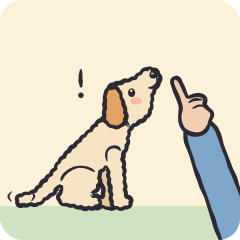 Core skill Understanding Cues Telling two similar cues — “Shake” and “Other paw” — apart.
 Core skill Comfort with Handling Being relaxed when either front paw is touched.
- ExerciseCharging Your Marker Word: How to Teach Your Dog That “Yes” Means a RewardDoable at home (Steps 1–4 at home)Read →
- ExerciseTouch Then Treat: Help a Dog Who Hates Being Handled Learn to Enjoy ItDoable at home (Steps 1–5 at home)Read →
Sources
- American Kennel Club — How to Teach Your Dog to Shake Hands (Shaking With Each Paw)
- Battersea Dogs & Cats Home — How to teach your dog to high five
- Dogs Trust — How to teach your dog to give a high five (paw and high five)
- Dogs for Good — Advanced training: Shake hands (PDF)
- Veterinary Partner (VIN) — How To Fade the Lure in Training
- PDSA — Reward-based training
- Whole Dog Journal — How to Teach a Dog to Shake (Paw) (Pat Miller, CBCC-KA, CPDT-KA)
- Chewy — How to Teach a Dog to Shake a Paw (Irith Bloom, CPDT-KSA)
- D’Aniello et al. (2016). The importance of gestural communication. Animal Cognition 19
- Dogmantics (Emily Larlham) — Adding a verbal cue or changing a cue
- Smart Dog University — How to Clean Up Cues and Transfer Cues
- Karen Pryor Clicker Training — Making the Connection: Behavior Chains
- Dog Discoveries — What Are Behavior Chains in Dog Training?
- Cornell Riney Canine Health Center — Recognizing pain in dogs