 BAUDOG The dictionary of dog–human communication
Contents
- The finished behavior
- Assessment: where is your dog now?
- The cue
- How to signal
- Teaching steps
- When to reward
- If a trainer came to your home: today’s session and the homework
- How high to hold your hand — and double high fives
- Am I doing it right? (Combos and changing the cue)
- A good sign to move on
- If it isn’t working
- Prescription: a suggested order
- In the moment: do / don’t
- When to see a professional
- Sources
The finished behavior
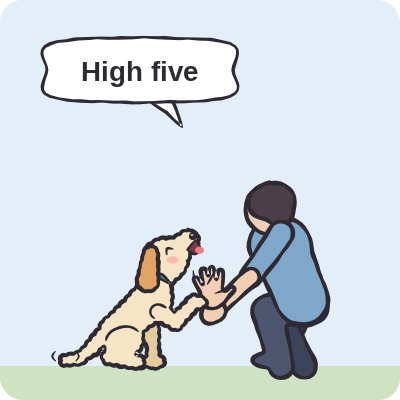
High five is your dog tapping one front paw against your upright palm. If she knows shake, raise your shake hand a little at a time and finish by turning your palm upright. If she doesn’t know shake yet, start there. As for height, our suggestion is to stop where she can reach from a sit — around her face or chest. Don’t hold your hand so high that she has to jump.
Assessment: where is your dog now?
A visiting trainer might check something like these three things before starting the high five.
When you say “Shake,” does her paw land on your palm?
→If yes, start at step 2. If not, start at step 1 of shake (pawing at a closed fist).
When she lifts a paw, does she bounce up or stand on her hind legs?
→If she jumps, lower your hand. The height is wherever she can reach from a sit.
What does your family use “touch” and “high five” for?
→If the nose touch and the paw high five share a word, change one of them so everyone uses the same words.
The cue
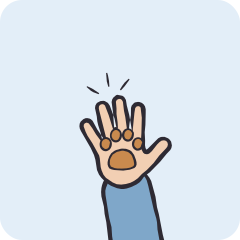
The voice cue is “High five.” The hand signal is your palm upright, facing your dog, at the height of her face or chest while she sits. BAUDOG tells it apart from “Shake” (palm facing up) by the angle of the hand. If your family uses “touch” to mean a paw high five, give the nose “Touch” a different word so the two don’t get mixed up.
How to signal
- Voice
Once you can hold your palm upright, say “High five” once, just before you hold out your hand.
- Hand
Hold your shake hand (palm up) a little higher each time. When it reaches face height, turn your palm upright toward your dog just as her paw starts to lift. Hand over the treat from your other hand.
- Leash
No leash indoors. When you show it outside, keep the leash in your hand.
- Body
Crouch or kneel in front of your dog. She stays sitting, on a floor that isn’t slippery.
Teaching steps
- 1
At home, quiet
Check shake
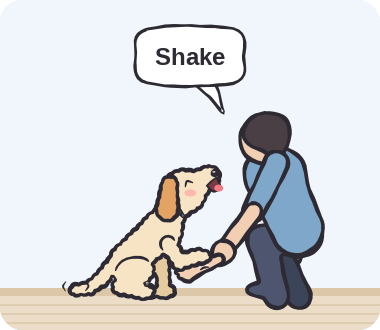
Ask for “Shake” 5 times — does her paw land on your palm? If not, start from step 1 on the Shake page.
A good sign to move onHer paw lands on “Shake” 4 out of 5 times
- 2
At home, quiet
Hand a little higher
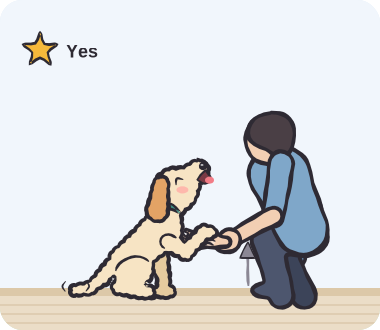
Hold your shake hand a little higher each rep. The moment her paw touches: “Yes” → treat. Stop at a height she can reach from a sit (around her face or chest).
A good sign to move onHer paw touches your hand at face or chest height, 8 out of 10 times
- 3
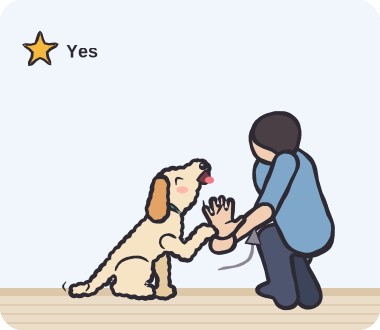
At home, quiet
Turn your palm upright
Just as her paw lifts, turn your palm from facing up to standing upright, facing her. When her paw taps the upright hand: “Yes” → treat.
A good sign to move onHer paw taps your upright palm, 8 out of 10 times
- 4
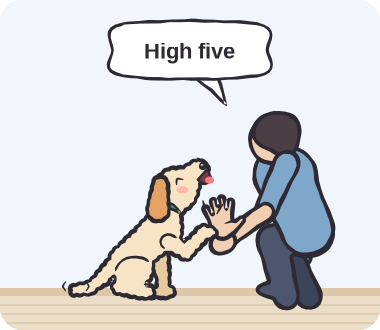
At home, quiet
Add “High five”
Say “High five” once, just before you hold up your hand. Paw taps it: “Yes” → treat.
A good sign to move on“High five” gets a paw tap, 8 out of 10 times
- 5
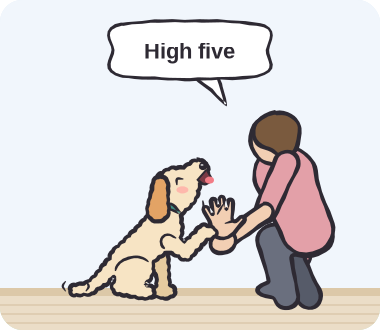
At home, small distractions
With the family, and with visitors
Whoever holds up a hand uses the same word. When you show visitors, do it only once or twice, and only while your dog is calm.
A good sign to move on8 out of 10 times with other people’s hands
When to reward
Just right
“Yes” the instant her paw taps your palm — the treat comes after.
Too late
“Yes” after she has put her paw down, or after you’ve moved your hand to meet her paw — she can’t tell that she did it herself.
If a trainer came to your home: today’s session and the homework
Here is how a first in-home session might go — one example BAUDOG has put together, not a fixed script.
- Today: after watching 5 shakes (step 1), raise your hand a little at a time (step 2). You and the trainer decide together the height your dog can reach without jumping.
- Homework: twice a day, about 3 minutes (5–10 reps). Steps 2–3. No “High five” word yet.
- Next visit: does her paw tap your upright palm? Our rule of thumb: at 8 out of 10, adding the word “High five” (step 4) becomes the next homework.
How high to hold your hand — and double high fives
In the American Kennel Club’s Trick Dog program, the high five is a Novice-level trick: on cue, the dog raises one paw to chest height. At that level she doesn’t have to wave or paw at the air. VCA Animal Hospitals lists the high five among the less strenuous tricks for older dogs.
With a two-paw high five, the higher you hold your hands, the more likely she is to stand up on her hind legs. A veterinarian advising the Japanese pet magazine Inu no Kimochi cautions that standing or jumping on the hind legs can put excessive strain on joints such as the hips and knees. Our suggestion: if you do two paws, keep your hands at a height she can reach from a sit, and don’t have her stand up.
Am I doing it right? (Combos and changing the cue)
We looked at ways owners have come up with on their own, through a trainer’s eyes.
- I taught the high five with the word “touch” → That’s fine. But if you later teach a nose “Touch” (hand target), the words will clash. Our suggestion: give the nose version a different word, such as “Nose” or “Boop.”
- I use the same hand shape for shake and high five → Dogs often watch your hands more than they listen to words. Our suggestion: change the angle of your hand — palm up for shake, upright for high five. Battersea’s method moves from a flat palm to an upright hand in the same way.
- I want to go “Shake → High five → Wave” → That works. Make each one solid on its own first (our rule of thumb: 8 out of 10 each), then link them. Hold your high-five hand just out of reach and it turns into wave practice.
- I want to change the word — to “Gimme five,” say → Say the new word, pause briefly, then give the old cue and hand as usual, and reward when her paw taps. If you say both at the same moment, she won’t learn the new word.
- I want a high five from the beg position → She has to hold her upper body up while moving one paw, which adds strain. Read the cautions on the Beg page first, and keep it short, with a healthy adult dog only.
A good sign to move on
- Steps 2–3: when her paw taps your hand at that height and angle 8 out of 10 times, move on (our rule of thumb)
- Step 4: when “High five” works 8 out of 10 times, try it with family and visitors (our rule of thumb)
- If she struggles, lower your hand and go back one step — our rule of thumb is two misses in a row
If it isn’t working
When I raise my hand, she jumps or stands up
Your hand is too high. Bring it down to where she can reach from a sit, and call that the finished trick. For a small dog, chest height is plenty.
When I turn my palm upright, she stops lifting her paw
Tilt it less. Go palm up → slightly tilted → upright over several reps. Turning your hand just as her paw starts to rise makes the tap easier.
She smacks my hand hard and her nails hurt
You can shape how hard she taps by what you reward. Our suggestion: reward the soft taps, and for hard smacks, don’t reward — take your hand away and try again.
Since learning it, she paws at people out of nowhere
Don’t answer paws that weren’t asked for. First check she’s getting enough walks and play and that nothing hurts; then start by ignoring her for a short time (about 30 seconds). Meanwhile reward “Say Please by Sitting.”
Prescription: a suggested order
The foundations for the high five, and practices for problems afterward.
- ExerciseCharging Your Marker Word: How to Teach Your Dog That “Yes” Means a RewardDoable at home (Steps 1–4 at home)So “Yes” can mark the moment her paw taps your hand.Read →
- ExerciseSay Please by SittingDoable at home (Steps 1–3 at home)A different way to ask, for a dog who has started pawing at people to demand things.Read →
In the moment: do / don’t
Do
- Build on shake
- Raise your hand a little at a time
- Stop at a height she can reach from a sit
- “Yes” the instant her paw taps
Don’t
- Hold your hand so high she has to jump
- Have her stand on her hind legs for a two-paw high five
- Grab her paw and tap it on your hand
- Say “High five, high five” over and over
When to see a professional
- She doesn’t want to lift one front paw, or favors a leg when walking. This can be a sign of pain. Stop practicing and see your vet
- She doesn’t like staying in a sit, or sits awkwardly. This can be pain in the back or hind legs. Talk to your vet
The skills behind this command
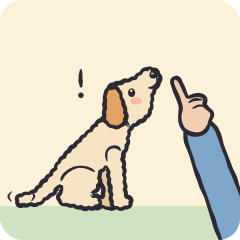 Core skill Understanding Cues Telling shake and high five apart by the angle of your hand and the word “High five.”
- ExerciseCharging Your Marker Word: How to Teach Your Dog That “Yes” Means a RewardDoable at home (Steps 1–4 at home)Read →
- ExerciseSay Please by SittingDoable at home (Steps 1–3 at home)Read →
Sources
- Battersea Dogs & Cats Home — How to teach your dog to high five
- Dogs Trust — How to teach your dog to give a high five
- American Kennel Club — AKC Trick Dog Participant and Evaluator Guide (PDF)
- VCA Animal Hospitals — Can Old Dogs Learn New Tricks?
- Inu no Kimochi Web Magazine (veterinarian-supervised, Japanese) — Why standing on two legs and jumping can be risky for dogs
- Dogs for Good — Advanced training: Shake hands (PDF)
- D’Aniello et al. (2016). The importance of gestural communication. Animal Cognition 19
- Dogmantics (Emily Larlham) — Adding a verbal cue or changing a cue
- Smart Dog University — How to Clean Up Cues and Transfer Cues
- Karen Pryor Clicker Training — Making the Connection: Behavior Chains
- American Kennel Club — How to Identify and Stop Attention-Seeking Behavior in Dogs
- Cornell Riney Canine Health Center — Recognizing pain in dogs