 BAUDOG The dictionary of dog–human communication
Contents
- The finished behavior
- Assessment: where is your dog now?
- The cue
- How to signal
- Teaching steps
- When to reward
- “Touch” vs. high five
- What you can do with touch
- If a trainer came to your home: today’s session and the homework
- Am I doing it right? (Combos and changing the cue)
- A good sign to move on
- If it isn’t working
- Prescription: a suggested order
- In the moment: do / don’t
- When to see a professional
- Sources
The finished behavior
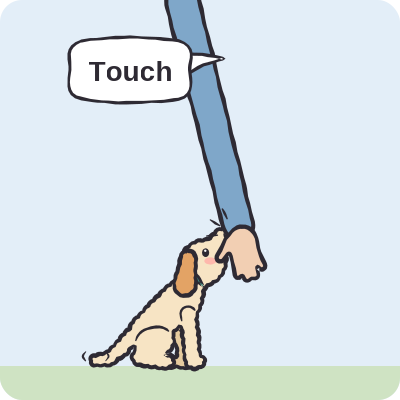
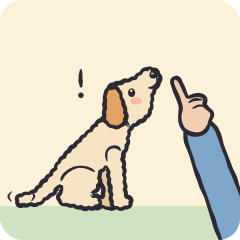
Touch — a hand target — is your dog bopping your outstretched palm with the tip of her nose. It’s not the same as a paw high five; at BAUDOG, the nose version is “Touch.” It’s easy to teach: hold your hand near her nose, wait, and say “Yes” the instant her nose touches it. Once she knows it, it becomes the base for all sorts of things — recall, getting on and off the sofa or into her crate, greeting people, ringing a bell. The full step-by-step plan is in the practice “Hand Target.”
Assessment: where is your dog now?
A visiting trainer might check something like these three things before starting touch.
When you hold your palm near her nose, does she come to sniff it — or move away?
→If she moves away, rub a little treat scent on your palm and start by holding your hand still and waiting. Go slowly with a dog who’s wary of hands near her face.
When you hold out your hand, does she nibble it or bat it with a paw?
→Mark the nose touch sooner, and take your hand away as soon as she touches.
What does your family use the word “touch” for? (Paw tricks, nose touch?)
→If one word is doing two jobs, change one of them so everyone uses the same words.
The cue
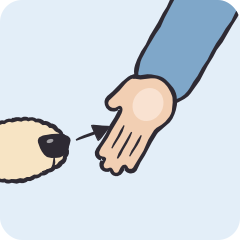
The voice cue is “Touch.” The hand signal is a flat palm, fingers together, facing your dog with your fingertips pointing down, held an inch or two (2–5 cm) from her nose. If your family already uses “touch” for a paw trick, give the nose version a different word, such as “Nose” or “Boop,” so the two words don’t clash.
How to signal
- Voice
Don’t say anything at first. Once she touches your hand straight away every time you offer it, say “Touch” once, just before you hold it out.
- Hand
Flat palm, fingers together, facing your dog with fingertips down, an inch or two (2–5 cm) from her nose — then wait. Don’t push your hand onto her nose. When her nose touches, take your hand away and give the treat from your other hand.
- Leash
No leash indoors. Outside, keep the leash in your hand, with some slack.
- Body
Stand or crouch. Once you’ve offered your hand, keep it still and wait. If bending down to a small dog is hard on you, a wooden spoon or similar can stand in for your hand.
Teaching steps
- 1
At home, quiet
Hand near her nose
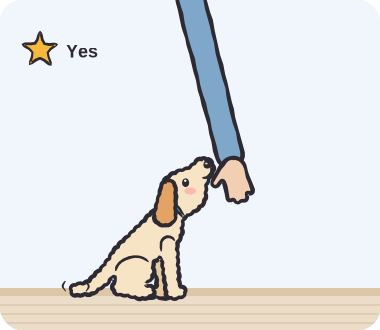
Palm facing your dog, fingertips down, an inch or two (2–5 cm) from her nose. The instant she sniffs or her nose touches: “Yes” → take your hand away and give a treat from your other hand. At first, even a sniff can earn a reward.
A good sign to move onShe touches your hand with her nose when you offer it, 9 out of 10 times
- 2
At home, quiet
Add “Touch”
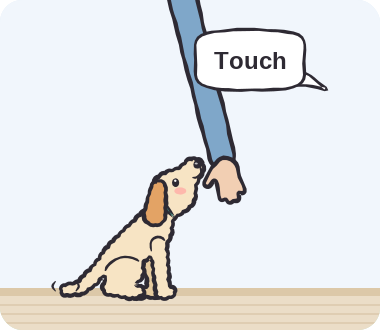
Say “Touch” once, just before you offer your hand. Say it, wait about a second, then hold out your hand. Touch: “Yes” → treat.
A good sign to move on“Touch” and an offered hand get an instant touch, 9 out of 10 times
- 3
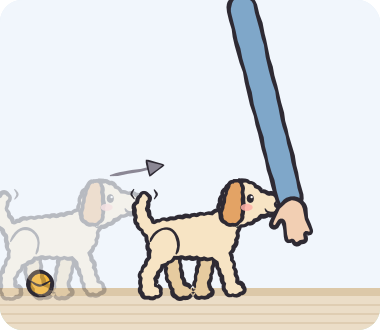
At home, small distractions
Change height and distance
Hold your hand a little higher, lower, to her left and right, a little farther away. Move your hand and have her follow it. Try it in a room with toys on the floor, too.
A good sign to move onShe comes to touch a hand about 3 feet (1 m) away, 9 out of 10 times
- 4
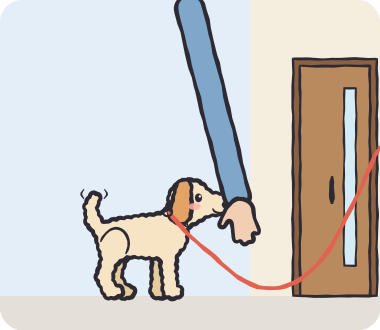
Yard, doorstep, outside the house
Yard, front step, outside your home
On leash, in front of your home or in the yard. Outside, use a better treat than usual.
A good sign to move on9 out of 10 times in that place
- 5
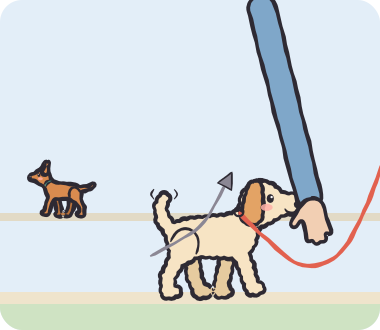
Around distractions
In the situations you need it
Instead of jumping on visitors; turning toward you when another dog appears on a walk; and so on. The details are in the practice “Hand Target.”
A good sign to move on8 out of 10 times in that situation
When to reward
Just right
“Yes” the instant her nose touches your palm. Take your hand away straight after, and give the treat from your other hand.
Too late
“Yes” after her nose has left your hand, or after you’ve pushed your hand onto her nose — she can’t tell that she did it herself.
Delivering the treat in front of your palm makes it clearer that putting her nose to your palm is what earns the reward (this is part of the American Kennel Club’s method).
“Touch” vs. high five
In English, “touch” usually means a hand target: your dog touches your hand with the tip of her nose. That’s a different behavior from a high five, where she taps your hand with a paw. At BAUDOG, the nose version is “Touch” and the paw version is “High five.”
One word for one behavior is the basic rule of cues. If your house already uses “touch” for a paw trick, teach this one with a different word, such as “Nose” or “Boop.”
What you can do with touch
Where a dog’s nose goes, her head and body follow — so your palm becomes a signpost you can move her with. Veterinary Partner, a veterinarian-run site, and Dogs Trust describe uses like these. It also counts as a trick in its own right: “Touch it” is one of the Novice tricks in the American Kennel Club’s Trick Dog program, where the dog touches the handler’s hand (or a target stick) held to the right of her head, then to the left, then in front.
- A second recall cue: she runs from a distance to touch your palm.
- Moving her around: on and off the sofa, from room to room, into her crate or the car, onto the scale or the exam table at the vet — without lifting or pushing her.
- Greetings: a visitor holds out a hand and she touches it with her nose instead of jumping up.
- Redirecting her from things that worry her: when another dog appears, she turns to your hand.
- Building tricks: move your hand in a circle parallel to the floor and you have a spin. Move the target from your palm to a sticky note or a lid, and she can ring a bell, close a door or drawer, or push a light switch.
If a trainer came to your home: today’s session and the homework
Here is how a first in-home session might go — one example BAUDOG has put together, not a fixed script.
- Today: the trainer shows where to hold your hand and how quickly to take it away once she touches, then you take over for 10 reps (step 1). They check on the spot that you’re not pushing your hand onto her nose.
- Homework: twice a day, about 3 minutes (8–10 reps). Step 1 — and on days she touches straight away, 5 reps of step 2.
- Next visit: on “Touch,” does she come to a hand held a little way off? At 9 out of 10, changing height and distance (step 3) becomes the next homework. (The 90% figure comes from a San Francisco SPCA handout.)
Am I doing it right? (Combos and changing the cue)
We looked at ways owners have come up with on their own, through a trainer’s eyes.
- I taught touch with a fist → That’s fine. You can teach it with a palm, a fist or two fingers. What matters more is that the whole family uses the same shape. If you want to change the shape later, use the same order as in “changing the cue” below.
- I want to link touch to a spin → That works. Once she follows your hand on “Touch,” move your hand in a circle parallel to the floor and reward when she goes all the way round. As she gets it, make the circle smaller and add a different word, such as “Spin.”
- I want to move from my palm to a sticky note, a bell or a target stick → Put the sticky note or lid on your palm and say “Touch”; reward when she touches the object. Gradually move it from your palm to your fingertips, then to the floor or a wall. If she hesitates, rub a little treat scent on the object.
- I want her to touch on my voice alone → Say “Touch,” wait about a second before offering your hand, and reward if she starts moving before your hand appears. But touch is a cue where your hand is the target, so there’s no need to drop the hand signal.
- I want to change “Touch” to “Nose” (because it clashes with a paw trick) → Say “Nose,” pause briefly, then give the usual “Touch” and hand, and reward the touch. If you say both at the same moment, she won’t learn the new word.
A good sign to move on
- Step 1: when she touches with her nose 9 out of 10 times you offer your hand, add “Touch” (the 90% benchmark)
- Steps 2–4: at 9 out of 10 in that place, move on. Step 5 (the situations you need it): 8 out of 10 in that situation (our rule of thumb)
- If she struggles, bring your hand closer again and go back one step — our rule of thumb is two misses in a row
If it isn’t working
She won’t come to my hand
For the first few reps, rub a little treat scent on your palm. Reward her for turning her nose toward it, or even just looking at it, and gradually wait for a touch.
She nibbles, licks or paws at my hand
Mark the nose touch sooner, and take your hand away as soon as she touches. Nibbling, pawing or barking can mean she’s confused about what you want. Go back a step, or take a break.
She just stares at my hand
If she hasn’t touched within 2–3 seconds, take your hand away and offer it again. Don’t keep repeating “Touch.”
She mixes it up with the high five and gives me a paw
Check that your hand shapes aren’t too alike. Touch is a palm with fingertips down; high five is an upright palm. Keep the shapes different, and use different words.
Prescription: a suggested order
The full step-by-step plan for touch, and the foundation it builds on.
- ExerciseHand Target: How to Teach Your Dog “Touch” — and Use It for Recall and Passing Other DogsDoable at home (Steps 1–3 at home)Takes touch in stages from indoors to the situations you need it. The homework and what to check at the next visit are there too.Read →
- ExerciseCharging Your Marker Word: How to Teach Your Dog That “Yes” Means a RewardDoable at home (Steps 1–4 at home)So “Yes” can mark the instant her nose touches.Read →
In the moment: do / don’t
Do
- Offer your hand an inch or two from her nose, and wait
- “Yes” the instant she touches; take your hand away straight after
- Add the word only once she touches straight away every time
- Keep the word and hand shape different from the high five
Don’t
- Push your hand onto her nose
- Use your hand for anything startling, like swatting or waving at her
- Say “Touch, touch” over and over
- Drag one session out
When to see a professional
- Just bringing your hand near her face makes her turn away, freeze or growl. This can be pain or fear of hands. Don’t push on; talk to your vet or a behavior professional
- Her expression has changed — ears pinned back, a pinched face — or her appetite has dropped. These can be signs of pain. See your vet
The skills behind this command
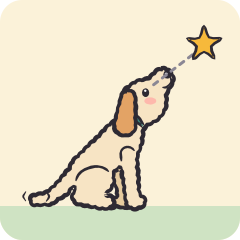 Core skill Focus Being able to focus on a target — your palm. Also useful for steering her away from things that worry her.
 Core skill Understanding Cues Knowing that “Touch” and your palm mean “touch it with your nose.” It also becomes a base for teaching other tricks.
- ExerciseHand Target: How to Teach Your Dog “Touch” — and Use It for Recall and Passing Other DogsDoable at home (Steps 1–3 at home)Read →
- ExerciseCharging Your Marker Word: How to Teach Your Dog That “Yes” Means a RewardDoable at home (Steps 1–4 at home)Read →
Sources
- Veterinary Partner (VIN) — Training Series: Target Training Dogs and Cats with Touch
- Dogs Trust — Target training: Train your dog to touch a target
- Oregon Humane Society — Hand Target (“Touch”)
- East Bay SPCA — Nose Targeting (PDF)
- American Kennel Club — How to Teach Your Dog to Nose Target or ‘Touch’
- American Kennel Club — AKC Trick Dog Participant and Evaluator Guide (PDF)
- San Francisco SPCA — Teaching A Dog To Target Your Hand (PDF)
- Dogmantics (Emily Larlham) — Adding a verbal cue or changing a cue
- Smart Dog University — How to Clean Up Cues and Transfer Cues
- Sarah Owen Dog Training and Behavior — Transferring Stimulus Control
- Cornell Riney Canine Health Center — Recognizing pain in dogs
- Dogs for Good — Advanced training: Shake hands (PDF)