 BAUDOG The dictionary of dog–human communication
Contents
- In short
- When it happens
- How your dog feels
- Which kind of “won’t come” is it?
- If a trainer came to your home: the first session and the first homework
- The recall plan: home, front door, open space, distractions
- Has “come” stopped working? Start a new word
- When can she go off leash?
- Do shock collars or punishment fix recall?
- She used to come — now she doesn’t. Is that normal?
- The missing core skill
- Exercises
- In the moment: do / don’t
- When to see a professional
- Sources
In short
Your dog isn’t being stubborn. Either coming to you has stopped paying off — it ends the fun, or it once got her scolded — or “come” was never really taught in the place you’re using it. Stop calling where it keeps failing, make every return the best thing that happens on the walk, and rebuild the recall in four stages: at home, in your yard or right outside your door, in a quiet open space on a long line, then around distractions. Our rule of thumb: move up a stage once she comes 8 out of 10 times.
When it happens
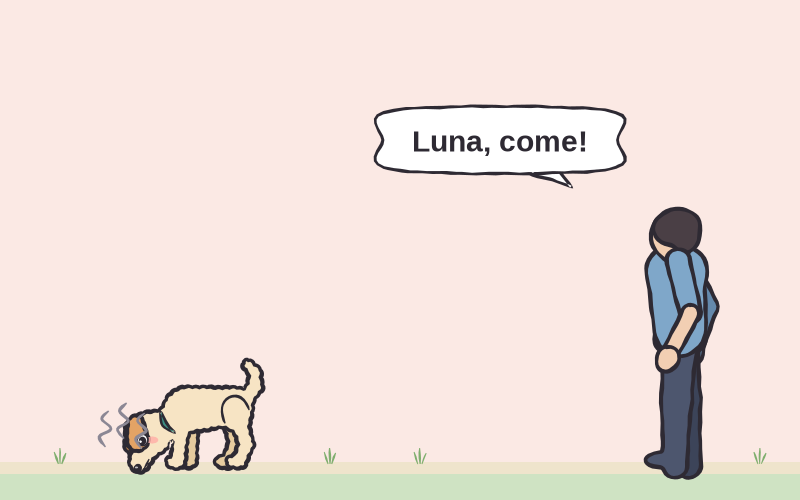
- At the park, your dog glances up when you call — then goes straight back to sniffing
- She comes every time in the kitchen, but outside “come” seems to mean nothing
- She trots toward you, then stops just out of reach, or ducks away when you go for her collar
- Calling her to leave the dog park turns into a game of keep-away
- She only comes when she can see the treat in your hand
How your dog feels
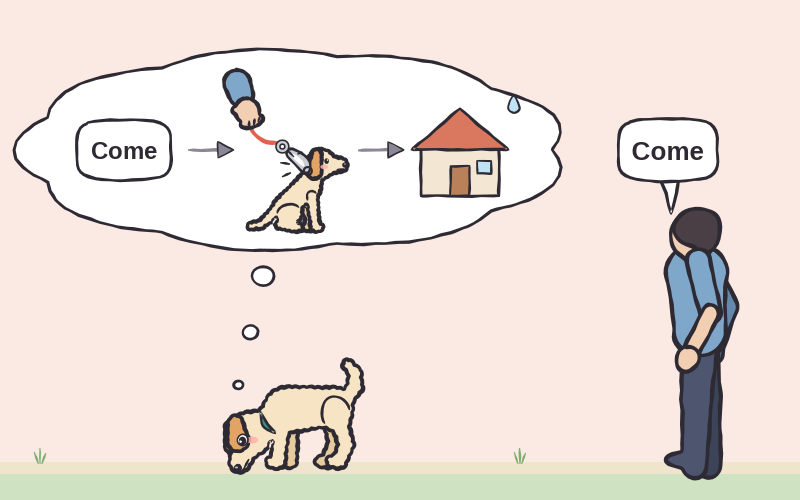
From your dog’s point of view, every recall is a trade. You’re asking her to leave a smell, a game or another dog — things that are rewarding all on their own — and run to you instead. If what she gets for coming is less interesting than what she leaves behind, staying put is the sensible choice.
Dogs also learn from what happens the moment they arrive. If coming means the leash clips on and the park is over, a bath, or a telling-off for taking so long, “come” starts to predict the end of good things. Some dogs answer by slowing down. Others discover that dodging you starts a brilliant game of chase.
And many dogs genuinely don’t know what “come” means outside. A cue that works in the living room hasn’t yet been learned on a field full of new smells. If the word has been repeated again and again with nothing following it, it fades into background noise — trainers call this a “poisoned” cue.
Which kind of “won’t come” is it?
Before you change anything, watch the next few times you call. How she fails tells you what is missing — and what to practice.
- She comes indoors but not outside → first check that she really is reliable indoors: call her once from another room. If she comes straight away, “come” just hasn’t been taught outside yet. That’s Understanding Cues: start at Stage 2, on leash in your yard or right outside your door, and work outward step by step. If she doesn’t come from another room, start at Stage 1, indoors.
- She hears you, glances over, and goes back to sniffing → the world is out-competing you. That’s Focus: start with The Name Game, so turning to you becomes a habit before you ask for the whole run back.
- She comes slowly, circles, or stays just out of reach → coming has led to unpleasant things. Change what happens after she arrives: reward, then often let her go back to playing. If she ducks away from your hand, practice collar touches separately at home — touch her collar, then treat — as in Recall Games.
- She runs off when you walk toward her → she has learned the chase game. Stop chasing; move away from her instead.
- She only comes when she sees food → the treat has turned into a bribe. Keep it out of sight until she reaches you.
- She has stopped reacting to her name and to other everyday sounds → see your vet first. Hearing loss can look exactly like ignoring you.
If a trainer came to your home: the first session and the first homework
Here is how we’d expect the first in-home session to go — one example, not a fixed script. Even for a dog who only fails at the park, a trainer would usually start by checking the recall indoors — one call from another room. If that isn’t solid yet, the recall is rebuilt indoors first: the UK charities Dogs Trust and the RSPCA both advise starting in the house or garden and moving out into the world only once she comes reliably there.
- Today: in a quiet room, say her name once and reward the turn of her head (step 1 of The Name Game). If there are two of you, try a round of “ping-pong” recalls across the room. If she already comes straight away from another room, start instead in the yard or just outside your door, on leash.
- Homework: twice a day, 3–5 minutes. 5–10 name calls; once she turns reliably, about 5 indoor ping-pong or hide-and-seek recalls. Agree on one recall word and one way of saying it for the whole family. Outside, don’t call her when you doubt she’ll come.
- Next visit: the trainer calls her once from another room. If she runs in about 8 out of 10 times (our rule of thumb), the next homework moves to the yard or the front of the house, on leash. If not, another week indoors.
The recall plan: home, front door, open space, distractions
Rebuild the recall where it can’t fail, then make it harder one thing at a time — distance, place or distraction, never two at once. Keep sessions short — a few minutes, around 3–5 — and stop while she still wants more. Spacing sessions out doesn’t waste them: in one small study of 18 laboratory beagles learning a clicker-shaping task, dogs trained once a week needed fewer sessions to learn it than dogs trained five times a week (though they took more calendar days).
There’s no honest number of days for this. Count successes instead: 10 calls, how many did she come on the first call? Our rule of thumb: at 8 out of 10, move up a stage. If she struggles, go back one — again a rule of thumb: two misses in a row.
- Stage 1 — At home. First The Name Game: say her name once and reward the turn of her head. Then recall games, a step or two away to start: say her name, then “come” — once, brightly — and back away so she chases you. When she reaches you, gently touch her collar, then treat. Two people at opposite ends of a room can take turns calling, or play hide-and-seek. Say “come” only when you’re sure she’ll run to you; if you’re not sure, make it easier first. Move on when she starts toward you within about 3 seconds, 8 out of 10 times (our rule of thumb).
- Stage 2 — Yard or front door. Still on leash: call her in the pauses between sniffs in your yard or just outside your home. Move on when she comes about 8 out of 10 times (our rule of thumb).
- Stage 3 — A quiet open space on a long line. An empty park or field, with a long line clipped to a harness, not a collar. There’s no standard length — long lines are sold from about 10 ft up to 100 ft (3–30 m) — but 15–30 ft (5–10 m) is a common choice: room for her to wander, short enough for you to stop her quickly. Hold the end of the line. Where local rules allow — a fenced area, for example; in many places a leash must be held in public — you can let it trail once she’s used to it. It’s there for safety, not for pulling her in when she ignores you. Use it only in open spaces away from roads and crowds; on streets and sidewalks, a long line is a trip hazard, and some places cap leash length in public — New York City at 6 ft, for example, and some local councils in England and Australia at 1.5–2 m in certain areas. Check your local rules. Call in the pauses between sniffs, reward with something better than you use indoors, then say “Free” and let her go back to exploring.
- Stage 4 — Around distractions. A ball rolling nearby, another dog in the distance. Start far away and close the gap only when she succeeds. Keep the long line on.
Has “come” stopped working? Start a new word
If you’ve said “come” a hundred times while she ignored you, or it has mostly meant “time to go home,” the word itself is now the problem. Pick a fresh one — “here,” “close,” even a whistle — and teach it from Stage 1 as if she had never heard a recall before. Make sure everyone in the family uses the same word, once, in the same cheerful voice.
Then protect it. Don’t use the new word unless you’re fairly sure she’ll come. When you need her and you’re not sure, walk over and get her instead.
When can she go off leash?
No recall is 100% reliable — RSPCA Australia says so plainly, and so does a recall handout from UC Davis’s veterinary school. A sudden fright, a car backfiring or a dog fight can override the best training. So the question isn’t “is she perfect?” but “is this place safe if she doesn’t come?”
A sensible bar: she comes 8 out of 10 times at Stage 4, on a long line, in that kind of place. RSPCA Australia uses the same benchmark — at least 80% on a long line in highly distracting situations before going off lead. Even then, only let her off leash in fenced or enclosed areas away from roads, and follow local leash laws. In our view, dogs bred to follow their nose or chase, like many hounds, often need the long line for longer.
Do shock collars or punishment fix recall?
No — and they aren’t needed. The American Veterinary Society of Animal Behavior (AVSAB) states that evidence supports reward-based methods for all dog training, and that there is no evidence aversive training is necessary.
Recall has been tested directly. In a 2020 study of 63 dogs referred for off-leash problems, dogs trained with a focus on positive reinforcement came on the first “come” 82.5% of the time, compared with 71.0% for dogs trained with remote electronic collars. The authors found no evidence that e-collar training was necessary. And punishing a dog who arrives late only teaches her that arriving is the dangerous part.
She used to come — now she doesn’t. Is that normal?
Not unusual, especially in young dogs. A large UK study (Generation Pup) asked owners about their dogs at 6, 9, 12, 15 and 18 months of age — about 1,700 dogs at 6 months, fewer at each later age. Recall problems were among the four behaviors owners reported most often, alongside barking, jumping up and pulling on the leash, though each was reported for only a small share of dogs. Recall problems came up more often at 9, 12 and 15 months than at 6 or 18 months. A recall learned at 12 weeks needs topping up as your dog grows up. Go back a stage, raise the value of the reward, and keep practicing — recall is a lifelong skill, not a one-time lesson.
The missing core skill
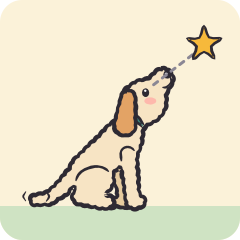 Core skill Focus Choosing you over the world. If your dog hears you but keeps sniffing, build this first — starting with The Name Game.
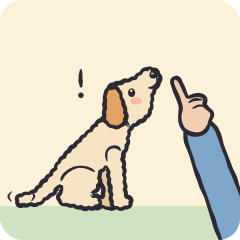 Core skill Understanding Cues Knowing what “come” means everywhere, not just in the kitchen. If she comes indoors but not outside, the cue hasn’t been taught in that place yet.
Exercises
- ExerciseThe Name GameDoable at home (Steps 1–2 at home)You say (if her name is Luna) “Luna” once, and within 2 seconds she turns toward you.Read →
- ExerciseRecall GamesDoable at home (Steps 1–3 at home)You say (if her name is Luna) “Luna, come” once, and whatever she’s doing, she runs straight to your feet.Read →
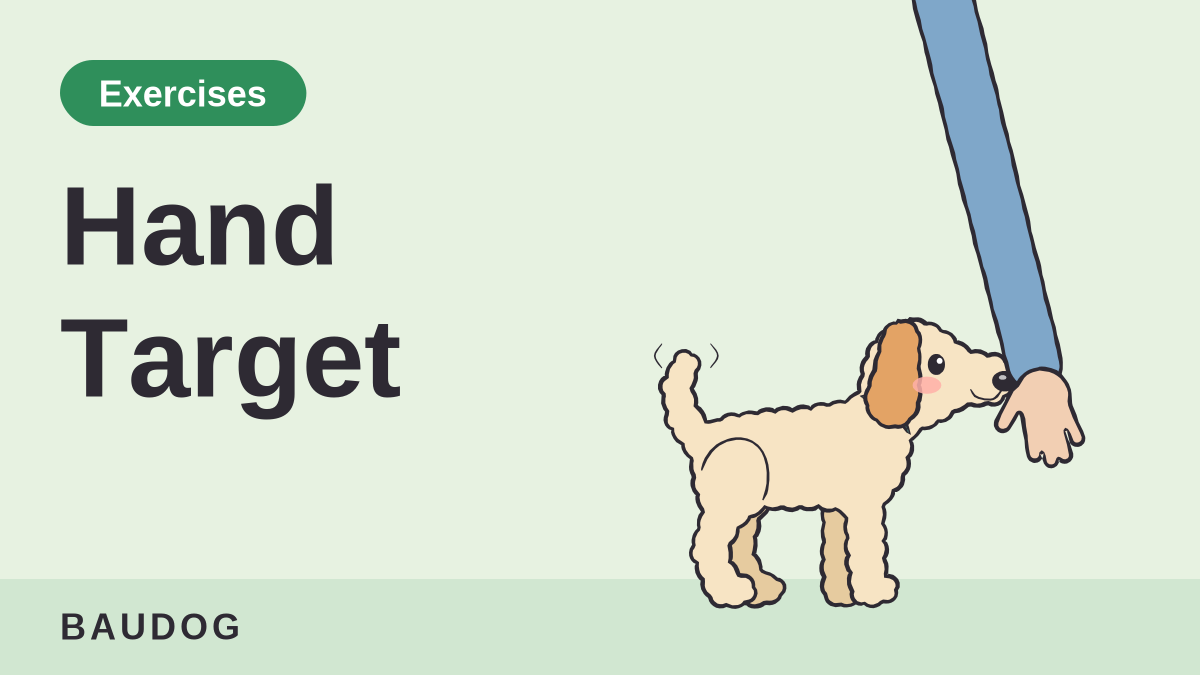
- ExerciseHand Target: How to Teach Your Dog “Touch” — and Use It for Recall and Passing Other DogsDoable at home (Steps 1–3 at home)When you hold out your palm, she comes over on her own and touches it with her nose.Read →
In the moment: do / don’t
Do
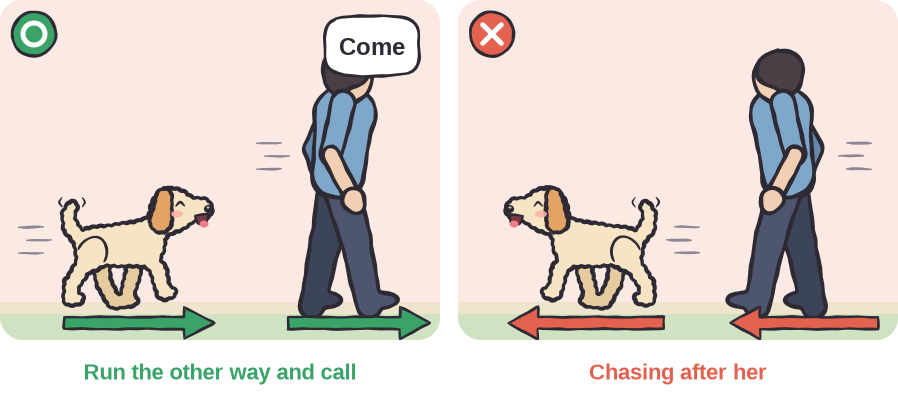
- Call once, brightly — then turn and jog away from her, or crouch down
- Reward every arrival, even a slow one: gently touch her collar, then give something she really loves
- Call her during play, reward, then let her go back to playing
- Keep a long line on outside until her recall is reliable
- If she doesn’t come, walk calmly over, clip the leash on, and try something easier
Don’t
- Chase her — it turns the recall into keep-away
- Repeat “come, come, COME” — it teaches her the first call is optional
- Scold her when she finally arrives
- Call her only to end the fun, for a bath or a nail trim
- Let her practice ignoring you off leash in places you can’t control
When to see a professional
- She no longer reacts to her name or to everyday sounds, or sleeps through noises that used to wake her — gradual hearing loss in older dogs can show up as not coming when called
- An older dog seems confused, gets stuck in corners, or forgets familiar routines
- She comes slowly or stiffly, or avoids sitting when she arrives — pain can make coming to you uncomfortable
- She stiffens, tucks her tail or growls when you call her or reach for her collar, or bolts in panic (at noises, people or other dogs) rather than running off to explore — these are signs of fear; talk to your vet or a qualified behavior professional
Go to the root
Don’t stop at the quick fix. Growing the skill underneath makes other problems lighter too.
Sources
- AVSAB — Position Statement on Humane Dog Training (2021)
- China, Mills & Cooper (2020). Efficacy of dog training with and without remote electronic collars vs. a focus on positive reinforcement. Frontiers in Veterinary Science 7:508
- Kinsman et al. (2025). Owner-perceived undesirable behaviours in young dogs and changes with age. Animals 15(8):1163
- Meyer & Ladewig (2008). The relationship between number of training sessions per week and learning in dogs. Applied Animal Behaviour Science 111:311–320
- UC Davis (Clinical Animal Behavior Service) — Recall Training in Dogs, a handout created by veterinary students as a class exercise
- RSPCA Australia — How can I teach my dog recall (to come when called)?
- Merck Veterinary Manual — Deafness in Dogs
- Dogs Trust — Recall training
- American Kennel Club — How to Train Your Dog to Come When Called: Step-by-Step Recall
- Battersea — How to teach your dog a recall
- RSPCA (UK) — Train your dog to come when called
- Maxwell, M. E. (2017). Teaching Name Recognition (AVSAB blog)
- Battersea — How to use a long line lead
- New York City Health Code Article 161, §161.05
- Cornell Riney Canine Health Center — Cognitive Dysfunction Syndrome
- Cornell Riney Canine Health Center — Recognizing pain in dogs