 BAUDOG The dictionary of dog–human communication
Contents
When to use this exercise
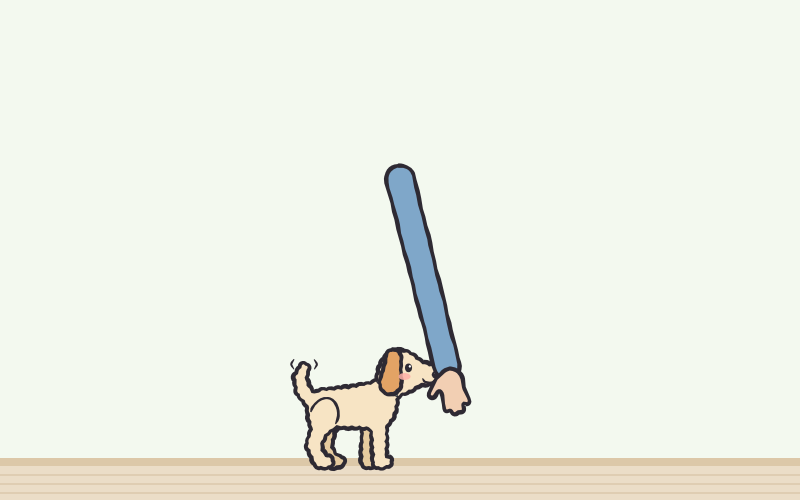
Think of it as a signpost for moving your dog around. You hold out your palm, and your dog comes over on her own and bumps it with her nose. You can use it to help with recall, to move her to your other side when you pass another dog, as a polite greeting instead of jumping up, and to let a shy dog approach people on her own terms. It builds attention, understanding of cues, and confidence. Start in a quiet room, get it solid at home, then take it outside.
GoalWhen you hold out your palm, she comes over on her own and touches it with her nose.
Assessment: what a trainer might check on the first visit
Before starting, a visiting trainer would usually check three things at home.
When you hold out your palm, does your dog come and sniff it? Or does she shy away?
→If she avoids it, rub a treat on your palm so it smells good, and get lower by bending your knees rather than leaning over her. With a dog who is wary of hands, take this exercise slowly.
When your hand comes out, does she get over-excited — mouthing, pawing at it, offering her paw?
→If her paw comes up, offer two fingers or a closed fist instead of an open palm. If she mouths, mark earlier — the moment her nose touches.
Do you present your hand at the same height and in the same shape each time? Are you moving it toward her nose?
→Hold your hand out, keep it still, and wait for her to come to it. This is usually the first thing a trainer fixes.
What you need
- Small treats she can eat quickly (her regular kibble is fine indoors; use something better for the outdoor steps — our suggestion)
- A treat pouch (deliver treats from your other hand or the pouch, not the target hand)
- A marker word she knows — “Yes” means a treat is coming (see Teach a Marker Word)
How to signal
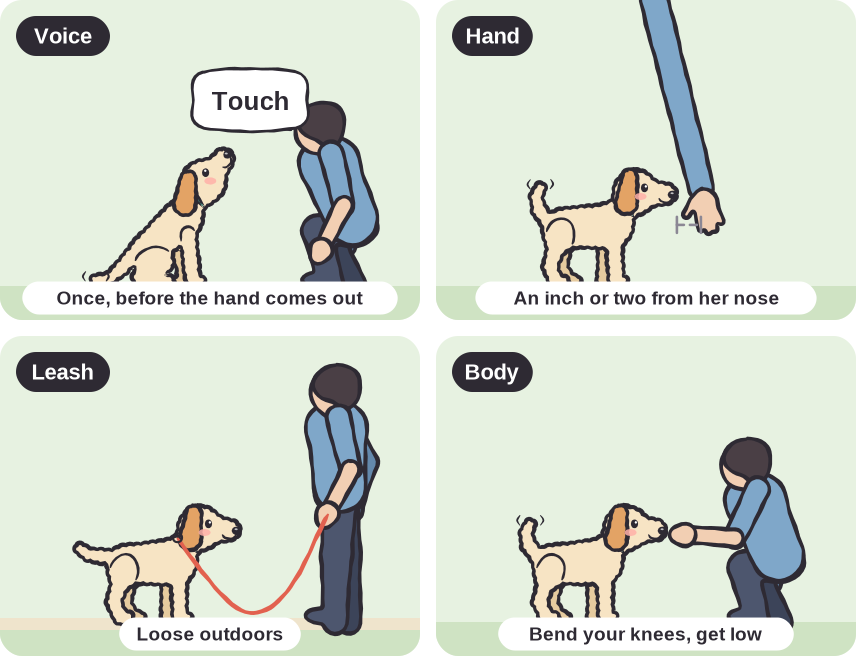
- Voice
Say nothing at first. Once she touches your hand every time it appears, say “Touch” once, just before you present it.
- Hand
Fingers together, palm facing her, fingertips pointing down, at nose height and about an inch or two (2–5 cm) from her nose. If an open palm makes her offer a paw, use two fingers or a closed fist.
- Leash
No leash indoors. Outside, hold it loose.
- Body
Stand, or crouch by bending your knees. Don’t lean over her. Once your hand is out, keep it still and wait.
Today’s session
With the trainer, you work on step 1.
Step 1Present your hand(At home, quiet)
The trainer shows you once, then hands over. With your palm facing your dog and fingers pointing down, hold your hand an inch or two from her nose; the moment her nose touches it — “Yes” → treat from your other hand. As you give the treat, put the target hand behind your back. Ten repetitions. The trainer watches for two slips and fixes them on the spot: moving your hand toward her nose, and marking too late.
Homework until the next visit
- How often
- Twice a day
- How long
- About 3 minutes each
- How much
- Up to about 10 per session
A good sign she’s readyYou say “Touch,” present your hand, and she touches it straight away, 9 times out of 10
What the trainer checks next visit
In front of the trainer, say “Touch” with your hand at different heights and on different sides, about 3 feet (1 m) away. Ten times.
If she canIf she comes and touches it 9 times out of 10 → next stage: step 4 (in the yard or at the front door) becomes the homework.
If not yetIf she doesn’t reach it, bring your hand closer again. Together you check whether your hand moves before you say “Touch,” and whether you changed distance and hand position at the same time.
Next stages: steps
- 1
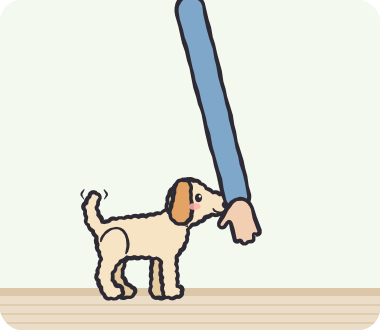
Start right next to her nose At home, quiet
Present your hand
Palm facing your dog, fingers pointing down, about an inch or two (2–5 cm) from her nose. When she sniffs it and her nose touches — “Yes” → treat from your other hand. Put the target hand behind your back, then present it in the same place again. Don’t say “Touch” yet.
A good sign to move onShe touches it straight away, 9 times out of 10
- 2
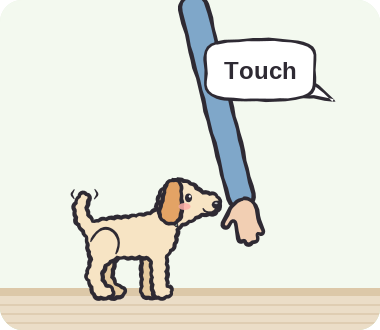
Say it, then show your hand At home, quiet
Add the cue
Once she touches your hand every single time it appears, say “Touch” once just before you present it. Say it, pause for a breath, then bring your hand out.
A good sign to move onYou say “Touch,” present your hand, and she touches it straight away, 9 times out of 10
- 3
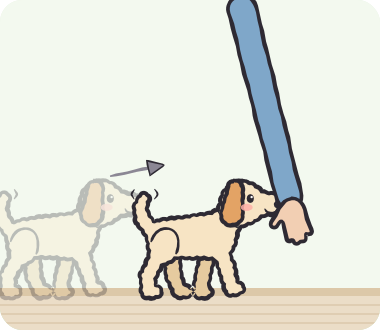
A little farther, higher, lower At home, small distractions
A little farther, a little more going on
Change your hand position bit by bit: higher, lower, left, right — and a few inches farther away each time, up to about 3 feet (1 m). Don’t change distance and hand position at the same time. Once that’s easy, try it in a room with toys on the floor, or with family moving around.
A good sign to move onShe comes and touches it from about 3 feet (1 m) away, 9 times out of 10
- 4
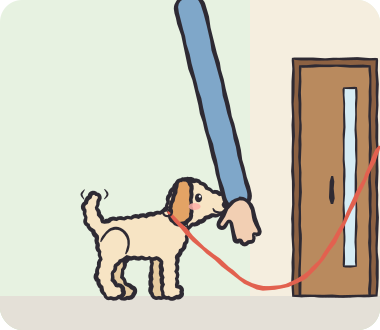
Outside your home, starting close Yard, doorstep, outside the house
In the yard or at the front door
On leash, in the yard or in front of your home, ask for “Touch.” Start close. Outside, use better treats than usual (our suggestion).
A good sign to move onIn front of the house, 9 times out of 10
- 5
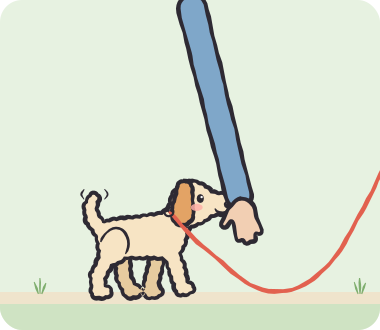
Now and then on a walk Quiet street
On a quiet street
Now and then on a walk, ask for “Touch.” When she touches — “Yes” → treat. Sprinkle a few through each walk.
A good sign to move onOn a quiet street, 9 times out of 10
- 6
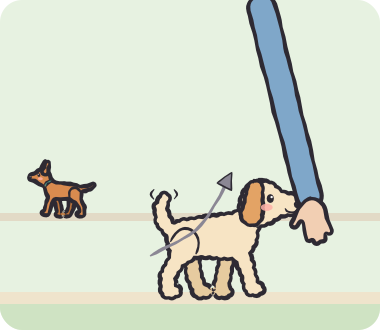
A signpost where you need it Around distractions
Where you need it
When another dog is in sight, use “Touch” to bring her to your far side as you pass (at a distance where she doesn’t bark). When guests arrive, she touches their hand instead of jumping up. You can also use it to guide her onto the scale at the vet’s.
A good sign to move onIn that situation, 8 times out of 10
Timing
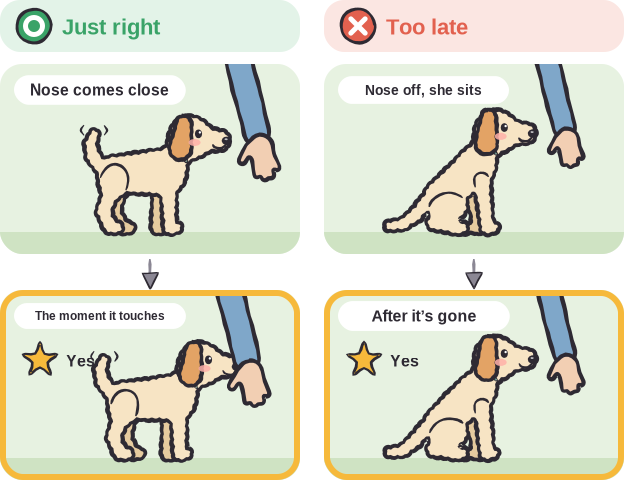
Just right
Say “Yes” the instant her nose touches your palm. The treat comes from your other hand, and the target hand disappears as you deliver it.
Too late
Saying “Yes” after her nose has left your hand — or pushing your hand onto her nose.
If she tends to bite at your hand, mark the moment her nose starts moving toward it, so the “Yes” comes before her mouth opens (Karen Pryor Clicker Training). If she starts mouthing, pawing or barking, go back a step or take a break (Dogs Trust).
How much and how often
About 3 minutes (around 10 reps) per session, about twice a day. Stop while she still wants more. Once you reach the outdoor steps, you can sprinkle reps through your walks.
If it isn’t working
She won’t come to my hand
For the first few reps, rub a treat on your palm so it smells good (Dogs Trust, SF SPCA and others). Holding a treat lightly between your fingers also works — but switch to an empty hand soon.
She mouths or licks my hand
At first, it’s fine to count a lick as a touch and reward it. If she nips, mark earlier — the moment her nose moves toward your hand. After each touch, take your hand away straight away.
She paws at my hand or offers a paw
Some dogs read an open palm as “shake.” Try two fingers or a closed fist.
She only comes to the hand with the treat in it
Don’t hold treats in the target hand — deliver them from your other hand or a pouch. Oregon Humane Society also says to start with the treats somewhere other than your hands.
When do I start saying “Touch”?
Once you could bet on her touching your hand every time it appears. Say it from the start and she learns to tune out a word that doesn’t mean anything yet. Most guides add the cue only once the behavior is reliable.
What can I use it for?
Helping with recall (she runs in to touch your hand), moving her to your far side when you pass a dog, greeting people with a nose touch instead of jumping up, letting a shy dog choose to touch a stranger’s hand, guiding her onto the scale at the vet’s, and more.
Does it work for shy dogs?
Yes. Best Friends Animal Society describes using it with dogs who are afraid of people: the person stands still with a hand held out to the side, and the dog comes over on her own to touch it. Because she decides whether to approach, she feels safer.
Avoid
- Pushing your hand onto her nose, or moving it toward her
- Using your hands for anything threatening — swatting, waving at her
- Leaning over a frightened dog to offer your hand
A good sign to move on
- Steps 1–4 (indoors → yard or front door → quiet street): in that place, she touches straight away 9 times out of 10
- Step 5 (where you need it): 8 times out of 10 in that situation (our rule of thumb)
- Make it harder one thing at a time (distance, hand position, place, or distractions — just one)
- If she struggles, go back a step — our rule of thumb is two misses in a row
Sources
- Veterinary Partner (VIN) — Training Series: Target Training Dogs and Cats with Touch
- American Kennel Club — How to Teach Your Dog to Nose Target or “Touch”
- Oregon Humane Society — Hand target / touch
- East Bay SPCA — Nose Targeting (PDF)
- SPCA Cincinnati — Clicker Training (PDF)
- Whole Dog Journal (Pat Miller) — Train Your Dog to Target
- Whole Dog Journal — On Target Training
- Karen Pryor Clicker Training (Laurie Luck) — How to Teach Your Pet to Target
- Maddie’s Fund — Teaching Your Dog to Touch
- Dogs Trust — Train your dog to touch a target
- San Francisco SPCA — Dog: Touch/Target (PDF)
- SPCA — Teaching A Dog To Target Your Hand (PDF)
- Best Friends Animal Society — Hand Targeting Dog Training
- Best Friends Animal Society — How hand targeting is helping a group of shy dogs gain confidence
- RSPCA Brighton — Teaching your dog hand target